
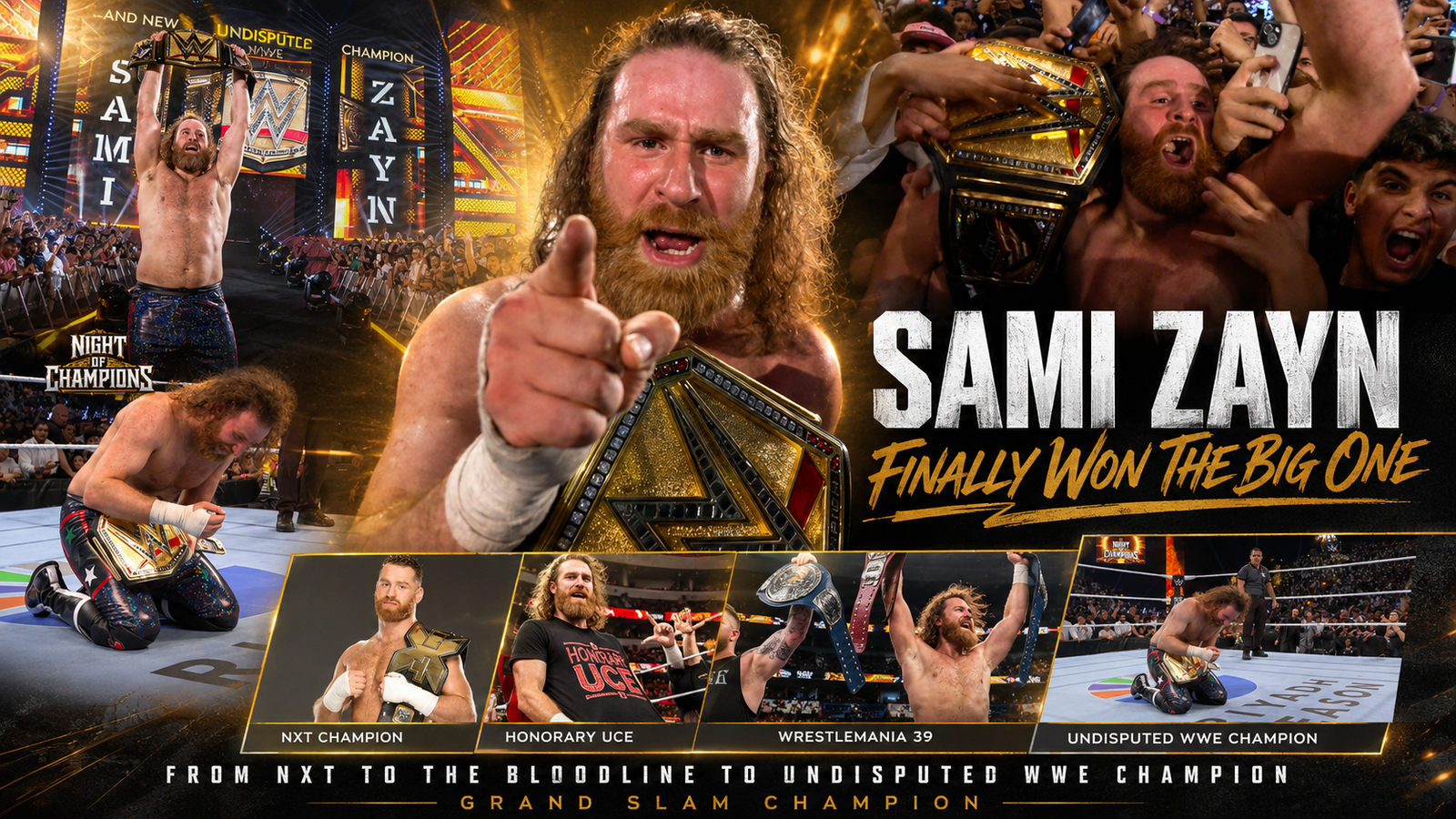
For more than a decade in WWE, Sami Zayn lived in the space between heartbreak and hope. He was never the obvious corporate prototype, never the unbeatable monster, never the polished chosen one who walked into the company with the machine already behind him. Sami’s career has always been something more complicated, more human and more emotionally honest. He was the cult favorite who became the NXT soul of a generation, the main-roster workhorse who could make anything matter, the paranoid heel who turned frustration into character work, the Honorary Uce who accidentally became the emotional center of The Bloodline, and the forever-underdog fans kept believing in even when WWE kept making them wait.
At WWE Night of Champions in Riyadh, Saudi Arabia, that waiting finally ended. Sami Zayn defeated Cody Rhodes and Gunther in a Triple Threat Match to become the new Undisputed WWE Champion, pinning Rhodes after surviving the champion’s Double Cross Rhodes, flipping his hips and trapping him for the three-count. In one moment, Sami went from the man who could never quite win the big one to the man standing on top of WWE with the richest prize in the industry. It was his first WWE world championship. It completed his modern Grand Slam résumé. More importantly, it gave a career built on almost, betrayal, sacrifice and belief the one ending fans had been begging WWE to finally deliver.
The Underdog Who Never Felt Like A Gimmick
The reason Sami Zayn’s title win hit so hard is because “underdog” was never just a nickname. It was the central truth of his career. Sami has always wrestled and performed like a man trying to prove something to the world and to himself at the same time. His body language is anxious, his selling is desperate, his hope feels reckless, and his comebacks always feel like they are being powered by emotion more than physical superiority.
That is what separates Sami from a normal sympathetic babyface. He does not feel like someone WWE simply tells fans to cheer. He feels like someone fans discovered, protected and carried with them through every era of his evolution. He can be funny without becoming meaningless. He can be tragic without becoming melodramatic. He can lose without feeling worthless. He can win without feeling manufactured.
For years, that made him one of WWE’s most valuable performers and one of its most frustrating booking cases. Sami could make opponents look better. He could elevate a segment. He could lose and still come out more loved. He could be plugged into comedy, drama, title programs, grudge feuds and faction stories. But that same versatility became part of the problem. WWE knew Sami could survive anything, so for years, he was asked to survive everything.
Night of Champions changed the way all of that history reads. Every delay suddenly became part of the climb. Every missed opportunity became part of the weight of the championship win. Every heartbreak became evidence that the audience had been right to keep believing.
Before Sami Zayn, There Was El Generico
Before WWE fans knew him as Sami Zayn, independent wrestling fans knew him as El Generico, the masked, wild, lovable, chaotic heart of a generation that helped reshape what modern wrestling could feel like. The character was absurd on the surface, but that was part of the genius. El Generico could make crowds laugh, then make them scream, then make them ache. He had the timing of a comedy performer, the explosiveness of a high-level athlete and the emotional instincts of a top babyface long before WWE ever signed him.
His years in promotions like PWG and Ring of Honor mattered because they built the foundation of Sami’s connection with fans. This was not someone who learned sympathy from a WWE script. He already understood it. He learned how to make crowds lean forward. He learned how to make near-falls feel like life-or-death moments. He learned how to turn friendship and betrayal into long-term storytelling currency.
Most importantly, his independent run tied him forever to Kevin Steen, the man WWE fans would later know as Kevin Owens. Their rivalry was not just a series of matches. It was a saga of brotherhood, jealousy, violence, betrayal and reluctant respect. That relationship became one of the emotional backbones of Sami’s entire career. Even when Owens was not physically in the ring at Night of Champions, his presence was still there. When Sami attempted the Package Piledriver on Cody Rhodes on the floor, it felt like a deliberate nod to the person most connected to his story.
That is why Kevin Owens’ reaction to Sami’s win mattered so much. Owens calling Sami undeniable was not just a friend congratulating a friend. It was the other half of one of modern wrestling’s most important relationships acknowledging that the story had finally reached the mountaintop.
NXT Made Sami Zayn The Heart Of A Brand
When Sami arrived in NXT, WWE stripped away the mask but kept the soul. He was no longer El Generico, but the emotional ingredients remained. Sami Zayn was still energetic, still explosive, still deeply likable, and still built around the idea that the clean-hearted wrestler could win without becoming cynical.
His chase for the NXT Championship remains one of the most important arcs in the brand’s history. Against Adrian Neville, Sami’s story became about more than winning a belt. It became about whether he could win the right way. Could the good guy stop falling short? Could the man with principles beat the champion who had become comfortable bending the rules? Could Sami prove he was not simply beloved, but great?
At NXT TakeOver: R Evolution, Sami finally did it. He defeated Neville and won the NXT Championship, giving NXT one of its earliest truly emotional peak moments. Full Sail loved him because he felt like theirs. The celebration felt pure, almost too pure for wrestling, which is exactly why Kevin Owens’ betrayal moments later was so devastating.
Owens powerbombing Sami onto the apron after his greatest WWE moment created the template for so much of Sami’s career: joy interrupted by pain. Sami won the title, but the memory most fans carried forward was not only the victory. It was the betrayal. The message became clear very early in Sami’s WWE run. He could reach the top, but happiness would never come easily.
The Main Roster Loved Sami, But Did Not Always Know What To Do With Him
Sami’s main-roster story was exciting, messy and often frustrating. His 2015 Raw appearance against John Cena during the U.S. Open Challenge instantly showed he could hang on WWE’s bigger stage. Introduced in Montreal by Bret Hart, Sami walked into a hostile-for-Cena hometown atmosphere and gave the United States Champion one of the most memorable open challenge matches of that run. Even in defeat, Sami looked like someone who belonged.
But belonging and being crowned are two very different things in WWE.
For years, Sami’s main-roster value was obvious, but his direction was inconsistent. He could have great matches with Kevin Owens, AJ Styles, Seth Rollins, John Cena and almost anyone else placed across from him. He could be the fiery babyface, the bitter loudmouth, the locker-room agitator, the conspiracy theorist, the delusional strategist and the wounded moral center. He won the Intercontinental Championship. He later won the United States Championship. He became a champion, but not the champion.
That distinction followed him. Sami’s résumé kept growing, but the top prize remained out of reach. WWE made use of his brilliance, but the company often treated him more like elite seasoning than the main course. He was trusted to make moments better. He was not always trusted to be the moment.
That is what made Night of Champions feel less like a surprise and more like a correction.
The Character Evolution That Saved Him
One of the strongest parts of Sami Zayn’s career is how every character change felt connected to the last one. He never became a completely different person. He became the same person reacting differently to disappointment.
The early Sami was the pure babyface: honest, emotional, stubborn and almost painfully sincere. When that version kept running into walls, bitterness crept in. The heel Sami was not random. It felt like the result of a man who had spent years believing in the system, only to decide the system was laughing at him. His conspiracy-theory character worked because there was a small piece of truth inside the delusion. Fans knew WWE had underused him. Sami simply turned that real frustration into paranoia, arrogance and comedy.
Then came The Bloodline, and everything changed.
At first, Sami’s involvement with Roman Reigns, The Usos, Solo Sikoa and Paul Heyman looked like comic relief. He was the outsider trying too hard to belong. He was awkward, overeager and desperate for approval. But that desperation became the emotional hook. Sami did not want power. He wanted family. He wanted acceptance. He wanted someone to look at him and say he mattered.
That made the Honorary Uce story one of WWE’s best accidents in years. The comedy opened the door, but the sincerity made it historic. Sami became the human crack in Roman Reigns’ empire. He made Jey Uso softer. He made The Bloodline funnier. He made Roman’s manipulation uglier. He made the audience care about the family dynamic in a different way.
By the time Roman demanded Sami prove himself by destroying Kevin Owens, the story had become bigger than faction drama. It was about identity. Was Sami willing to betray who he was just to stay accepted? At the 2023 Royal Rumble, he answered that question with a steel chair to Roman’s back.
That chair shot was one of the defining WWE moments of the decade because it was not just a turn. It was Sami choosing himself. It was Sami choosing Kevin Owens. It was Sami choosing right over belonging. And when Jey Uso walked away instead of joining the beatdown, it proved Sami had not just escaped The Bloodline. He had changed it.
Montreal Was The Heartbreak Before The Miracle
Elimination Chamber 2023 in Montreal remains one of the most emotionally charged losses in modern WWE history. Sami challenged Roman Reigns for the Undisputed WWE Universal Championship in his hometown, and for one night, the crowd believed in the impossible with everything it had.
That match was not just about whether Sami could beat Roman. It was about whether WWE would dare to let emotion overwhelm the machine. The building wanted it. The story supported it. Sami had the momentum, the moral clarity and the audience connection. For a few minutes, especially during the late near-falls, it felt like WWE might actually pull the trigger.
They did not.
Roman retained. Sami lost. Montreal was crushed. It was the kind of loss that could have ended a lesser character’s momentum, but Sami somehow left bigger than he entered. That is the strange power of his career. He can lose and still gain emotional capital because fans do not see his failure as weakness. They see it as proof that he keeps getting back up.
Looking back after Night of Champions 2026, Montreal feels like the necessary wound. If Sami had won there, it would have been incredible. But the fact that he did not made Riyadh even more powerful. Montreal was the night fans learned heartbreak. Saudi Arabia was the night they got release.
WrestleMania 39 Was Not A Consolation Prize
After Montreal, WWE moved Sami into the WrestleMania 39 tag-team title story with Kevin Owens against The Usos. At the time, some fans saw that as the backup plan after Sami did not beat Roman. In reality, it became one of the most important moments of his career.
Sami and Owens defeating Jimmy and Jey Uso in the main event of WrestleMania Saturday was not simply a tag title win. It was the first major structural collapse of The Bloodline. It was friendship beating blood. It was Sami and Owens turning years of betrayal, reunion, resentment and love into a WrestleMania-closing victory.
That match proved Sami could stand in the main event of WrestleMania and not feel out of place. It proved WWE could close a stadium show with Sami Zayn as one of the emotional anchors. It proved his connection was not limited to NXT nostalgia, internet fans or a single hot storyline. He could carry the biggest stage.
That matters now because Night of Champions did not have to convince fans Sami was main-event material. WrestleMania 39 had already done that. Night of Champions simply gave him the singles crown to match the emotional level he had already reached.
WrestleMania XL Proved Sami Could Beat The Monster
If WrestleMania 39 proved Sami could main-event emotionally, WrestleMania XL proved he could conquer the impossible physically. Gunther’s Intercontinental Championship reign was not just long. It felt oppressive. He had become WWE’s final boss of violence, a champion who treated wrestling like punishment and hierarchy.
Sami beating Gunther to end the historic 666-day Intercontinental Championship reign was one of the biggest wins of his career. It mattered because Gunther was everything Sami was not. Gunther was control. Sami was chaos. Gunther was discipline. Sami was emotion. Gunther was cold inevitability. Sami was stubborn belief.
That match became a preview of the Night of Champions dynamic. Gunther could dominate Sami, punish him and dismiss him, but he could not erase him. Sami’s whole career has been built on surviving long enough to make opponents regret assuming he was finished.
At Night of Champions, Gunther again entered as the most physically dangerous man in the match. But Sami had already beaten him once when nobody thought he should. That history gave the 2026 Triple Threat a deeper layer. Sami was not just the sentimental challenger. He was the one man in the match who had already proven Gunther’s aura could crack.
The Road To Night Of Champions Made Sami Stop Asking Politely
The 2026 build to Night of Champions worked because it turned Sami’s insecurity into open conflict. Cody Rhodes was the reigning Undisputed WWE Champion. Gunther was the dominant force who believed the championship picture should be governed by superiority and order. Sami was the emotional variable neither man fully respected.
That disrespect became the final ingredient.
The June 19 SmackDown angle with Sami as special guest referee pushed everything over the edge. Sami’s involvement in Cody Rhodes vs. Gunther was not clean, and that was the point. He meddled. He reacted emotionally. He made himself impossible to ignore. After years of trying to win the right way, after years of being told he was not quite the guy, Sami finally forced the title picture to make room for him.
Then Cody sharpened the knife on the final SmackDown before Night of Champions. Bringing up Kevin Owens and pointing out that Owens had been WWE Champion struck at one of Sami’s deepest insecurities. It was not just trash talk. It was Cody saying the quiet part out loud. Owens had reached the mountaintop. Sami had not. Cody was champion. Gunther was treated as inevitable. Sami was still being asked to justify why he belonged.
That is what made the match bigger than a Triple Threat. Sami was not just fighting for the championship. He was fighting against every implication that he was the third wheel in his own destiny.
The Match Finish Was Perfect Because It Was Pure Sami Zayn
Night of Champions did not give Sami a dominant coronation. It gave him something more honest.
Gunther started by neutralizing him and going after Cody. Cody responded with the champion’s confidence, hitting Cody Cutters and surviving major offense. Gunther looked like the punishing machine. Cody looked like the star champion. Sami looked like the man trying to hang on as the match kept threatening to leave him behind.
Then the match started bending toward his kind of chaos.
The Blue Thunder Bomb nearly caught Cody. The Helluva Kick nearly stole it from Gunther. Cody yanking the official out before Sami could get the three-count was crucial because it gave fans one more Sami heartbreak before the payoff. It was the familiar feeling: he had it, and it was taken away.
The outside sequence with Sami attempting the Package Piledriver gave the match its Kevin Owens echo. Cody countering him through the announce table felt like Sami being punished for reaching into his past. Gunther powerbombing Cody through another table and locking in the Sleeper made it look like the match was slipping away from everyone. But Sami arrived again, refusing to let the story end without him.
That final sequence was the entire Sami Zayn career in miniature. Cody hit the Double Cross Rhodes. Sami should have been done. The moment should have belonged to the champion. Instead, Sami hung on, shifted his weight, rolled Cody up and caught him.
It was not a superhero finish. It was a survivor’s finish. It was not about Sami being stronger than Cody or scarier than Gunther. It was about Sami being alive in the moment one second longer than everyone expected.
That is why it worked.
Saudi Arabia Gave The Win A Different Kind Of Emotion
The location mattered. Sami Zayn winning the Undisputed WWE Championship in Saudi Arabia carried a cultural and emotional resonance that would not have felt exactly the same anywhere else. Sami is a Canadian-born wrestler of Syrian descent and a Muslim performer whose relationship with Middle Eastern audiences has always carried significance. Seeing him celebrated so loudly in Riyadh gave the moment a texture beyond normal title-change emotion.
The crowd did not just react like fans watching a title change. They reacted like people watching someone they had claimed as their own finally be validated. That made the win feel massive. It felt communal. It felt less like WWE simply booked a surprise and more like the building itself dragged the moment into history.
WWE’s social media framed it as a miracle in Saudi Arabia, and that wording fit. Not because Sami winning was impossible from a talent standpoint, but because WWE had spent so long making it feel impossible from a hierarchy standpoint.
The Grand Slam Changes The Way Sami’s Career Reads
Before Night of Champions, Sami Zayn already had a résumé most wrestlers would dream of. NXT Champion. Intercontinental Champion. United States Champion. Undisputed WWE Tag Team Champion. WrestleMania main-event winner. Bloodline centerpiece. One of the best talkers and most emotionally reliable performers of his generation.
But without a world title, there was always an asterisk. Not a fair one, but a real one. Sami was still the guy who never won the big one.
Now that is gone.
By winning the Undisputed WWE Championship, Sami completed the modern Grand Slam picture. He has world title gold, Intercontinental Championship gold, United States Championship gold and tag-team championship gold. That does not just make his trophy case fuller. It changes the category he belongs in.
Sami Zayn is no longer a “best wrestler to never win the WWE Championship” conversation. He is no longer just a beloved underdog, a great hand, a brilliant character worker or a sentimental favorite. He is a WWE world champion. He is a Grand Slam Champion. He is a completed story.
Why This Was The Right Time
Some title wins happen too late. Some happen after the emotional peak has passed. This one did not feel that way. Sami’s popularity has evolved, but it has not disappeared. He is older, more layered and more believable now than he was when he first became a fan favorite in NXT. The 2026 version of Sami carries all the history with him: the innocence, the bitterness, the Bloodline scars, the Owens bond, the Montreal heartbreak, the WrestleMania victories and the years of doubt.
That made this the right Sami to win the title. Not the pure NXT underdog. Not the conspiracy heel. Not the comic Honorary Uce. The Sami who won at Night of Champions was all of them at once.
That is why the moment felt so earned. WWE did not need to explain why fans should care. The career had already explained it.
What Comes Next
The hardest part now is not making Sami champion. WWE has already done that. The hardest part is booking him like the win mattered after the emotion settles.
Sami should not suddenly become an unbeatable superhero. That would miss the point. His championship reign should still feel like a fight. He should be vulnerable, emotional and human. But vulnerability cannot mean weakness. The difference now is that Sami is no longer chasing validation. He has it. The story moving forward should be about whether a man who spent his entire career trying to prove he belonged can now carry the burden of being the standard.
That opens the door to fascinating directions. Gunther has every reason to come after him. Cody Rhodes has every reason to feel robbed and shaken. Oba Femi’s King of the Ring win puts another monster on the horizon if WWE wants to test Sami against the future. Roman Reigns still exists as the ghost of Sami’s most famous heartbreak. Kevin Owens, even injured, remains emotionally tied to everything Sami does.
The title win is not the end of Sami Zayn’s story. It is the end of the question that haunted it.
Can Sami Zayn win the big one?
Yes. He just did.
Final Thoughts
Sami Zayn becoming Undisputed WWE Champion at Night of Champions was not powerful because it was shocking. It was powerful because deep down, fans always believed it should happen. WWE simply made them wait long enough for the moment to feel enormous.
This was the payoff to El Generico’s emotional language, NXT’s pure-hearted chase, Kevin Owens’ betrayals and reunions, the Bloodline’s toxic family drama, Montreal’s broken dream, WrestleMania 39’s catharsis, WrestleMania XL’s impossible win over Gunther and years of main-roster frustration. It was not one night of storytelling. It was a career cashing in every receipt at once.
Sami Zayn did not need to become a different wrestler to win the WWE Championship. He did not need to become colder, flashier or more corporate. He won because the thing that made him special all along finally became undeniable.
For years, Sami Zayn was the man fans kept saying deserved more.
At Night of Champions, he finally got everything.
Make sure to subscribe to our Late Night Crew Wrestling YouTube Channel. Follow @yorkjavon, @kspowerwheels & @LateNightCrewYT on X.
I’m the quiet one until the bell rings then I’ve got takes. I live for WWE NXT and TNA, I want every promotion to succeed, and I will absolutely roast the bad decisions on sight (because someone has to). Anime taught me to respect long-term storytelling; wrestling taught me that sometimes the plan is “we panicked” and called it “unpredictable.” The Miz got me into all of this, so yeah I appreciate confidence, commitment, and the art of talking like you’re already the main event. Now I bring that same energy to the page as the main writer for Late Night Crew Wrestling because if you’re not here to be must-see and tell the truth, why are you here?!