SPOILER WARNING: The following article contains major spoilers for AEW Grand Slam Australia. If you want to experience the show unspoiled, stop reading now.
AEW’s trip to Australia wasn’t framed like a novelty stop on the calendar — it was presented like a pressure test. The roster arrived with rivalries already simmering, championships already under siege, and the looming shadow of AEW Revolution hanging over every entrance ramp stare-down. Grand Slam Australia delivered the kind of night AEW loves to weaponize: decisive wins that clarify the pecking order, controversial outcomes that demand rematches, and one particular post-match moment designed to echo through the company’s next month of television.
Here are the full spoilers
Jon Moxley (c) vs. Konosuke Takeshita — AEW Continental Championship
Result: Time-limit draw (Champion retains)
AEW opened the night by leaning into tension instead of spectacle: Moxley and Takeshita went the distance and hit the hard stop of a time-limit draw. No fluke finish. No interference shortcut. Just a result that leaves the belt with the champion while refusing to give the challenger a definitive loss.
Post-match direction: The real story wasn’t that Moxley “escaped.” It was that Takeshita didn’t blink for twenty minutes and didn’t break. The draw tells the audience one thing loud and clear: this rivalry isn’t finished — it’s under-cooked on purpose.
Willow Nightingale & Harley Cameron (c) vs. Megan Bayne & Penelope Ford — AEW Women’s Tag Team Championships
Result: Willow Nightingale & Harley Cameron retain
The champions survived the challenge, but the match itself ended up being the calm before the storm.
Post-match angle: A debut hit immediately after the bell — Lena Kross appeared, aligned with Bayne and Ford, and joined in the attack on the champions. The message was blunt: the challengers didn’t come to Australia to “get a title shot.” They came to start a takeover.
3) Hangman Adam Page vs. Andrade El Idolo — No. 1 Contender’s Match (AEW World Title)
Result: Hangman Adam Page wins to become No. 1 contender
This was the fulcrum match for the entire event — the bout that turned the “road to Revolution” from vague possibilities into a straight line. Page earned the shot, and the victory didn’t feel like a chapter; it felt like a turning key.
Immediate consequence: The win didn’t just elevate Page. It placed him — directly in the world title lane, with no fog, no committee, no asterisks. Revolution now has a named destination.
Toni Storm & Orange Cassidy vs. Wheeler Yuta & Marina Shafir — Hair Stipulation Match
Result: Toni Storm & Orange Cassidy win
Aftermath: Wheeler Yuta’s head is shaved
If AEW wanted a moment that would live past the final bell, this was it. Storm and Cassidy took the win — and then came the humiliation. Yuta, the man who took the fall, paid the price in full as the stipulation was enforced, producing a visual that turns a loss into a scar.
Why this matters in real time: AEW doesn’t book a forced shave for a quick laugh. That’s a feud accelerant. That’s a character pivot. That’s the kind of humiliation that demands escalation, not closure.
Kyle Fletcher (c) vs. Mark Briscoe — TNT Championship Ladder Match
Result: Kyle Fletcher retains
Grand Slam’s ladder match delivered exactly what that stipulation promises: chaos, punishment, and career-shortening risk. Fletcher survived Briscoe’s willingness to throw himself into disaster, climbed, and pulled down the TNT Championship to keep his reign intact.
Post-match note: Fletcher unveiled a custom pink TNT title, a not-so-subtle statement that this reign is about branding and identity — not merely surviving defenses.
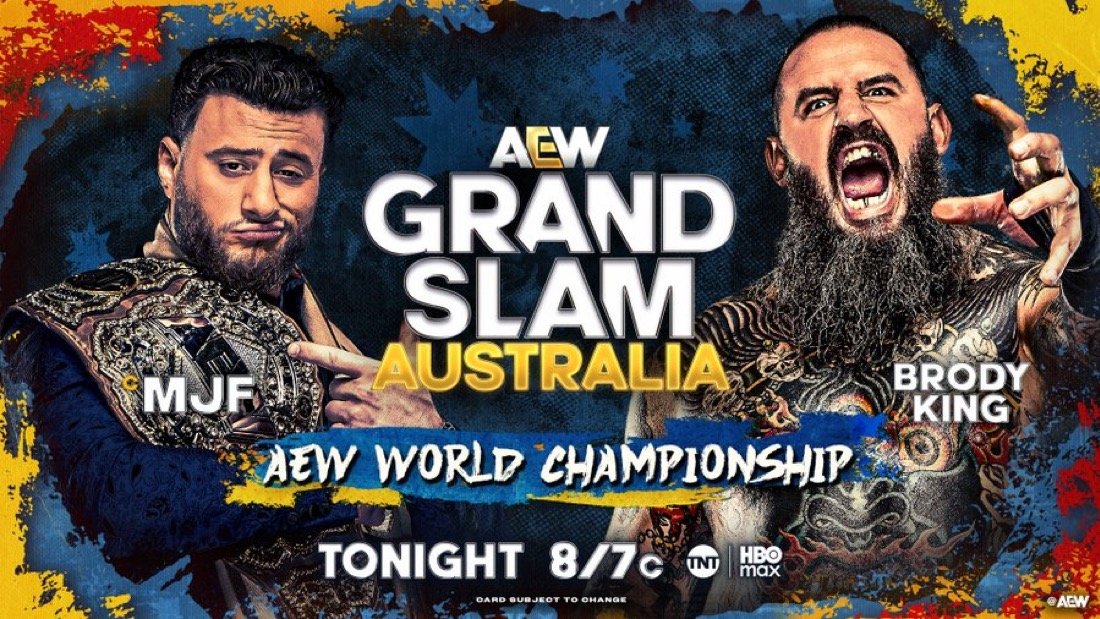
MJF (c) vs. Brody King — AEW World Championship
Result: MJF retains
Brody King brought the kind of threat that forces a champion to prove he can survive a fight, not just outsmart it. MJF retained, and in typical fashion, the finish wasn’t about making you feel comfortable — it was about making sure the champion walks out with the belt.
Post-match angle: Hangman Page confronted MJF, and the Revolution trajectory was made explicit. Page signed, stared him down, and punctuated the moment with a psychological power play — the kind that doesn’t injure the body but exposes the champion’s nerves.
Breakdown and Analysis
The show’s core theme: “Revolution pressure”
Grand Slam Australia didn’t try to juggle ten main-event directions. It made three priorities crystal clear:
- Revolution’s world title picture is no longer theoretical.
Hangman Page didn’t “position himself.” He became the No. 1 contender and immediately stepped into MJF’s space. AEW framed Page as inevitable: a challenger who doesn’t need a faction, doesn’t need misdirection, and doesn’t need a long monologue to make you believe he can take the belt. The post-match confrontation underscored the psychology: Page is direct, controlled, and dangerous; MJF is brilliant, but suddenly forced to react instead of dictate. - The Continental title scene just earned a bigger match.
The time-limit draw is AEW’s way of telling you Takeshita can stand in Moxley’s world and not drown. It protects Moxley while legitimizing Takeshita as a man who doesn’t need “moral victories” — because the draw itself functions like a statement win in AEW’s language. This is the type of result that typically triggers escalation: higher stakes, longer time, harsher stipulations, or a rematch positioned as unavoidable. - The women’s tag division got an actual “act,” not just challengers.
The Lena Kross debut wasn’t framed as a cameo — it was framed as recruitment into violence. By aligning with Bayne and Ford instantly, AEW created a simple weekly engine: the champions are now outnumbered, the heels have a new enforcer, and the next chapter doesn’t require complicated explanation. It’s about power and numbers — the easiest story for an audience to feel.
Who is Lena Kross — and why the debut matters
Lena Kross arrived with a built-in advantage: Australia is her home territory, and AEW used that context to make the moment feel grounded rather than random. She’s positioned as a powerhouse addition — not a flashy “surprise wrestler of the week,” but a physically imposing presence designed to change the math in the division immediately.
What the alignment signals:
Kross didn’t debut to “introduce herself.” She debuted to pick a side and attack champions. That’s a creative shortcut in the best sense — it tells you her role, her vibe, and her purpose in one beat. If AEW follows through, Kross becomes the difference-maker that turns Bayne and Ford from threats into a problem.
The hair stipulation: humiliation that must be repaid
The Yuta shave is a narrative grenade. AEW uses humiliation angles to create urgency: you don’t just “move on” from a forced shave. The character has to either spiral, retaliate, or evolve. And the surrounding pieces matter:
- Yuta now has an identity shift forced onto him.
- Shafir becomes more dangerous by association, because her presence suggests the humiliation was strategic, not incidental.
- Storm and Cassidy get a win that carries consequence beyond the record book.
This is the kind of angle that usually ends in a stipulation blowoff, because the emotional logic demands something harsher than a normal match.
The TNT title: Fletcher’s reign is being branded as a centerpiece
The ladder match gave Fletcher what champions need most: the perception that he can survive high stakes. The custom pink TNT title is a visual power move — it’s Fletcher planting a flag and telling everyone the championship reflects his era.
Why this matters heading into Revolution season:
When AEW customizes a belt around a champion, it usually means one of two things:
- The reign is about to become a signature run with high-profile defenses, or
- Someone is being positioned to destroy the symbol to ignite the next rivalry.
Either way, the title isn’t just being defended — it’s being spotlighted.
The main event’s final message: Page is the threat MJF can’t fully control
MJF retaining isn’t the end of a story. It’s the setup for the story AEW wants to tell next: a champion who survives everybody — meeting a challenger who doesn’t need to be “outplayed” to win. The post-match confrontation was all about temperament. Page didn’t need chaos. He needed proximity. He needed to let MJF feel, for a moment, what it’s like when the usual tricks don’t make the other guy flinch.
And then he made the champion flinch anyway.
Final Thoughts
AEW Grand Slam Australia functioned like a statement episode with pay-per-view consequences. It established Hangman Page as the clear roadblock standing in MJF’s way at Revolution, elevated Takeshita by refusing to let him lose, introduced Lena Kross in the most efficient way possible — by changing the women’s tag division’s power dynamics instantly — and delivered a humiliation angle with Wheeler Yuta that practically guarantees a nastier escalation.
This wasn’t a show built to simply entertain for one night. It was built to create problems AEW now has to solve on the march to Revolution.
Make sure to subscribe to our Late Night Crew Wrestling YouTube Channel. Follow @yorkjavon, @kspowerwheels & @LateNightCrewYT on X.
I’m the quiet one until the bell rings then I’ve got takes. I live for WWE NXT and TNA, I want every promotion to succeed, and I will absolutely roast the bad decisions on sight (because someone has to). Anime taught me to respect long-term storytelling; wrestling taught me that sometimes the plan is “we panicked” and called it “unpredictable.” The Miz got me into all of this, so yeah I appreciate confidence, commitment, and the art of talking like you’re already the main event. Now I bring that same energy to the page as the main writer for Late Night Crew Wrestling because if you’re not here to be must-see and tell the truth, why are you here?!