AEW Revolution was a show built to leave people talking, and in that sense it absolutely succeeded. The problem is that not all of the conversation feels flattering. There was strong wrestling on this card, some real star power, a few smart storyline pivots, and enough returns and title changes to make the road to Dynasty feel busy right away. But there was also the same issue AEW keeps running into on its biggest nights: the company confuses excess with importance. Revolution was eventful, sometimes thrilling, sometimes frustrating, and by the time it ended with MJF standing over a blood-soaked Hangman Adam Page, it felt less like AEW had delivered a truly complete show and more like it had once again given fans a lot to react to without always giving those moments the discipline they deserved. That mix of praise and criticism is the real story of this pay-per-view.
Here are the full results
Zero Hour
Boom & Doom def. The Infantry
Willow Nightingale (c) def. Lena Kross (TBS Championship)
Jungle Jack Perry won the 21-Man Blackjack Battle Royal to win the AEW National Championship
Main card
FTR (c) def. The Young Bucks (AEW World Tag Team Championship)
Toni Storm def. Marina Shafir
Jon Moxley (c) def. Konosuke Takeshita (AEW Continental Championship, No Time Limit)
Divine Dominion def. The Babes of Wrath (c) (AEW Women’s World Tag Team Championship)
Swerve Strickland def. Brody King
Thekla (c) def. Kris Statlander, 2-1 (AEW Women’s World Championship, 2 Out of 3 Falls)
JetSpeed & Místico def. Don Callis Family (c) (AEW World Trios Championship)
Andrade El Ídolo def. Bandido
Roderick Strong, Orange Cassidy & Darby Allin def. The Dogs (Tornado Trios Match)
MJF (c) def. Hangman Adam Page (AEW World Championship, Texas Death Match)
The first issue with Revolution is simple: having a huge card does not automatically make a card stacked. It makes it long. AEW loaded this show with thirteen matches, three title changes, multiple returns, and a major celebrity-style surprise, but that volume also made the event feel bloated. That was reflected in the reaction afterward. Some fans and reviewers praised the spectacle, the pace, and the sheer number of things that happened. Others came away feeling like AEW did what AEW too often does on pay-per-view—throw everything at the wall and hope the size of the wall becomes the story. That criticism is fair. Revolution had big moments, but it also had plenty of “did this really need to be here?” energy.
Zero Hour was a perfect example. Jungle Jack Perry winning the National title in a 21-man battle royal gave him a hometown payoff and finally ended the stale Ricochet title run, but it also exposed how thin that feud really was. If Perry was always going to end up with the title, a singles match would have carried more weight. Instead, AEW used a battle royal that felt like both a shortcut and a roster showcase for underused names. That may be useful for the card, but it does not exactly help the belt feel important. The same logic applied to the women’s tag title switch. AEW at least told a story there—Willow was hurt after surviving earlier on the pre-show, and that damage came back to cost her team later—but it still looked awkward that one half of the new champions lost earlier in the night and still ended up leaving with gold. Logical does not always mean clean.
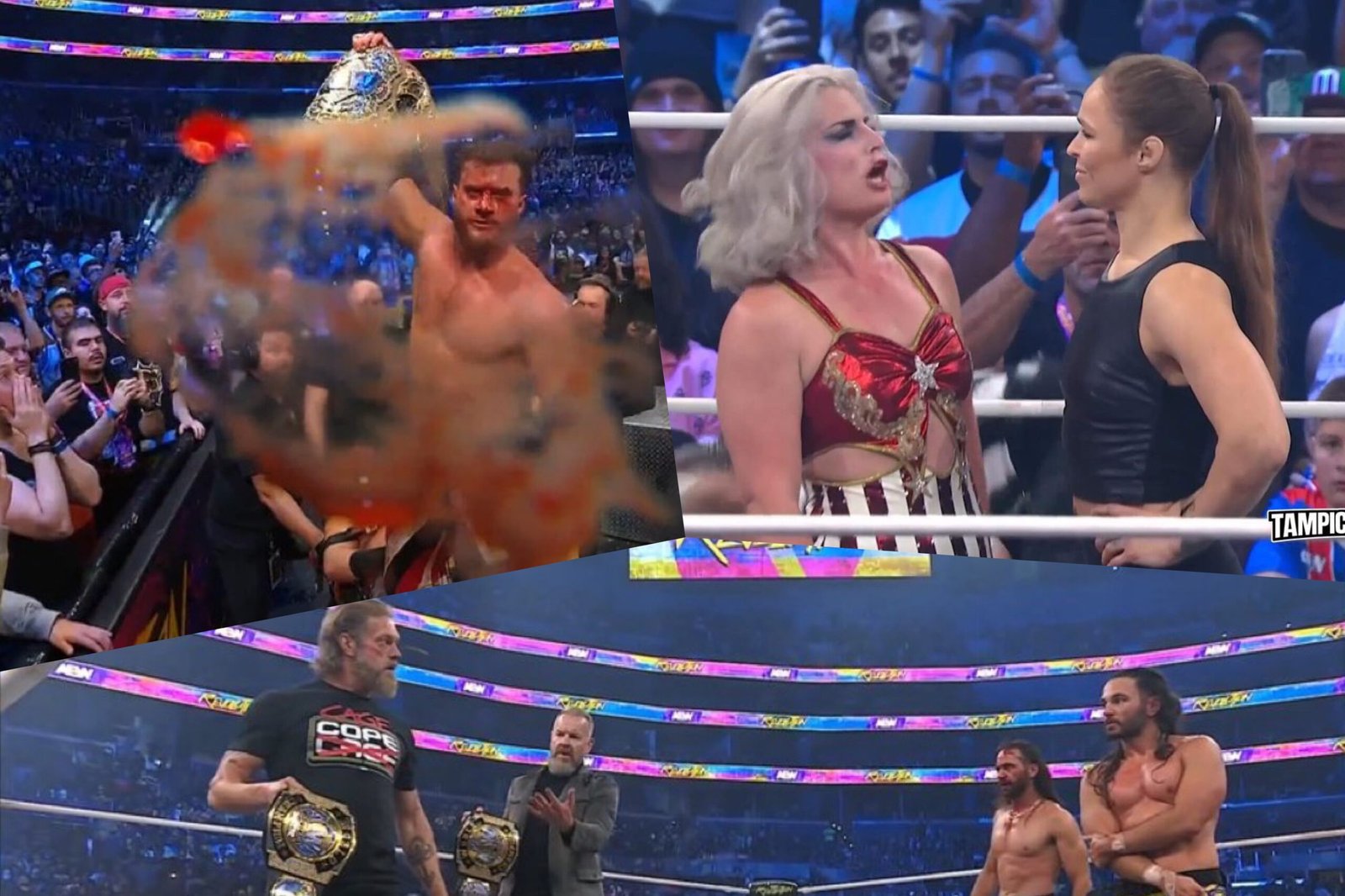
FTR vs. The Young Bucks was one of the clear high points because it had something AEW too often forgets to trust: history. That rivalry already means something, and the match felt important before the blood even showed up. FTR retaining worked. The post-match return of Adam Copeland and Christian Cage was an even bigger win because it instantly gave the tag division new life and a fresh direction heading toward Dynasty. That is the kind of return AEW should be aiming for—one that actually reshapes a division instead of just creating a headline. At the same time, even here, AEW could not resist overdoing the blood. It added grit, sure, but it also set the tone for a show that kept reaching for the same dramatic device over and over.
Then came Ronda Rousey, and this is where the article has to lean harder into the criticism because the criticism is deserved. Her appearance after Toni Storm beat Marina Shafir was absolutely one of the biggest talking points of the night, but biggest does not mean best. There are political reasons some fans do not want her in AEW, and those are real. But even beyond that, there is the much simpler wrestling criticism: Rousey has spent years talking down to the business, acting above it, and carrying herself like pro wrestling is something she can drop in and out of whenever it benefits her. That is why the backlash felt immediate. For a lot of fans, she does not come off like a major addition. She comes off like a toxic name with mainstream value. That is not the same thing. Post-show reaction online was sharply divided, and a lot of the pushback centered on the same point: AEW keeps telling fans to care about the shock of the surprise instead of whether the person actually fits the company.
That criticism only gained more weight after the AEW post-show conference. Tony Khan did not fully define what Rousey’s future looks like, but the tone of his comments made it clear he saw her appearance as a big win. That is part of the problem. The move felt like a headline-first decision, the kind of thing designed to dominate discourse whether or not it actually strengthens the product long-term. AEW wasted no time turning the angle into a No Holds Barred match between Toni Storm and Marina Shafir for Wednesday’s Dynamite, so the fallout is immediate. But immediate fallout and smart booking are not always the same thing. Sometimes AEW is so eager to prove it can surprise you that it forgets to ask whether the surprise deserves the spotlight.
Jon Moxley vs. Konosuke Takeshita was one of the bright spots because it felt grounded in actual wrestling hatred and not just gimmick excess. The No Time Limit stipulation fit the rivalry, Takeshita came out of the loss looking tougher, and Will Ospreay’s return afterward gave the Continental title picture real direction. That was one of the night’s best uses of a return because it sharpened a story instead of distracting from one. The same cannot really be said for the Trios division, which somehow managed to feel even more meaningless after another title change. JetSpeed and Místico winning the belts was a feel-good moment, and Místico being announced as All Elite is a legitimate story. But the titles themselves still feel like props. They change hands too easily, they rarely anchor anything of substance, and Mark Davis losing his first defense only reinforced how little gravity the division has. Fans were already saying that online, and Revolution did not do anything to prove them wrong.
Elsewhere, Swerve Strickland beating Brody King gave the show one of its more straightforward pieces of violence, which actually helped on a card this crowded. The return of Kenny Omega afterward gave Swerve another major direction and added another top name to the Dynasty picture. That worked. The Dogs losing, however, did not. The group had momentum, edge, and the kind of presentation AEW should have protected. Instead, they lost their first major pay-per-view outing, which felt like another example of the company cooling off an act before it ever really gets hot. That kind of booking is why it can be hard to fully invest in AEW’s newer groups.
And then there was the main event, which was both the show’s biggest strength and one of its most self-defeating choices. MJF vs. Hangman Adam Page already had everything it needed. The world title. A deeply personal feud. The Texas Death stipulation. Hangman putting his future title eligibility on the line. That was enough. Instead, AEW pushed the match into full gruesome spectacle: glass, barbed wire, syringes, chain spots, dog collars, and most of all the blood. The now-notorious blood-splatter camera shot is going to be what a lot of people remember, and that is exactly the problem. It was striking, sure, but it also felt like the visual overtook the emotion. Hangman’s blading was not just heavy; it became the centerpiece. What should have been a devastating story about a man losing his last shot at the prize turned into a gross, trend-friendly image. That is where AEW too often loses me. It does not just use blood—it leans on blood to do emotional work the story should already be doing.
To be fair, the finish itself was strong. MJF using the Dynamite Diamond Ring and then hanging Hangman over the ropes with the chain to keep him down for the ten-count was vicious, memorable, and exactly the kind of ending that cements a top heel. That part landed. The gamble now is what AEW does next. If the stipulation sticks, Hangman could actually have a compelling next chapter because the title that defined him is now gone. If AEW walks this back too quickly, then the entire main event becomes empty shock theater. That is the significance of Revolution in one sentence: AEW gave itself a hot road to Dynasty, but it also gave itself a lot of follow-through pressure.
That is also why the wider reaction felt so split. Fans online praised the returns, the title changes, the chaos, and the sense that the show mattered. Reviewers and journalists also gave credit where it was due: MJF felt bigger, Ospreay’s return mattered, the tag division got a jolt, and the event definitely left AEW with momentum. But the criticism was just as real. The card was too full. The Trios titles still felt worthless. Rousey’s appearance was divisive at best. The main event was memorable but arguably too indulgent for its own good. Even the tone coming out of the Late Night Crew Wrestling YouTube stream matched that push and pull—there was admiration for the talking points, but also skepticism about whether AEW really knows how to balance payoff with restraint. That tension is what defines this show. Revolution was big, but not always disciplined. Important, but not always elegant. Entertaining, but not always convincing.
What was announced for AEW Dynamite
- “Timeless” Toni Storm vs. Marina Shafir (No Holds Barred Match)
- Darby Allin vs Gabe Kidd (Coffin Match)
Final thoughts
Revolution was not a bad pay-per-view. It was a frustrating one. There was too much talent on this card for the show to fail, and when AEW kept things simple, it often worked really well. But the company also slipped back into some of its worst habits: overstuffing the card, treating certain titles like props, over-relying on blood, and betting on shock value to carry the conversation. The road to Dynasty is now full of major angles, major names, and major questions. That is the good news. The bad news is that AEW still feels like a company asking fans to be impressed by the size of the moment instead of the quality of the control behind it. Revolution mattered. I am just not convinced AEW made all of it matter for the right reasons.
Make sure to subscribe to our Late Night Crew Wrestling YouTube Channel. Follow @yorkjavon, @kspowerwheels & @LateNightCrewYT on X.
I’m the quiet one until the bell rings then I’ve got takes. I live for WWE NXT and TNA, I want every promotion to succeed, and I will absolutely roast the bad decisions on sight (because someone has to). Anime taught me to respect long-term storytelling; wrestling taught me that sometimes the plan is “we panicked” and called it “unpredictable.” The Miz got me into all of this, so yeah I appreciate confidence, commitment, and the art of talking like you’re already the main event. Now I bring that same energy to the page as the main writer for Late Night Crew Wrestling because if you’re not here to be must-see and tell the truth, why are you here?!