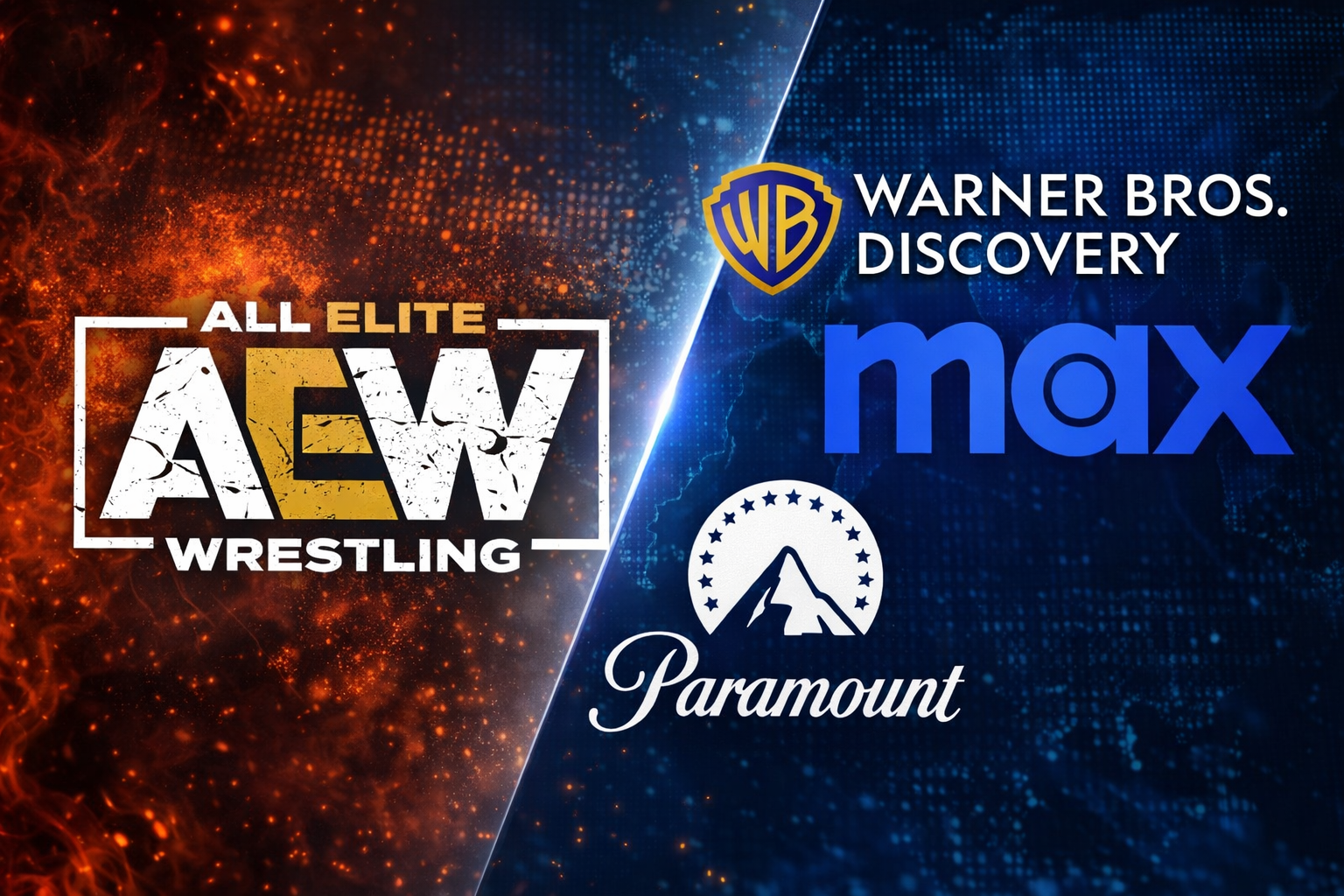
What makes this story so important is that it is not really a wrestling story at all. It is a media industry story that just happens to have AEW sitting right in the middle of it.
That is the part that makes this feel bigger than the usual television rights conversation. This is not simply about whether AEW stays on the same networks, whether Dynamite and Collision keep their current homes, or whether pay-per-views remain tied to the same streaming platform. Those are important questions, but they are surface-level questions. The deeper issue is what happens to AEW if the company overseeing its media future is swallowed into a much larger entertainment consolidation play.
That is why the Warner Bros. Discovery uncertainty has become one of the most important business stories in wrestling.
For AEW, the conversation is no longer just about renewal strength or the value of its weekly television. It is about what role the company plays in a media ecosystem that could be restructured by mergers, streaming priorities, debt pressure, executive shakeups, and a larger fight over where the entertainment business is heading next. In other words, AEW’s future may be decided by Hollywood, not wrestling.
The reason that matters is simple. Wrestling fans naturally look at AEW through the lens of creative momentum, roster depth, pay-per-view quality, attendance trends, and week-to-week buzz. Media companies do not. They look at properties differently. They want to know whether a show fills meaningful hours of programming, whether it brings in dependable ad dollars, whether it keeps viewers engaged live, whether it has streaming value, and whether it is worth the rights fee in a market that is becoming more unstable by the year.
That is where AEW becomes such an interesting case study.
AEW has real value in a modern television environment because live programming still matters. In a world where scripted shows can be binged whenever viewers want, live sports and sports-adjacent programming still gives networks something increasingly rare: appointment viewing. Wrestling remains one of the few forms of weekly entertainment where viewers are conditioned to watch in real time, react in real time, and stay tied into the broader conversation as the show unfolds. That has value to advertisers, value to networks, and value to streaming services that want consistent engagement instead of one-week spikes followed by drop-off.
That is why AEW has always made sense for Warner Bros. Discovery. It provides weekly live content, a dedicated core audience, and the kind of reliable programming inventory that cable networks still need. It may not command the scale of the NFL or the NBA, but it does not need to. Its value has always been tied to cost efficiency, consistency, and flexibility. AEW can anchor multiple nights of content, support shoulder programming, and help fill both linear television and streaming platforms in a way that many scripted properties cannot.
But what happens when the company making those decisions changes?
That is where this story becomes bigger than a wrestling rights deal.
If Paramount is able to complete a takeover of Warner Bros. Discovery and outmaneuver Netflix in the process, the story immediately becomes one of corporate scale, debt, platform consolidation, and internal prioritization. A deal of that size is never just about acquiring assets. It is about deciding which assets matter most once the dust settles. Every merger is sold publicly as a growth move. In practice, it usually becomes a sorting process. Some brands are elevated. Some are streamlined. Some are repositioned. Some are quietly treated as expendable.
That is the risk for AEW.
Not because AEW lacks value, but because media mergers create new hierarchies.
A combined Paramount and Warner Bros. Discovery structure would not simply inherit AEW and continue business as usual. It would likely reassess everything. That means the future of HBO, Max, Paramount+, the cable networks, sports rights strategy, film studio priorities, and premium brand positioning would all be up for renewed scrutiny. Once that happens, AEW is no longer just being judged by executives who already know how it fits within the WBD machine. It is being judged inside a much larger portfolio where every property has to justify its place all over again.
That is what makes the situation so important.
AEW has benefited from being more than just a cable product. The company’s value increased the moment its relationship with Warner Bros. Discovery expanded beyond traditional network placement and into streaming. Once AEW became part of that larger multi-platform strategy, it stopped being just another wrestling show looking for a television home. It became part of a broader distribution model. That helped the company’s credibility. It helped its reach. It helped position AEW as something that could live across multiple media lanes instead of being trapped in one.
But mergers can change the meaning of that progress very quickly.
A newly combined media company would almost certainly begin asking hard questions about brand identity. Where does HBO fit? What does Max represent? What is the future of Paramount+? Which brands are meant to carry prestige? Which platforms are meant to carry volume? Which live properties are considered essential, and which are simply useful? These are not abstract corporate questions. They have direct consequences for how a company like AEW is presented to viewers.
That is why the HBO part of this conversation matters so much.
For years, HBO has carried a specific reputation in entertainment. It is not just another content label. It has long represented prestige, curation, and a higher-end identity in television. If AEW programming continues to sit in that orbit through Max, there is value in that association. It gives the promotion greater visibility and a stronger sense of legitimacy in a crowded streaming environment. But if a combined media giant starts redrawing lines between prestige content, broad entertainment content, and sports-adjacent properties, AEW’s place in that ecosystem could change.
That does not automatically mean AEW would lose visibility. It does mean its positioning could shift.
And in media, positioning matters just as much as placement.
There is a major difference between being carried as part of a company’s growth strategy and being carried because you are useful inventory. One suggests long-term importance. The other suggests replaceability. AEW’s challenge in any new corporate structure will be proving that it is more than just hours to fill. It has to remain something that executives believe adds strategic value, whether that is through live engagement, subscriber retention, advertising support, or brand diversification.
This is where the larger entertainment industry context becomes impossible to ignore.
Hollywood is still dealing with the aftershocks of the streaming wars. The old model was built around cable profits, syndication value, and theatrical windows that created predictable cash flow. That model has eroded. Streaming became the industry’s great gold rush, but the last few years have forced every major media company to confront the same truth: scale alone is not enough if the economics do not work. Subscriber growth matters, but profitability matters more. Prestige matters, but not at any cost. Libraries matter, but only if they can be monetized effectively. Sports rights matter, but only if they justify the price.
That is the environment AEW is operating in.
So while some wrestling fans may read a story like this and wonder whether it is too corporate or too far removed from the in-ring product, the reality is the exact opposite. This story may shape the in-ring product more than people realize. If AEW’s media partner is restructured, then everything downstream can be affected. Budget allocation can be affected. Promotion can be affected. Streaming integration can be affected. Executive support can be affected. Distribution can be affected. Even the company’s leverage in future negotiations can be affected.
That last point may be the most important one of all.
AEW’s business strength has always improved when there were multiple potential suitors in a competitive market. Any wrestling company benefits when networks and platforms need live content and are willing to bid aggressively for it. But major consolidation changes leverage. If one giant buyer absorbs the company that already knows AEW best, then the field can narrow in ways that make future negotiations more complicated. AEW may still have options, but fewer top-level options means less natural pressure on a partner to overpay or overcommit.
That is why this cannot be dismissed as another boardroom headline with little real impact.
It is a leverage story. It is a distribution story. It is a visibility story. And above all, it is a priority story.
Where does AEW rank when a new corporate regime starts deciding what matters most?
Is it viewed as a dependable live property worth protecting and expanding? Is it seen as a useful but secondary piece of programming? Or is it treated as something that can be shifted around depending on the needs of a broader sports and entertainment portfolio? Those distinctions matter because they shape how much support the product receives and how secure its long-term future actually is.
The truth is that AEW is in a strong enough position to matter, but not a dominant enough position to be untouchable.
That is the balance that makes this worth watching so closely. AEW is not some fringe property that can be ignored in a merger. It has too much weekly value for that. At the same time, it is not so essential to a mega-company’s overall identity that it can assume protection no matter what happens. It will still need champions within the corporate structure. It will still need to perform. It will still need to prove its worth in a system that may soon have different leadership, different priorities, and a different vision of what its platforms should look like.
And that brings us back to the core of the story.
AEW’s future with Warner Bros. Discovery is no longer just about whether the current partnership has worked. It is about what happens if the media company behind that partnership is transformed into something else entirely. Once that happens, wrestling takes a back seat to the bigger forces driving the entertainment business: consolidation, debt, branding, streaming strategy, and corporate power.
That is why this remains one of the most important business stories in wrestling today.
Because the next chapter of AEW may not be written by match quality, fan discourse, or even pay-per-view success alone. It may be written by executives in boardrooms deciding which brands fit their future and which ones do not.
That is what makes this story so significant.
For AEW, the biggest question on the table is no longer just whether it has a media partner.
It is whether, in a reshaped Hollywood, that partner still sees AEW as part of the future.
Make sure to subscribe to our Late Night Crew Wrestling YouTube Channel. Follow @yorkjavon, @kspowerwheels & @LateNightCrewYT on X.

I’m the quiet one until the bell rings then I’ve got takes. I live for WWE NXT and TNA, I want every promotion to succeed, and I will absolutely roast the bad decisions on sight (because someone has to). Anime taught me to respect long-term storytelling; wrestling taught me that sometimes the plan is “we panicked” and called it “unpredictable.” The Miz got me into all of this, so yeah I appreciate confidence, commitment, and the art of talking like you’re already the main event. Now I bring that same energy to the page as the main writer for Late Night Crew Wrestling because if you’re not here to be must-see and tell the truth, why are you here?!