
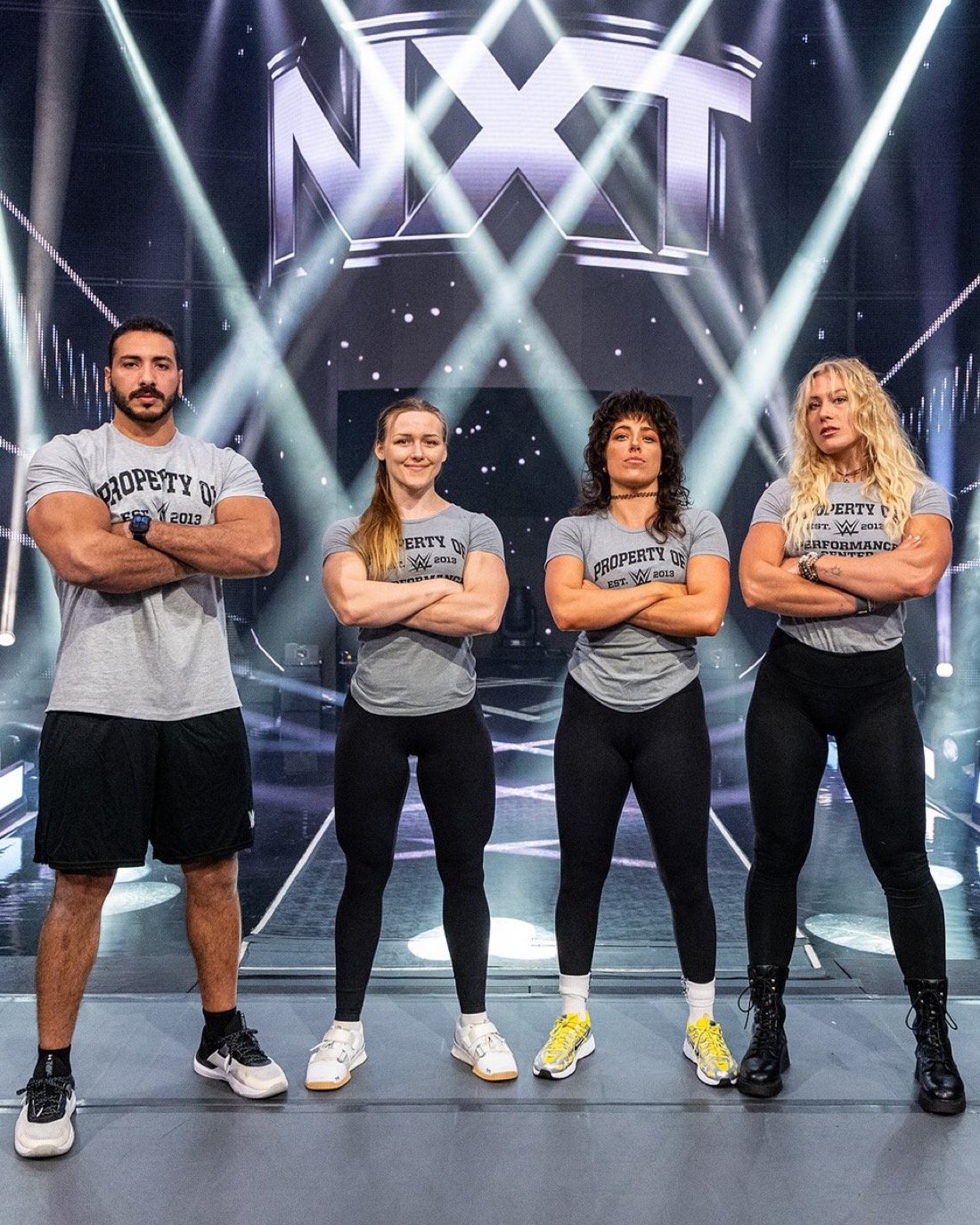
WWE NXT’s latest “They got next” announcement did more than introduce four new names to the Performance Center pipeline.
It offered a revealing look at how WWE is continuing to shape the next generation of the brand: not through one narrow recruiting lane, but through a deliberate blend of polished independent wrestling experience, international amateur credentials, elite strength sports backgrounds, and long-term athletic upside. WWE officially announced four new Performance Center recruits on March 11, 2026, with the group joining the developmental system in Orlando.
That is the headline. The more interesting story is what this class says about NXT itself. For years, WWE’s developmental strategy has swung between two poles: finished independent workers who can be sharpened for television, and raw athletes who can be built from the ground up in the company’s system. This group reflects both philosophies at once. One recruit arrives as the most ring-ready addition of the four, while the others come in through more traditional athlete-to-WWE pathways, each bringing a distinct physical profile that fits the modern Performance Center model.
The roots of this class trace back to WWE’s SummerSlam 2025 tryout in New Jersey, which featured 38 athletes and wrestlers. That tryout serves as the clearest common thread linking all four of today’s recruits. One member of the class quickly emerged as the standout almost immediately, earning MVP honors from the tryout and separating herself from an already competitive field.
That matters because tryouts are not just talent identification camps anymore. In modern WWE, they function almost like live auditions for developmental philosophy. The company is not only looking for athleticism, presence, and coachability; it is looking for how a prospect fits into an evolving NXT ecosystem that now has to balance television readiness, social media visibility, international expansion, and eventual main roster projection. This class checks those boxes in different ways, which is exactly why it stands out.
Rayne Leat
Rayne Leat enters this class as the most ring-ready of the four recruits, and that immediately makes her one of the most intriguing additions in WWE’s latest developmental intake. Known to many fans from the UK and European independent wrestling scene as Rayne Leverkusen, she already brings something invaluable to the Performance Center: a working understanding of ring geography, match pacing, physical storytelling, and crowd connection. While the other recruits are largely entering the system as athletic conversion projects, Rayne arrives with an actual wrestling foundation that gives her a very different developmental ceiling and timeline.
That distinction became even clearer during WWE’s SummerSlam 2025 tryout in New Jersey, where she did not just participate — she stood out. Rayne was named the MVP of the tryout, a noteworthy distinction in a group that featured 38 athletes and wrestlers. That recognition matters because it suggests WWE did not merely see potential in her; it saw immediate value. In a recruitment environment where WWE is constantly weighing upside against readiness, being singled out as the top performer in a loaded tryout class says a great deal about how she was perceived internally.
Rayne’s recruitment also feels like part of a broader WWE trend of identifying experienced independent wrestlers who can be refined rather than completely rebuilt. She has already worked in notable promotions across the UK and Europe, and that experience gives NXT something every class needs: at least one prospect who plausibly looks capable of moving from training to actual screen integration faster than the rest. That does not mean she is finished product, because WWE’s in-ring system remains highly specific, but it does mean her developmental runway should look very different from someone learning wrestling from scratch.
That idea was reinforced again when she appeared ringside at NXT Vengeance Day on March 7 during the NXT Underground match. Even in a minor visible role, that kind of appearance matters. It suggested Rayne had already begun transitioning from prospect to someone being subtly folded into the NXT presentation before today’s class announcement ever became official. For a brand constantly looking for its next wave of women’s talent, Rayne feels like more than a long-term project. She feels like a recruit with a realistic chance to make an impact sooner rather than later.
Ahmed Essam Samy Twfiq
Ahmed Essam Samy Twfiq may be the least familiar name to many WWE fans right now, but his athletic profile makes him one of the most fascinating developmental bets in the group. Reports surrounding his background have consistently pointed to amateur wrestling, with an international résumé that has been described as including African and Arab championship success. Even without overstating every accolade attached to his name, the broader point remains clear: Ahmed enters WWE with a legitimate combat-sports base that should translate naturally to several core elements of pro wrestling.
That foundation is important because amateur wrestling has historically been one of the most reliable backgrounds for WWE developmental prospects. Athletes who come from that world already understand balance, leverage, body control, pressure, positioning, and takedown mechanics in ways that cannot be easily manufactured. The challenge is not usually whether they can learn physicality. The challenge is whether they can learn performance — character, rhythm, pacing, facial expression, timing for audience reaction, and the subtle theatrical side of the craft. But when WWE recruits an athlete with this type of base, it is often because the company believes the hardest part — credible movement and believable contact — is already there.
Ahmed’s road to this class also appears to show that WWE’s interest in him was not brief or casual. He was part of the SummerSlam 2025 tryout in New Jersey, but reporting also linked him to WWE’s London tryouts in April 2025, making it seem like he was evaluated multiple times before the company made its move. That matters. WWE does not usually keep revisiting the same prospect unless the company believes there is something worth investing further time into. A second or repeat look often signals genuine interest, and that kind of repeated evaluation can sometimes say more than the signing itself.
For NXT, Ahmed represents the kind of recruit the system has been designed to develop over the years: a serious athlete with transferable fundamentals, an international résumé, and room to be molded into something unique within the WWE structure. He does not arrive with the same ring polish as Rayne Leat, but he may have one of the strongest pure athletic foundations in the entire class. If the Performance Center can help him bridge the gap between legitimate grappling ability and WWE performance instincts, he has the profile of someone who could eventually stand out in a meaningful way.
Ellen Akesson
Ellen Akesson may be the most instantly recognizable “WWE prospect” in this class once her athletic résumé comes into focus. Her background in arm wrestling, powerlifting, strongwoman competition, and streetlifting gives her one of the most visually and physically distinct profiles of the four recruits. WWE has long been drawn to strength athletes whose legitimacy is obvious before they ever step into a ring, and Ellen fits squarely into that lineage.
The appeal is not simply that she is strong. It is that her kind of strength naturally carries presence. Power athletes often project dominance before they say a word, and that matters in WWE. NXT coaches can teach mechanics, structure, and performance timing, but there is something inherently valuable about a recruit whose physical identity already reads clearly on camera. In a developmental environment where first impressions matter and character often begins with silhouette and body language, Ellen enters with an advantage that cannot be ignored.
Like the rest of this class, Ellen’s public path to WWE runs through the SummerSlam 2025 tryout in New Jersey. Her inclusion in that group connects her directly to the same recruiting process that produced this latest Performance Center class, but her projection within it is especially interesting because she feels like the kind of athlete WWE signs with a clear vision already in mind. This is not a recruit who needs to be imagined as physically imposing. She already is. The question is how quickly that power can be adapted into the rhythms of wrestling.
That, ultimately, will define Ellen’s ceiling. Strength sports do not automatically prepare someone for pro wrestling’s movement patterns, selling, spacing, timing, and character-based performance. But WWE has always been willing to invest heavily in athletes with rare physical tools, because those tools are far harder to teach than in-ring structure. Ellen feels like the sort of prospect who could eventually be built as a force once the technical and performance pieces catch up. In a women’s division as deep and competitive as NXT’s, that kind of unmistakable physical identity could become a major asset.
Delia Schweizer
Delia Schweizer rounds out this class as perhaps the clearest long-term developmental project, but that should not be mistaken for a lesser upside. In many ways, she represents one of the most modern types of recruits WWE now targets: a high-level functional athlete whose strengths lie in movement, coordination, explosiveness, endurance, and body awareness. With a background in CrossFit and weighted calisthenics, Delia does not come from a traditional wrestling pipeline, but she absolutely comes from the kind of athletic environment NXT has increasingly learned to value.
The connection to the SummerSlam 2025 tryout in New Jersey again provides the central origin point for her recruitment. That event served as the bridge between raw athletic promise and WWE interest for all four members of this class, and for Delia it likely functioned as proof that her athletic profile could translate within the early framework of WWE developmental training. Tryouts are not only about who looks impressive physically; they are about identifying which athletes can absorb instruction, adjust quickly, and show the kind of body control that suggests a teachable future. Delia’s signing indicates WWE saw those traits.
One of the more interesting details surrounding Delia’s path is that reports suggested she had already moved to the United States before the formal announcement of the class. That makes today’s reveal feel less like a sudden beginning and more like public confirmation of a process already underway. In WWE developmental terms, that often matters because relocation signals commitment, structure, and the beginning of true immersion into the Performance Center system. The earlier that process starts, the earlier WWE can begin shaping an athlete in its own image.
From a broader NXT perspective, Delia brings something useful to this class because she widens the athletic spectrum even further. She is not the polished independent wrestler. She is not the amateur wrestling-based combat athlete. She is not the strength-sport powerhouse. She is the movement athlete — the recruit whose value lies in flexibility, conditioning, repetition capacity, and the potential to turn body control into in-ring fluidity over time. Those projects can take patience, but when they click, they often produce performers who move differently from everyone else around them. That alone makes Delia one of the more quietly interesting names in this group.
That is what makes this class feel coherent rather than random. On paper, these four recruits come from different corners of the sports and wrestling world. In practice, they reflect a very specific WWE recruiting philosophy. One is the ready-made worker with proven upside. One is the combat-based athlete with strong foundational transfer. One is the power prospect with obvious visual identity. One is the movement athlete with developmental elasticity. None of those profiles duplicate one another, and that is exactly the point.
The timing also tells a story. Reports on March 10 indicated that three of the recruits had already signed developmental deals, while the believed signing of the standout independent wrestler had been reported in early February. That same recruit’s presence at Vengeance Day before the official class announcement further suggested that at least one member of this group had already begun the subtle transition from recruit to visible NXT presence. By the time WWE posted the “They got next” graphic, this was less a surprise unveiling than a coordinated public introduction to talent already entering the system.
There is also a larger brand-level implication here. NXT has become increasingly comfortable defining itself as both a finishing school and a scouting weapon. It is no longer just the place where independent wrestlers go to be repackaged. It is also the place where WWE tries to manufacture the next generation of performers out of elite athletes from outside the business. This class reflects that dual identity almost perfectly. It is not one model winning out over the other. It is WWE betting that the healthiest version of developmental is one where multiple talent pipelines coexist.
That is why this announcement should be read as more than a routine Performance Center update. It is a snapshot of where WWE believes its future lies. The company still wants workers who can step into the system with ring experience and separate themselves quickly. It still wants high-level athletes with legitimate amateur combat backgrounds. It still believes in mining strength sports and functional fitness for physically gifted prospects. And it still believes NXT is the place where those very different raw materials can be shaped into something television-ready.
Whether every member of this class reaches television in a meaningful way is a different question. That is always the risk with developmental. But as a statement of intent, this class is difficult to miss. WWE is not recruiting one type of future. It is building several at once. And in this newest Performance Center class, NXT’s next wave looks like a deliberate investment in variety, upside, and the increasingly global identity of the brand.
Make sure to subscribe to our Late Night Crew Wrestling YouTube Channel. Follow @yorkjavon, @kspowerwheels & @LateNightCrewYT on X.

I’m the quiet one until the bell rings then I’ve got takes. I live for WWE NXT and TNA, I want every promotion to succeed, and I will absolutely roast the bad decisions on sight (because someone has to). Anime taught me to respect long-term storytelling; wrestling taught me that sometimes the plan is “we panicked” and called it “unpredictable.” The Miz got me into all of this, so yeah I appreciate confidence, commitment, and the art of talking like you’re already the main event. Now I bring that same energy to the page as the main writer for Late Night Crew Wrestling because if you’re not here to be must-see and tell the truth, why are you here?!