
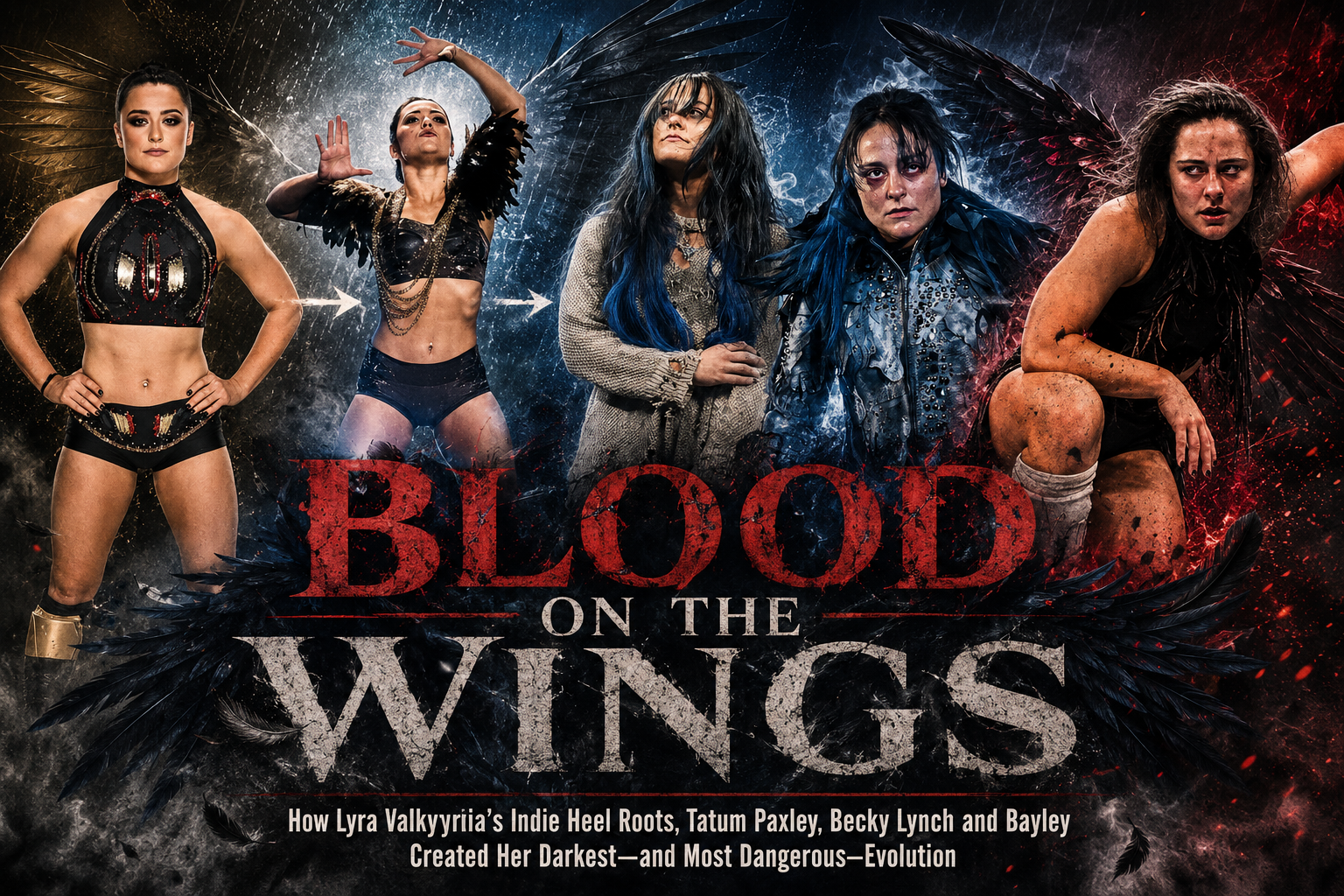
Lyra Valkyria did not suddenly lose her mind.
She did not wake up one Monday morning, cover her face in dark makeup, alter her entrance and randomly decide that Bayley was responsible for every disappointment in her career. What is happening to Lyra on Monday Night RAW is not an abrupt heel turn created because WWE needed another villain in the women’s division. It is the culmination of years of championship pressure, broken trust, conditional affection, damaged mentorships and failures that Lyra repeatedly attempted to absorb without ever properly confronting what they were doing to her.
That distinction is what makes this character development so compelling.
The darkness we are seeing now is new to WWE’s audience, but it is not entirely new to Lyra. Before arriving in the company, while competing as Valkyrie on the Irish independent scene, she proved that she could thrive as a cold and opportunistic heel. She turned against her mentor, Katey Harvey, aligned herself with Debbie Keitel as The Woke Queens and defeated the popular Raven Creed to capture the OTT Women’s Championship. Valkyrie became one of the defining villains of OTT’s women’s division before Harvey eventually returned and dethroned her at the promotion’s Fifth Year Anniversary inside the National Stadium.
That history matters because WWE is not forcing Lyra into a role she has never played. It is returning her to instincts that existed before NXT and placing them inside a much richer emotional framework.
The independent-scene version of Valkyrie was willing to betray a mentor and manipulate relationships to reach the top. The current WWE version is far more psychologically complicated. She is not simply choosing ambition over loyalty. She has convinced herself that loyalty, mentorship and emotional attachment are the reasons she has repeatedly failed.
That belief connects every important relationship in her WWE career.
Tatum Paxley became obsessed with her while she was NXT Women’s Champion.
Becky Lynch inspired her, validated her and ultimately betrayed her.
Bayley became her partner, her responsibility, her emotional burden and eventually the person Lyra decided to blame for everything that had gone wrong.
Each relationship began with admiration, trust or genuine affection. Each eventually became tangled in championships, jealousy, disappointment and abandonment. Lyra kept trying to repair those connections without confronting how deeply they had changed her. She remained composed. She acted like the mature one. She continued wrestling, continued trusting and continued pretending every betrayal could be processed simply by moving toward the next opportunity.
Now those consequences are standing in front of us.
The Lyra Valkyria who left Bayley unconscious at Saturday Night’s Main Event, blood running down her face before she drove her former partner onto the steel steps, was not a completely different person. She was the same woman we had been watching all along after the restraint, patience and emotional discipline finally burned away.
This is the character change Lyra desperately needed.
For all her talent, athleticism and credibility, Lyra spent too much of her main-roster career being defined by what she could do rather than who she was. She was the gifted wrestler with the wings. She was the promising young champion. She was the respectful protégé. She was the reliable tag team partner. She was regularly positioned beside more established personalities whose emotions, legacies and stories were louder than hers.
The darkness changes that.
Lyra is no longer participating in somebody else’s story. She has become one of the most psychologically interesting women on RAW because her character is finally reacting to everything that has happened to her. Her losses matter. Her relationships have consequences. Her appearance reflects her deterioration. Her wrestling has become more vicious. Even the way she wins has changed.
The rest of WWE’s roster should be taking notes.
This is how a wrestler evolves without pretending the previous version never existed.
Tatum Paxley Was the First Warning
Before Becky Lynch betrayed Lyra and before Bayley became the focus of her resentment, Tatum Paxley showed us what Lyra’s relationships could become when affection, obsession and championship ambition were allowed to overlap.
Tatum did not approach Lyra like a normal friend.
She watched her. She followed her. She interfered on her behalf. She treated Lyra less like an equal and more like something precious that needed to be protected, possessed and kept close. Their relationship was intentionally uncomfortable because Tatum’s affection was never emotionally healthy. Lyra was the NXT Women’s Champion, and Tatum became fascinated by both the woman and the status surrounding her.
Lyra initially resisted that fixation. She did not want Tatum interfering in her matches or deciding what was best for her. At the same time, Lyra did not completely reject her. She recognized that something sincere existed beneath Tatum’s instability. When Tatum showed that she could respect Lyra’s boundaries, Lyra rewarded that progress by agreeing to team with her against The Kabuki Warriors.
That decision revealed something essential about Lyra’s character.
She has always wanted to believe damaged people can be reached.
Lyra did not dismiss Tatum as irredeemable. She attempted to establish boundaries, build trust and transform Tatum’s obsession into something healthier. She wanted to turn instability into loyalty and create a functional partnership out of an emotionally unbalanced connection.
That instinct would eventually carry over into her relationship with Bayley.
Lyra repeatedly places herself in the position of emotional stabilizer. She sees somebody struggling, believes she can help and gradually accepts responsibility for keeping the relationship together. The problem is that Lyra does not know when to stop carrying another person’s emotional weight.
Her partnership with Tatum eventually collapsed. Lyra accidentally struck her during their Women’s Tag Team Championship opportunity, and after Lyra lost the NXT Women’s Championship, Tatum attacked her. Tatum’s attraction had been tied, at least partly, to the championship and the status Lyra represented. Once the title was gone, the relationship changed.
That betrayal should not be overlooked when examining Lyra’s current character.
Tatum taught Lyra that admiration could be conditional.
She taught her that somebody could claim to care deeply while also being attached to the success, prestige or championship surrounding her. Lyra had been worth following and protecting while she was champion. Once she lost the title, she was no longer viewed in quite the same way.
Yet Lyra still forgave her.
When Lyra later returned to NXT and rescued Tatum, the reunion showed that she remained willing to repair a relationship even after betrayal. That moment fit the version of Lyra we knew then. She absorbed the hurt, returned to the person who caused it and tried again.
The reunion did not erase the damage. It reinforced a pattern.
Lyra gets hurt.
Lyra suppresses the resentment.
Lyra tries to repair the relationship.
Lyra carries on as though forgiveness has removed the wound.
It never does.
There is also a fascinating reversal taking place now. The current Lyra increasingly resembles the qualities she once tried to control in Tatum. She has become possessive, emotionally unstable and unable to separate affection from achievement. She believes Bayley’s presence took something from her. She has become fixated on punishing the person she once wanted to protect.
Tatum was not merely Lyra’s unusual NXT partner.
She was the first warning of what Lyra herself could become when loyalty, identity and championship ambition stopped having boundaries.
Becky Lynch Turned Validation Into Trauma
If Tatum taught Lyra that affection could be conditional, Becky Lynch taught her that mentorship could become manipulation.
Lyra’s relationship with Becky carried enormous emotional weight because Becky was not simply another opponent or temporary tag partner. She was one of Lyra’s primary inspirations.
When Lyra defeated Becky for the NXT Women’s Championship at Halloween Havoc in 2023, the victory was supposed to represent generational validation. Becky had returned to NXT, elevated the championship and tested the younger women around her. Lyra beating her cleanly positioned Lyra as someone capable of carrying the division forward.
It was more than a championship victory.
It was an endorsement.
Lyra could look at Becky and see proof that her own ambitions were attainable. Becky had fought through uncertainty, criticism and years of struggle to become one of the defining wrestlers of her generation. Lyra, another Irish wrestler attempting to establish herself on WWE’s largest stage, had now defeated her.
That should have been the beginning of Lyra stepping out of Becky’s shadow.
Instead, their relationship eventually showed her how quickly admiration could become exploitation.
When Lyra reached RAW, Becky again played an important role in helping establish her. Lyra assisted Becky against Damage CTRL and quickly advanced to the Queen of the Ring final. WWE positioned her as someone who belonged around the top of the women’s division almost immediately.
The mutual respect appeared genuine.
That is precisely why Becky’s eventual betrayal landed so hard.
At WrestleMania 41, Bayley was attacked and removed from the Women’s Tag Team Championship match. Becky replaced her beside Lyra. Together, Becky and Lyra won the titles, briefly making Lyra a double champion.
It should have been one of the most affirming moments of Lyra’s career. She stood at WrestleMania beside the woman who had inspired her, holding championship gold.
One night later, the titles were gone and Becky attacked her.
Becky eventually revealed that she had attacked Bayley as well. Her partnership with Lyra had not been a meaningful reunion between mentor and protégé. Lyra had been useful. She had been a vehicle through which Becky could return, collect another WrestleMania moment and insert herself into the championship picture.
The symbolism was brutal.
Tatum had valued Lyra while Lyra possessed a championship.
Becky valued Lyra when Lyra could help her obtain one.
Lyra responded by fighting Becky over the Women’s Intercontinental Championship, a title Lyra had given immediate historical significance by becoming its inaugural holder. Their rivalry quickly became about more than possession of the championship. Becky attacked Lyra’s legitimacy, questioned whether she truly belonged at her level and imposed conditions designed to establish permanent superiority.
When Becky defeated Lyra for the championship, Lyra was forced to raise her hand and acknowledge her as the better woman. Lyra complied before attacking her, showing that the resentment was already beginning to break through the respectful exterior.
That moment should now be viewed as an early stage of the transformation we are seeing.
Lyra did what was required. She fulfilled the stipulation. She demonstrated restraint for a few seconds. Then the humiliation became unbearable.
The feud continued through Evolution and SummerSlam. Becky survived the triple threat involving Bayley and Lyra, and Lyra later lost the No Disqualification Last Chance match at SummerSlam. The stipulation prevented Lyra from challenging Becky again while Becky remained champion.
Another door had closed.
Lyra had once defeated Becky to begin her NXT Women’s Championship reign. On the main roster, Becky returned, took Lyra’s championship and denied her another opportunity to reclaim it.
That was more than a wrestling loss. It destroyed the comforting belief that surpassing one’s hero is a permanent achievement.
Lyra had believed defeating Becky in NXT meant she had arrived. Becky returned and reminded her that the hierarchy could always be reasserted.
The emotional effects did not disappear when their feud ended.
Lyra internalized the SummerSlam defeat as personal failure. She was not simply angry about losing. She believed she had failed to produce the performance expected of her, adding professional disappointment to the betrayal and humiliation already attached to the feud.
That perfectionism is essential to understanding her current collapse.
Lyra does not process failure normally.
She stores it.
She carries it.
She attempts to correct it through the next match, the next championship and the next partnership. When that opportunity also goes wrong, the previous disappointment does not disappear. It becomes heavier.
Becky did not directly create the current Lyra, but she destroyed Lyra’s faith in mentorship. She demonstrated that a role model could praise Lyra’s potential while still feeling threatened by her growth. She showed her that encouragement could become manipulation, partnership could become exploitation and respect could vanish when a championship was involved.
That experience also reawakened something from Lyra’s independent career.
Years earlier, Valkyrie had decided that a mentor had become an obstacle and turned against Katey Harvey. The circumstances were different, but the instinct was familiar. Once Lyra believes the person guiding her has started limiting her, admiration begins turning into resentment.
Becky gave that instinct new justification.
By the time Lyra’s relationship with Bayley began falling apart, she had already learned the ugliest possible lesson from her idol:
Sometimes the only way to escape another person’s shadow is to destroy the person casting it.
Bayley Became Lyra’s Partner, Project and Emotional Burden
Bayley’s role in Lyra’s transformation is more complicated than Tatum’s or Becky’s because Bayley was not simply an obsessive admirer or a manipulative mentor.
Bayley genuinely cared about Lyra.
She supported her. She teamed with her. She helped her. She also accepted Lyra’s help when her own confidence and identity were deteriorating. Their partnership developed over a longer period, which means its eventual collapse carries more emotional weight.
Their connection was never completely uncomplicated.
Lyra and Bayley competed against one another during Lyra’s reign as Women’s Intercontinental Champion. They later entered a gauntlet match together and earned a Women’s Tag Team Championship opportunity for WrestleMania 41. Before they could receive it, Bayley was attacked and replaced by Becky.
That attack distorted all three relationships at once.
Bayley lost her WrestleMania opportunity.
Lyra gained a championship moment beside Becky.
Becky used the situation to manipulate both women.
When Bayley returned, the emotional damage became impossible to separate. Lyra was upset because Bayley had not communicated with her after the attack. Bayley was focused on revenge against Becky. Lyra felt ignored by the partner whose place she had reluctantly continued without.
The three women eventually fought over the Intercontinental Championship, but underneath the title was a deeper conflict involving trust, replacement and resentment.
Lyra defeated Bayley in a two-out-of-three falls match and earned another opportunity against Becky. Shortly afterward, Lyra and Bayley resumed their partnership and pursued the championship opportunity they had originally earned together.
Their alliance was always tenuous.
They were not suddenly presented as inseparable friends. They were two women attempting to recover something that had been stolen from both of them. Their team existed because they shared history, mutual respect and unfinished business.
After Lyra lost to Becky at SummerSlam, her frustration became increasingly visible. Instead of separating from Bayley, however, Lyra became more involved in Bayley’s emotional state.
Bayley was experiencing an identity crisis of her own, caught between the warmth of her former Hugger persona and the aggression of the Role Model she had become. During a tag team match, Lyra slapped Bayley to provoke the more ruthless version of her. The tactic worked. Bayley became more aggressive and helped secure the victory.
At the time, the slap could be interpreted as Lyra helping Bayley rediscover what she needed.
In hindsight, it was another warning.
Lyra was learning that violence could function as emotional communication.
She could not talk Bayley through her uncertainty, so she struck her. She forced Bayley’s darker personality to emerge because that version was more effective in the moment. Lyra believed she was stabilizing Bayley, but she was also becoming accustomed to managing her partner’s emotions.
That responsibility continued growing.
By WrestleMania 42, Lyra had made it her personal mission to help Bayley return to the event after the previous year’s attack had cost her the opportunity. Their shared objective was to finally win the Women’s Tag Team Championship together.
That should have been the triumphant conclusion to their story.
Lyra would correct the injustice from WrestleMania 41.
Bayley would receive the moment she had been denied.
Their partnership would finally produce tangible success.
Instead, they lost.
Brie Bella and Paige captured the championships. Lyra and Bayley continued pursuing them, but the failures accumulated. They lost another major tag team match after outside distractions. Lyra also lost an individual opportunity against Women’s Intercontinental Champion Sol Ruca.
That singles defeat is an important part of the story because it prevented Lyra from honestly blaming everything on the partnership.
She had already lost the championship she helped establish.
She had failed to regain it from Becky.
She had failed at WrestleMania.
She had failed with Becky.
She had failed with Bayley.
She had now failed on her own against Sol.
The line separating personal failure from collective disappointment was disappearing.
Through all of it, Lyra continued presenting herself as the person trying to move forward.
She found opportunities.
She supported Bayley.
She tried to repair their team.
She remained the practical one.
Underneath that maturity, however, resentment was growing.
Lyra had spent months helping Bayley rediscover herself, return to WrestleMania and pursue championship gold. Somewhere along the way, Lyra began believing Bayley’s recovery had been purchased with Lyra’s momentum.
That belief may not be entirely fair, but it is emotionally believable.
Lyra looked at the time she invested in Bayley and saw opportunities she could have pursued alone. She looked at their losses and saw a partner she had repeatedly attempted to motivate. She looked at Bayley’s legendary career and realized she had once again become a supporting character in an established star’s redemption story.
Becky had made Lyra feel like an accessory to her comeback.
Bayley made Lyra feel like a caretaker in someone else’s recovery.
The critical difference is that Bayley did not deliberately exploit her. Bayley’s affection was real. Bayley was not secretly using Lyra in the way Becky had.
That makes the betrayal more tragic.
Bayley became the safest person for Lyra to blame precisely because Bayley was the person close enough to receive all the anger Lyra had accumulated elsewhere.
The Downward Spiral Began When Winning Stopped Being Enough
Lyra’s eventual attack on Bayley was not merely the night their team ended. It was the moment her entire definition of success changed.
During their latest Women’s Tag Team Championship opportunity, Lyra hit Paige with a Fisherman’s Buster and had a chance to make the cover.
She did not take it.
Instead of immediately attempting to win, Lyra became consumed with inflicting additional damage. The hesitation allowed Paige to recover, hit Ram-Paige and hand Lyra and Bayley another loss.
After the bell, Lyra snapped and brutally attacked her partner.
That sequence explained Lyra’s transformation better than any monologue could.
Bayley did not hold Lyra back in that moment.
Lyra held herself back.
She had a potential victory directly in front of her and chose punishment over strategy. Her anger had become more important than the championship she claimed to want.
That is the central contradiction of this version of Lyra Valkyria.
She insists that everyone around her has prevented her from succeeding, yet her obsession with proving dominance is now actively sabotaging her success.
It would have been easier for Lyra to acknowledge that she made a mistake. It would have been easier to admit that the accumulated pressure affected her judgment. Instead, she redirected that shame toward Bayley.
Bayley became the explanation for every disappointment.
Lyra could tell herself she had not failed to pin Paige because Bayley had weakened her.
She had not lost momentum because Bayley had consumed it.
She had not become unstable because Bayley had driven her there.
That is what makes Lyra’s downward spiral compelling. She is not completely detached from reality. There are fragments of truth inside her accusations.
She did devote significant time to Bayley.
She did become entangled in Bayley’s emotional problems.
She did repeatedly place partnership above individual advancement.
She did lose major opportunities while attempting to make their team work.
The delusion comes from turning those truths into a complete explanation for everything.
Bayley did not force Lyra to delay the pin.
Bayley did not force her to attack after the match.
Bayley did not force her to surrender control of her emotions.
Lyra’s new personality is built on refusing to accept that distinction.
Her attack was not only the end of a partnership. It was the moment Lyra decided personal accountability was less useful than finding someone to punish.
Calling Bayley the Weakest Horsewoman Was an Attack on Her Entire Identity
When Lyra confronted Bayley and accused her of holding her back, she did not simply call Bayley a bad partner.
She attacked Bayley’s legacy.
Calling Bayley the weakest of the Four Horsewomen was designed to strike at the insecurity beneath Bayley’s entire career. Bayley has spent years being compared with Becky Lynch, Charlotte Flair and Mercedes Moné. She has reinvented herself repeatedly, carried divisions, built factions and won championships, yet the debate over where she ranks among that group has followed her.
Lyra knew exactly where to place the knife.
The insult also showed how completely she had begun rewriting their shared history.
Bayley was no longer the partner Lyra helped because she cared about her. In Lyra’s new version of events, Bayley was a declining veteran attaching herself to a younger wrestler.
Their WrestleMania pursuit was no longer a shared dream. It was Bayley consuming another one of Lyra’s opportunities.
Lyra helping Bayley through an identity crisis was no longer an act of friendship. It was evidence that Bayley was weak and dependent.
This is what resentment does.
It edits the past until every act of love becomes exploitation.
The darker presentation made the transformation feel complete. Lyra’s distressed appearance, sinister entrance and unsettling calm did not communicate simple confidence. They communicated deterioration. She looked like someone who had stopped hiding the damage.
That is far more interesting than turning her into a conventional arrogant heel.
A typical villainous Lyra could have bragged about being younger, faster and technically superior to Bayley. This Lyra speaks as though she has uncovered a conspiracy only she can see. Her anger is deeply personal, but she presents it as revelation.
She believes she has finally awakened.
Everyone watching can see that she is actually unraveling.
The Blood at Saturday Night’s Main Event Made the Transformation Real
Lyra’s busted nose at Saturday Night’s Main Event transformed her match with Bayley from a heated grudge fight into something far more disturbing.
Early in the match, Bayley caught Lyra in the face and opened her nose. The action briefly slowed while Lyra received attention, and blood became visible across her face and the canvas.
Performer safety is more important than any storyline, and nobody should romanticize a legitimate injury or pretend wrestlers need to be hurt for a match to matter. Once Lyra was cleared to continue, however, the blood became impossible to separate from the story being told.
It enhanced everything.
The dark makeup and eerie presentation had introduced the new Lyra aesthetically. The blood stripped away some of that theatricality and made the transformation feel physical.
She no longer looked like a wrestler performing a darker character.
She looked like someone who had been hurt and decided the pain gave her permission to become even more violent.
Bayley attacked the damaged area and applied pressure across Lyra’s face while using the crossface. Lyra continued fighting, escaped and eventually draped Bayley throat-first across the top rope before trapping her in the choke that rendered her unconscious.
The match could have become a story about Lyra protecting herself.
Instead, the injury appeared to focus her.
Every streak of blood made her expression look more vacant. Every time she absorbed punishment, she appeared less concerned with winning conventionally. The physical damage matched the emotional damage that had been accumulating throughout the storyline.
It was not blood used as decoration.
It became character development.
Lyra’s face told the story of someone crossing a threshold. She had been hurt, embarrassed and forced to confront the consequences of her own aggression. Rather than retreating, she became more committed to destroying Bayley.
The finish was especially effective because Lyra did not pin her.
She choked Bayley unconscious.
A pinfall would have established that Lyra was the better wrestler that night. Passing Bayley out communicated something more personal. Lyra deprived Bayley of the ability to respond. She silenced the woman she believed had controlled too much of her career.
Bayley could not encourage her.
She could not explain herself.
She could not challenge Lyra’s version of their history.
She could not even submit.
Her body simply stopped responding, and the referee ended the match.
That was a far more powerful victory for this character than a clean Nightwing followed by a three-count.
The post-match attack completed the transformation.
Lyra initially walked away, creating the possibility that she had made her statement and regained control. Then she turned around. She reapplied the choke and delivered Nightwing onto the steel steps.
That return was the detail that made her genuinely frightening.
A calculating heel would have understood the match was over.
Lyra could not stop.
She had already defeated Bayley. The official result had been settled. The record book would show Lyra as the winner. None of it satisfied her because this feud is no longer about victory.
Lyra needs Bayley to suffer enough to validate her belief that the relationship destroyed her.
The Nightwing on the steps also changed the meaning of Lyra’s signature move. It was no longer simply the technique she used to win matches. It became an act of punishment delivered after the competitive portion had ended.
Lyra transformed her finishing move into an execution ritual.
The blood covering her face made the final image unforgettable. It visually represented the entire story: Lyra had been damaged, but Bayley was the one left motionless.
She did not merely defeat her former partner.
She made a statement about what this version of Lyra Valkyria is willing to become.
Lyra Is Becoming the Villain in Her Own Story
The smartest part of this storyline is that Lyra still believes she is the protagonist.
She does not see herself as a jealous partner who attacked someone after losing. She sees herself as a woman who has finally escaped years of manipulation.
Tatum was obsessed with her championship.
Becky used her.
Bayley held her back.
From Lyra’s perspective, the pattern is obvious. Everyone who becomes close to her eventually turns into an obstacle.
What Lyra cannot recognize is that she has now become the common denominator.
Her relationships were different. Their failures cannot all be explained by the same betrayal.
Tatum’s obsession was not the same as Becky’s manipulation.
Becky’s manipulation was not the same as Bayley’s friendship.
Lyra has compressed all three experiences into one emotional conclusion:
Attachment creates weakness.
That conclusion gives her new character a coherent philosophy.
She no longer wants mentorship because mentorship creates hierarchy.
She no longer wants partnership because partnership requires compromise.
She no longer wants friendship because friendship introduces vulnerability.
She wants control.
That philosophy also reconnects the current character with her independent-scene heel run. The younger Valkyrie was willing to reject a mentor and align herself with someone who could help her reach the top. The current Lyra has lived through enough betrayal to convince herself that this ruthless version is not merely effective—it is necessary.
The tragedy is that Lyra once built her identity around overcoming darkness without surrendering to it. Her Valkyrie imagery suggested grace, resilience and almost mythic nobility. She was the figure who descended into battle and survived.
Now she resembles something closer to a chooser of the fallen.
She does not enter to inspire.
She enters to decide who deserves to be broken.
That evolution is stronger than discarding her established imagery for an unrelated gimmick. The bird, wings and mythology can all remain. Their meaning has changed.
The feathers no longer symbolize freedom.
They symbolize a predator.
WWE Cannot Reduce This to Black Makeup and Screaming
The greatest danger facing Lyra’s character is overproduction.
WWE has found something genuinely unsettling. The company should resist the urge to explain every detail through supernatural lighting, excessive visual effects, repetitive backstage attacks or long promos about darkness.
Lyra does not need to become another wrestler who laughs uncontrollably and repeatedly declares herself crazy.
Her most effective quality at Saturday Night’s Main Event was focus.
She was frightening because she appeared disconnected from normal emotional limits while remaining completely capable inside the ring. The character should operate through controlled deterioration rather than constant chaos.
Her promos should become shorter and more precise.
She does not need ten minutes to explain every chapter of her relationship with Bayley. She should isolate one memory, distort its meaning and use it as justification.
Bayley could remind Lyra that she helped her receive an opportunity.
Lyra could answer that Bayley only helped when it benefited Bayley.
Bayley could remind her that they were friends.
Lyra could respond that friendship was the cage she finally escaped.
Those exchanges would reveal far more than generic threats.
Her in-ring style should continue changing as well.
The choke that ended the Saturday Night’s Main Event match should become one of her defining weapons. Lyra has always possessed excellent technique, but a submission capable of rendering opponents unconscious gives this character a more sinister form of finality.
Nightwing can remain her traditional finishing move, but the choke should represent the moment a match stops being competitive.
Opponents should fear becoming trapped in it.
Commentary should emphasize that Lyra does not need an opponent to submit. She will maintain the hold until the referee intervenes.
Nightwing can then become something she occasionally uses after victory when her anger remains unsatisfied. That separation would give her two distinct levels of danger: the move used to win and the move used to punish.
Most importantly, Lyra’s violence needs direction.
She should not randomly attack every woman backstage. Her targets should represent the relationships, institutions and failures she believes damaged her.
Bayley represents partnership.
Becky represents mentorship and legacy.
Sol Ruca represents the championship Lyra believes still belongs to her.
A future Women’s World Champion would represent the status Lyra believes she has been denied.
Every feud should feel like part of the same psychological campaign.
Bayley Is the Perfect Person to Expose Lyra’s Delusion
Lyra defeating Bayley at Saturday Night’s Main Event should not end their feud.
It should deepen it.
Bayley is uniquely qualified to recognize what is happening because she has experienced different versions of the same emotional collapse.
Bayley knows what it means to feel overlooked.
She knows what it means to abandon a beloved identity.
She knows what it means to blame everyone around her.
She knows what it means to weaponize mentorship.
She also knows how intoxicating it can feel to stop seeking approval and embrace resentment.
That history prevents Bayley from being positioned as a naïve victim. She should understand Lyra better than Lyra wants to admit.
Bayley’s strongest response would not be immediate revenge.
It would be recognition.
She should tell Lyra that she understands exactly what this feels like. She should admit that parts of Lyra’s criticism may be valid. Perhaps Bayley became too dependent on her. Perhaps Lyra spent too much time protecting their partnership. Perhaps Bayley failed to recognize how much pressure Lyra was carrying.
Then Bayley should draw the line.
Understanding Lyra does not excuse what Lyra has done.
Bayley can accept responsibility for her own failures without accepting responsibility for Lyra’s choices. That distinction would directly challenge the foundation of Lyra’s new personality.
Lyra needs Bayley to be completely guilty.
If Bayley acknowledges her mistakes while refusing to become Lyra’s scapegoat, Lyra loses control of the narrative.
That could push her even further.
The next match should be more than a standard rematch. Their story has become too personal for another ordinary singles contest. A No Holds Barred match, an I Quit match or another stipulation centered on emotional surrender would fit the feud.
An I Quit match would be especially appropriate.
Lyra believes Bayley made her weak. Bayley believes Lyra is hiding behind blame. Each woman would be attempting to force the other to verbally validate her interpretation of their relationship.
WWE should not rush Bayley into defeating her, however.
Lyra’s victory at Saturday Night’s Main Event must matter. She rendered one of the most decorated women in WWE history unconscious while bloodied and then assaulted her after the match. Immediately reversing that momentum would reduce a potentially career-changing transformation to another temporary feud.
Bayley can eventually achieve a form of redemption without taking away Lyra’s momentum.
Perhaps Bayley fails to defeat her but succeeds in exposing the truth.
Perhaps Lyra wins again and still cannot feel satisfied.
Perhaps Bayley refuses to quit until officials intervene, denying Lyra the emotional validation she wants.
The feud should end with Lyra more dangerous but less stable.
That would allow Bayley to remain emotionally resilient while Lyra advances toward championship contention.
The Women’s Intercontinental Championship Is the Most Meaningful Next Step
Lyra can eventually become Women’s World Champion, but the most meaningful immediate destination is the Women’s Intercontinental Championship.
That title is not simply another belt to her.
Lyra was its inaugural champion.
She established its identity.
She carried it through its earliest defenses and gave it credibility before Becky Lynch took it from her.
Her loss to Sol Ruca demonstrated that the championship still occupies a vulnerable place in Lyra’s mind. She did not merely fail to win gold. She failed to reclaim something that once defined her.
A darker Lyra pursuing the Intercontinental Championship would have a built-in motive beyond ambition.
She would believe the division had mishandled her creation.
She would view every champion who followed her as someone occupying her position.
She would not frame the pursuit as another opportunity.
She would frame it as repossession.
That creates a compelling contrast with Sol Ruca. Sol represents spectacular athleticism, optimism and forward momentum. Lyra represents accumulated resentment and a refusal to let go of the past.
Their earlier match could become the evidence Lyra uses to justify targeting her. Lyra can claim the loss occurred before she stopped allowing relationships and emotion to weaken her. A rematch would test whether the transformation has actually made Lyra better or merely more violent.
A second Intercontinental Championship reign could become the ideal bridge between Lyra’s current development and the Women’s World Championship.
She should not win it and suddenly become a conventional workhorse champion.
Her reign should feel oppressive.
She should target challengers’ weaknesses, trap them in the choke and treat every successful defense as evidence that empathy was the only thing preventing her from dominating the division.
The championship would also give her consistent television presence without forcing WWE to rush her directly into the world title picture.
Lyra could defend against younger wrestlers who resemble the person she used to be. She could reject handshakes, mock admiration and punish anyone who mentions being inspired by her.
That would bring the Becky Lynch story full circle.
Lyra once followed an idol and felt betrayed.
As champion, she could become the idol who terrifies the next generation.
A Women’s World Championship Reign Is No Longer Difficult to Imagine
Before this transformation, Lyra had the wrestling ability to become Women’s World Champion but lacked a character powerful enough to command the entire division.
That is no longer the case.
A world champion needs more than excellent matches. She needs presence, conflict and a reason for viewers to care whether she remains champion.
The current Lyra has all three.
Her entrance immediately separates her from everyone around her.
Her history gives her motives against multiple top names.
Her wrestling style can now support long championship matches and violent personal feuds.
Her relationship with Becky remains available for revisiting.
Her feud with Bayley has become the foundation of her transformation.
Her past with Tatum provides another emotionally complicated story should WWE ever reunite them on the main roster.
Her independent-scene history proves this side of her character has deeper roots than one current rivalry.
The path toward a world championship should still be gradual enough to preserve the downward spiral.
Lyra should not become completely calm the moment she wins gold. A championship should intensify the problem.
She has spent years associating titles with affection, legitimacy and control. Becoming Women’s World Champion would not heal her. It would convince her the darkness had been correct all along.
She could interpret every victory as proof that friendship weakened her.
Every challenger would become another person trying to take away the identity she had finally reclaimed.
That paranoia could produce a championship reign with more layers than a routine series of defenses.
Lyra might become increasingly protective of the title, not simply because she fears losing status, but because she believes losing it would make her unworthy of attention again—the same wound created when Tatum’s affection became tied to Lyra’s championship.
She could insist that she does not need anyone while becoming more emotionally dependent on the title than she ever was on a partner.
That is world championship material.
It gives the title psychological meaning.
This Is the Kind of Character Development WWE Needs More Often
Lyra’s current evolution works because it is changing every part of her presentation.
Her appearance changed.
Her entrance changed.
Her speech changed.
Her match structure changed.
Her finishing sequence changed.
Her relationships were reinterpreted.
Her previous losses became part of the motivation.
Her independent history gained new relevance.
That is what genuine character development looks like.
Too often, a wrestler turns heel because the story suddenly requires another villain. The wrestler attacks a partner, offers a short explanation, changes gear colors and behaves arrogantly until the feud ends. The character’s history remains untouched.
Lyra’s story is working because the past has not been discarded.
Her heel run beside Debbie Keitel matters.
Katey Harvey matters.
Tatum matters.
Becky matters.
Bayley matters.
The NXT Women’s Championship matters.
The Women’s Intercontinental Championship matters.
WrestleMania matters.
SummerSlam matters.
The failed tag team championship pursuits matter.
Even the decision not to pin Paige matters.
The character has become more compelling because events are finally leaving visible marks on her.
That is the lesson the rest of WWE’s roster should take from Lyra.
Wrestlers should not remain emotionally identical after betrayals, championship losses and years of disappointment. Stories should change how people behave. A wrestler who has repeatedly been manipulated should become suspicious. A wrestler who has repeatedly failed should either become more determined or more desperate. A wrestler who has invested everything in a partnership should not simply move on when it collapses.
Lyra is finally allowing the audience to see the cost of her career.
She is not merely saying she has changed.
She looks changed.
She fights differently.
She reacts differently.
The blood at Saturday Night’s Main Event brought the entire progression together in one unforgettable image. Lyra stood over Bayley with her face damaged and her restraint gone. She had achieved one of the most significant victories of her career, yet winning was still not enough. She returned, choked Bayley again and drove her onto the steel steps.
That is where the true demon exists.
Not in the makeup.
Not in the entrance music.
Not in supernatural effects.
It exists in Lyra’s inability to feel satisfied.
She defeated Bayley and remained angry.
She proved she could succeed alone and still needed to punish her former partner.
She escaped the partnership but remained emotionally controlled by it.
The more Lyra attempts to prove she is free, the more obvious it becomes that Bayley, Becky and Tatum are still influencing every decision she makes. Even the cold opportunist she once became on the independent scene has resurfaced, only now that ruthlessness is carrying years of emotional damage with it.
That contradiction can take Lyra to the top of the RAW women’s division.
Lyra Valkyria spent years trying to be worthy of her partners, mentors and championships. She is finished asking for validation now. She has decided she will take it through force, choke out anyone who questions her and leave the people who once cared about her wondering whether they helped create the monster standing in front of them.
Lyra’s wings were never clipped by Bayley.
They were weighed down by every betrayal, disappointment and failure Lyra refused to confront.
At Saturday Night’s Main Event, covered in her own blood and standing over the body of her former partner, she finally decided to use them.
Make sure to subscribe to our Late Night Crew Wrestling YouTube Channel. Follow @yorkjavon, @kspowerwheels & @LateNightCrewYT on X.

I’m the quiet one until the bell rings then I’ve got takes. I live for WWE NXT and TNA, I want every promotion to succeed, and I will absolutely roast the bad decisions on sight (because someone has to). Anime taught me to respect long-term storytelling; wrestling taught me that sometimes the plan is “we panicked” and called it “unpredictable.” The Miz got me into all of this, so yeah I appreciate confidence, commitment, and the art of talking like you’re already the main event. Now I bring that same energy to the page as the main writer for Late Night Crew Wrestling because if you’re not here to be must-see and tell the truth, why are you here?!