
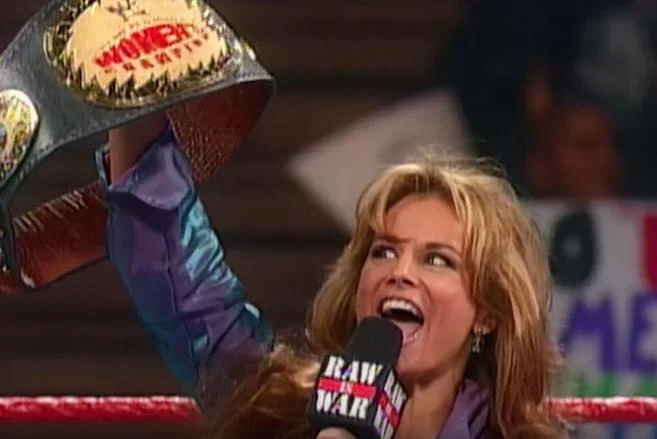
March is Women’s History Month, so I’m going to give Ivory her real flowers — not the polite, “oh yeah, I remember her” kind either. I mean the honest version: Ivory was one of the few actual workers in an era where women’s wrestling in WWE was too often treated like a punchline. And somehow, she still carved out a résumé that proves she belonged in the ring with anybody.
Ivory’s story is basically the story of women’s wrestling in that time period: huge moments, shaky follow-through, a lot of “now go do something embarrassing,” and then — every so often — a match where you could see what the division could’ve been if the company had made different choices.
The debut run: she won the title fast, but the division wasn’t built for her
Ivory (Lisa Moretti) came into WWF in early 1999, and within months she was Women’s Champion — she won the belt from Debra on Raw, June 14, 1999, with Nicole Bass involved in the finish. WWE’s own footage archive has that match sitting there like a time capsule.
That’s the part people forget: she wasn’t presented like a random midcard add-on at first. The issue was what the era did to women’s wrestling overall. You had trained wrestlers trying to wrestle, while the creative direction kept yanking the division toward spectacle-first chaos. Ivory was constantly trying to drag things back toward wrestling, and she said as much in real time — SLAM! ran a 2000 interview where she’s clearly frustrated about the state of women’s wrestling in WWF while still trying not to burn bridges.
The match that tells you everything: Ivory vs. Tori, the “first” that still holds up
If you want one piece of tape for the Women’s History Month argument, it’s this: on Raw, September 6, 1999, Ivory vs. Tori in what’s widely credited as the first WWF women’s hardcore match, and it happened while Ivory was champion.
This wasn’t “great for the women.” It was just a legitimately entertaining brawl with memorable violence and a finish people still talk about. It’s also the perfect example of Ivory’s value: she could take a ridiculous premise and still give it structure, urgency, and a reason to watch. That’s a skill.
Right to Censor: the heel run that aged better than people admit
Then came the pivot that, honestly, might be her best character work: Right to Censor.
RTC itself debuted in mid-2000, a very Attitude Era answer to real-world backlash about WWF content. Ivory didn’t become “Ivory the RTC enforcer” until later that year, but once she did, she committed. Like, fully. The cadence, the posture, the self-righteous heat — she played it like someone who believed she was cleaning up the company.
And the run wasn’t just comedy. It came with real accomplishment: Ivory won the Women’s Championship for the third time by beating Lita (c), Trish Stratus, and Jacqueline in a Fatal 4-Way, something WWE still highlights in her official bio.
Here’s the key detail that always gets fuzzy online, so I double-checked it: that title win lines up with Raw, October 23, 2000 (the same night the RTC direction really crystallized for her on-screen).
Then she dropped the belt to Chyna at WrestleMania X-Seven (April 1, 2001) — a quick match, but an important history marker because it’s part of that era’s weird balancing act: flashes of seriousness, then right back to “what are we even doing.”
The praise and the critique, straight up
Here’s the fair way to talk about Ivory in 2026:
The praise:
- A legitimate in-ring worker in a period that didn’t consistently reward that.
- A three-time WWE Women’s Champion, with title runs in 1999 and the RTC reign in 2000.
- A character performer who could get heat without needing the division to be built around her — which is why even now you’ll see fans say RTC worked better than it had any right to because Ivory took it seriously.
The critique (and it’s not really about her):
- She was trapped in the era’s worst habits: “slop,” humiliation angles, and segments that undercut the talent even when the roster had trained wrestlers who could actually go. That SLAM! interview exists for a reason — she was living it in real time.
- WWE gave her moments, but rarely gave her the consistent runway her ability deserved — which is why her best legacy is tied to the times she forced the material to become wrestling.
Why she’s a Women’s History Month name
Because Ivory represents a type of historical importance fans don’t always celebrate properly: the woman who kept trying to wrestle seriously while the system around her kept trying to turn it into a joke.
And when her career got the proper recognition, it made sense. Ivory was inducted into the WWE Hall of Fame Class of 2018, with mainstream coverage pointing out she was a Women’s Champion and a real contributor across multiple eras of women’s wrestling presentation.
That’s the Ivory legacy to me: not the loudest star of her era, but one of the most important. The kind of wrestler who shows you what women’s wrestling could’ve been sooner — and, in flashes, what it eventually became.
If Women’s History Month is about honoring the women who helped move the whole thing forward, Ivory absolutely counts.
Make sure to subscribe to our Late Night Crew Wrestling YouTube Channel. Follow @yorkjavon, @kspowerwheels & @LateNightCrewYT on X.

I’m the quiet one until the bell rings then I’ve got takes. I live for WWE NXT and TNA, I want every promotion to succeed, and I will absolutely roast the bad decisions on sight (because someone has to). Anime taught me to respect long-term storytelling; wrestling taught me that sometimes the plan is “we panicked” and called it “unpredictable.” The Miz got me into all of this, so yeah I appreciate confidence, commitment, and the art of talking like you’re already the main event. Now I bring that same energy to the page as the main writer for Late Night Crew Wrestling because if you’re not here to be must-see and tell the truth, why are you here?!