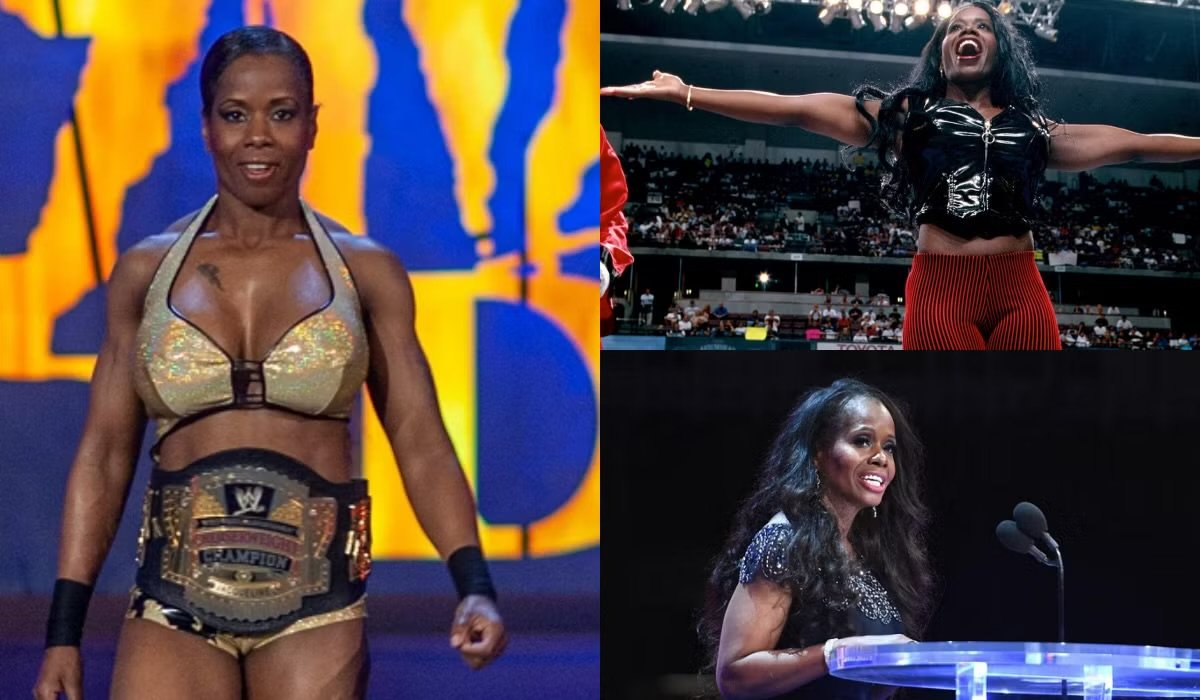
March is Women’s History Month, which is exactly when I like to pull the spotlight off the most obvious names and put it on the women who quietly did everything—and did it in eras that didn’t always deserve them.
Jacqueline is one of those names.
Because when people talk about the Attitude Era, they usually remember the loudest stuff first. That’s fair. But Jacqueline’s career is a reminder that even when the women’s division was getting jerked around by creative and stuck in nonsense, there were still a few performers who showed up like pros and tried to make it wrestling. Jacqueline did that, and she did it while being asked to play roles that ranged from serious to ridiculous—sometimes in the same month.
And the part that matters in a Women’s History Month series: she didn’t just survive that era. She made history inside it.
The Sable/Mero mess was the story… but Jacqueline was the worker
WWE introduced Jacqueline on Raw, June 1, 1998 as Marc Mero’s new on-screen girlfriend, which immediately put her into the hottest women’s storyline in the company—Sable, Mero, jealousy, all of it.
If we’re being honest, that angle was never built to showcase Jacqueline’s strengths as a wrestler. It was built for shock value and crowd reaction. But here’s what I always respected: Jacqueline still treated it like she had a job to do. She brought credibility to segments that could’ve collapsed into pure circus. In hindsight, she was basically doing damage control in real time.
The title win that actually changed history
The WWF Women’s Championship had been gone since 1995, and when WWE brought it back, the first champion of that revived era wasn’t Sable. It was Jacqueline.
On Raw, September 21, 1998, Jacqueline beat Sable—helped by Mero—to win the reinstated Women’s Championship.
And WWE has been clear about what that meant historically: Jacqueline became the first African-American Women’s Champion in WWE. WWE even highlighted that point again during her Hall of Fame recognition and in later coverage, because it’s not trivia—it’s a real landmark moment.
Women’s History Month isn’t just about “firsts,” but when a “first” is this significant, you don’t brush past it.
She won again… in the most Attitude Era way possible
Jacqueline’s second Women’s Championship reign is one of those “you can’t make this up” footnotes that also tells you everything about the time period. On SmackDown, February 1, 2000, she beat Harvey Wippleman (in the “Hervina” gimmick) to win the Women’s Title again.
Do I love the optics of that era? Not really. But Jacqueline taking a segment that could’ve been pure comedy and still carrying herself like a champion—that’s the story. She worked through the chaos.
2004: the night she shocked SmackDown and snatched the Cruiserweight title
Now here’s the part of Jacqueline’s résumé that even some longtime fans forget until you bring it up:
On SmackDown, May 6, 2004, Jacqueline answered Chavo Guerrero’s open challenge and won the Cruiserweight Championship. WWE’s official Cruiserweight title history lists her reign right there with the dates—May 6, 2004 to May 16, 2004.
And yes, she dropped it back to Chavo at Judgment Day 2004 (May 16), in that gimmick match where Chavo’s arm was tied behind his back.
But the Women’s History Month point isn’t the length of the reign. It’s the fact it happened at all—and WWE itself framed it as another example of Jacqueline breaking ground.
The respect she got from the people who actually worked with her
When Jacqueline went into the WWE Hall of Fame in 2016, WWE leaned hard into the word that always follows her: tough. The Dudley Boyz inducting her wasn’t random. They spoke openly about her being one of the toughest and strongest people they’d ever been in the ring with.
That’s the kind of praise I take seriously, because it’s wrestler praise. Not “she was popular.” Not “she had a look.” It’s “she could go, and she hit hard.”
My honest Jacqueline take, in 2026
Jacqueline’s legacy is complicated in the way a lot of women’s legacies from that era are complicated.
The praise is easy:
- She’s a true trailblazer—first African-American Women’s Champion in WWE history.
- She’s one of the rare women from that time who felt like she could plug into any role—wrestler, heater, veteran, title anchor, whatever—and still look believable.
- She did something nobody expected: she became Cruiserweight Champion on a brand that wasn’t exactly handing women “firsts” for fun.
The critique isn’t really about her:
- She spent too much of her prime working around the company’s limitations for women’s wrestling instead of getting to fully show what she could do consistently.
And that’s why Jacqueline belongs in this Women’s History Month series. She’s a reminder that some women weren’t just “part of an era.” They were carrying the era on their backs—sometimes without the company even realizing it.
Jacqueline didn’t need the machine to tell you she was legit. She proved it anyway.
Make sure to subscribe to our Late Night Crew Wrestling YouTube Channel. Follow @yorkjavon, @kspowerwheels & @LateNightCrewYT on X.
I’m the quiet one until the bell rings then I’ve got takes. I live for WWE NXT and TNA, I want every promotion to succeed, and I will absolutely roast the bad decisions on sight (because someone has to). Anime taught me to respect long-term storytelling; wrestling taught me that sometimes the plan is “we panicked” and called it “unpredictable.” The Miz got me into all of this, so yeah I appreciate confidence, commitment, and the art of talking like you’re already the main event. Now I bring that same energy to the page as the main writer for Late Night Crew Wrestling because if you’re not here to be must-see and tell the truth, why are you here?!