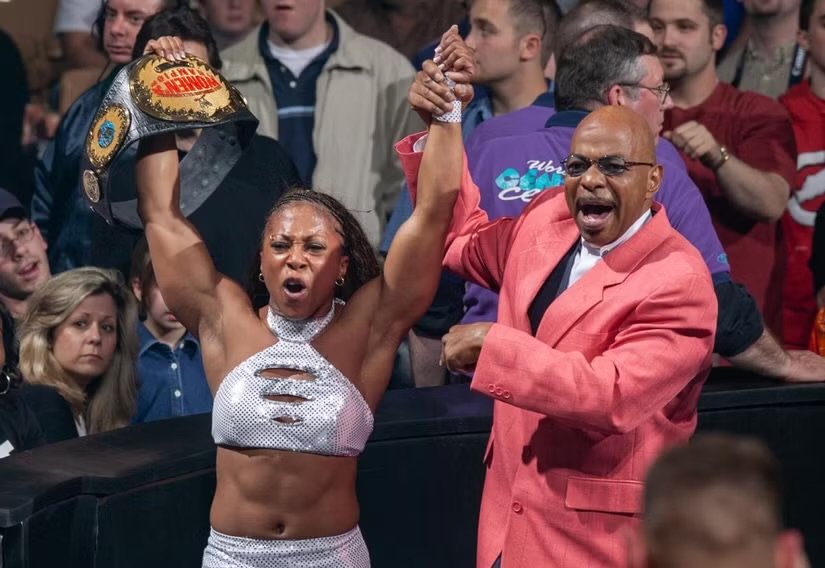
March is Women’s History Month, and Jazz is one of those names I always circle because her impact is louder than her “highlight packages.” Jazz didn’t get remembered for glitz, slogans, or being the company’s chosen face. She gets remembered because when she showed up, the women’s division stopped feeling like a break in the action and started feeling like the action.
Jazz wrestled like she wanted to hurt you — not in a sloppy way, in a purposeful way. She hit with intent, she sold like the match actually cost something, and she brought a physical edge that the division badly needed in the early 2000s. In a time when women were constantly fighting the booking as much as they fought opponents, Jazz did the simplest, hardest thing: she made the work undeniable.
Before WWE, Jazz already had that “don’t play with me” aura
Jazz’s résumé didn’t begin with a WWE tryout story. She was already a grinder, already seasoned, already comfortable being the enforcer type who could stand next to men and not look out of place doing it. That matters for her legacy because she didn’t enter WWE as a blank slate — she entered as a wrestler with a clear identity: toughness, pressure, and violence with structure.
And that identity is why, when WWE finally plugged her into the women’s title scene, it felt like a reset.
2001–2002: the heel champion run that forced the division to tighten up
Jazz’s WWE peak is a very specific era: the transition into the Trish/Lita spotlight years, when the company started slowly realizing women could draw if you treated them seriously. Jazz was the antagonist who made the seriousness stick.
She debuted in late 2001, and once she got rolling, the booking was obvious: put her in the title orbit because she raised the match quality and the stakes at the same time. She won the Women’s Championship from Trish in early 2002, and the reign is remembered for one reason more than anything — it felt physical. It wasn’t “divas doing moves.” It was a champion who wrestled like she was trying to take something from you.
WrestleMania X8 is the snapshot of that era: Jazz defending the title against both Trish and Lita in a triple threat. That match still stands out because it captures what Jazz brought to the table: she made the others fight harder. You could feel the urgency in the pacing because Jazz’s whole presence screamed, “If you make one mistake, I’m going to punish you for it.”
Then came the most “Jazz” detail of all: she drops the title in a hardcore rules match — because even her title loss had to be a fight. Injury issues cut into that run, but the point was already made. Jazz proved the women’s title could be worked like a real championship, not a prop.
2003: the second reign and the hidden historical footnote
Jazz’s second Women’s Championship reign in 2003 is one of those chapters that tends to get skipped because it sits in an awkward space between eras. But historically, it matters. She wins the belt again, holds it into the summer, and then drops it to Gail Kim on the night of Gail’s WWE debut.
That’s not a small detail. That’s Jazz being the bridge: the champion who could legitimize a title change and make a new star look like they earned something by beating her. A lot of people can “put someone over.” Not everyone can make it feel credible. Jazz could.
The post-WWE years: proof she was never a one-era wrestler
Women’s History Month is also about longevity and reinvention, and Jazz’s career after WWE is a big part of why she deserves the flowers. She kept working, kept appearing across promotions, and then added a major late-career chapter by becoming NWA World Women’s Champion in 2016 and holding that title for a long, defining reign before vacating due to personal and medical circumstances.
That matters because it reinforces what a lot of us already knew: Jazz wasn’t only a WWE-era name. She was a women’s wrestling name — the type you could build a division around when you needed credibility.
The influence: Jazz is one of those “study tape” wrestlers
This is where Women’s History Month hits hardest with Jazz. Because her influence isn’t just “fans liked her.” Her influence is that wrestlers studied her.
We’ve literally seen modern stars say that when they started training, Jazz was one of the first people they were told to watch — especially Black women trying to find examples of power, toughness, and legitimacy in a business that didn’t always spotlight them fairly. Naomi has spoken about being shown Jazz and Jacqueline early on as foundational examples. Bianca Belair has publicly talked about studying Jazz when she got into wrestling. And more recently, Jazz herself has talked about how emotional it was meeting up with wrestlers who straight up told her they idolized her.
That’s how you measure legacy in this business. Not by applause alone — by the next generation saying, “That’s the blueprint.”
The present-day legacy: she’s literally shaping the next generation now
And here’s the cleanest “2026” update that ties the entire story together: Jazz isn’t just an influence in memory — she’s actively in the pipeline. She’s coaching at the WWE Performance Center now, after years of training wrestlers through her own gym/dojo work with Rodney Mack.
So when we talk about Women’s History Month and what it’s supposed to be — honoring the past while recognizing who’s still building the future — Jazz checks both boxes at once. Her matches helped force a tougher standard when the division needed it. And now she’s in a position to teach that standard to the next wave.
The Women’s History Month takeaway
Jazz was never the “pretty” champion. She was the champion who made it hurt. She made the women’s division feel like a fight you couldn’t fake your way through, and she helped lay groundwork for a generation that gets to be taken more seriously today.
Women’s History Month isn’t just about celebrating who got the spotlight.
It’s about celebrating the women who made the spotlight brighter by raising the bar — and Jazz did that every time she walked to the ring.
Make sure to subscribe to our Late Night Crew Wrestling YouTube Channel. Follow @yorkjavon, @kspowerwheels & @LateNightCrewYT on X.
I’m the quiet one until the bell rings then I’ve got takes. I live for WWE NXT and TNA, I want every promotion to succeed, and I will absolutely roast the bad decisions on sight (because someone has to). Anime taught me to respect long-term storytelling; wrestling taught me that sometimes the plan is “we panicked” and called it “unpredictable.” The Miz got me into all of this, so yeah I appreciate confidence, commitment, and the art of talking like you’re already the main event. Now I bring that same energy to the page as the main writer for Late Night Crew Wrestling because if you’re not here to be must-see and tell the truth, why are you here?!