
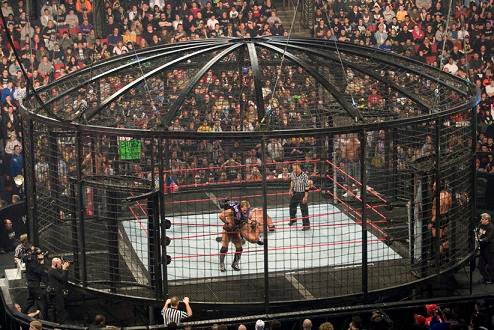
Disclaimer: This ranking is subjective and based on my analysis of historical impact, match quality, and the weight of fan and critical opinion.
This Saturday, February 28, 2026, WWE unleashes Elimination Chamber at the point in the calendar where careers tilt and WrestleMania paths harden—one brutal night designed to turn contenders into survivors and storylines into inevitabilities.
That timing matters, because the Chamber has always been WWE’s most honest lie: it looks like uncontrolled carnage, but the greatest versions are engineered to do something precise. They crown champions, manufacture challengers, fracture factions, and—when the match is truly elite—turn the crowd’s belief into storyline gravity. The Chamber became iconic because it doesn’t just test bodies; it tests identity. Who can adapt? Who can endure? Who can make the crowd believe the impossible is about to happen?
So here’s the all-time Top 5—the matches that didn’t just deliver spectacle, but left fingerprints on what the Chamber is supposed to feel like when it’s at its best.
5) Elimination Chamber 2019 — WWE Championship
Daniel Bryan (c) vs AJ Styles vs Jeff Hardy vs Randy Orton vs Samoa Joe vs Kofi Kingston
This is the modern-era Chamber that proves WWE can still create a groundswell so loud it changes the emotional temperature of an entire WrestleMania season. Bryan entered as the smirking architect of control—champion, manipulator, ideological villain—while Kofi entered as the combustible variable: not the chosen one, but the man the audience chose.
How the spots were earned (and why it mattered):
This wasn’t framed as “six guys announced.” The build baked in advantages and positioning, and it made the Chamber feel like something you strategize for rather than simply survive. Orton’s last-entry advantage mattered because it gave the match a visible chess piece. Kofi’s inclusion mattered because it turned the fight into a referendum once the crowd sensed he wasn’t just hanging—he was belonging.
The story inside the match:
This Chamber is paced like a slow closing fist. Early portions feel like a true ensemble—Styles’ explosiveness, Joe’s menace, Hardy’s risk, Orton’s predatory patience—but the match steadily narrows into what the crowd is begging for: Bryan vs. Kofi, ideology vs. belief. The final act doesn’t merely tease an upset; it dares the arena to will one into existence.
The praise is consistent: the closing stretch is one of the best examples of crowd-driven main event energy inside a gimmick match in the modern era. The criticism is consistent too: some viewers feel the early-to-mid portion is a funnel designed to reach one emotional destination rather than a war where every phase feels equally legendary.
Why it’s #5:
Because its greatness is most concentrated in the final act and in what it ignites afterward. It’s excellent—often phenomenal—but the four above it either sustain mythic intensity across more of the runtime, redefine what the Chamber is capable of, or stand as complete self-contained classics even when detached from the larger story that followed.
4) No Way Out 2009 — World Heavyweight Championship Elimination Chamber
John Cena (c) vs Chris Jericho vs Rey Mysterio vs Kane vs Mike Knox vs Edge (after stealing Kofi Kingston’s spot)
This is the Chamber as a crime story—an arena-sized heist performed under the guise of a title defense.
How the spots were earned—and stolen:
The genius of this match is that the field is presented as legitimate and qualified, which is exactly why the twist detonates so hard. Edge doesn’t just enter late; he turns the concept of “earning a spot” into a punchline. The Chamber’s strict structure—pods, timing, attrition—becomes the weapon he uses against men who have been bleeding minutes and stamina while he’s been waiting for the perfect moment to strike.
The story inside the match:
This isn’t just violence; it’s access. Everyone else fights to survive. Edge fights to arrive. The match becomes a study in exhaustion and timing, where the “best wrestler” isn’t necessarily the winner and the “most damaged man” isn’t necessarily the loser—because the Chamber rewards opportunists as much as warriors.
Fans remember it like folklore, because it feels like a once-in-a-lifetime kind of shock—one of those finishes you can describe in a sentence and still make people’s eyes widen. Critics who love it tend to love it for the same reason: the story isn’t stapled on. It’s only possible because this is the Elimination Chamber. The pushback, from purists, is predictable: that it’s “booking-first,” that the match is remembered more for the theft than the craft.
Why it’s #4:
Because it’s arguably the greatest Chamber angle ever, but the identity of the match leans heavily on that one narrative bomb. The top three don’t require a single twist to justify their greatness; they’re complete blueprints from bell to bell. This is legendary, but legendary in a different way: Chamber mythology more than Chamber perfection.
3) No Way Out 2008 — Raw Elimination Chamber (WrestleMania Title Shot)
Triple H vs Shawn Michaels vs Jeff Hardy vs Chris Jericho vs JBL vs Umaga
If #4 is a heist, #3 is an action movie that never stops accelerating. It’s the Chamber as ecosystem: every wrestler has a role, every role feeds the pacing, and the violence feels like escalation rather than decoration.
How the spots were framed:
The prize here matters: a WrestleMania title shot. That single detail turns the Chamber into a legitimacy furnace—survive this and you don’t just get an opportunity, you get credibility burned into your name.
The story inside the match:
This Chamber has one of the clearest internal designs WWE has ever put inside the structure:
- Michaels and Jericho provide the “pro wrestling spine”—timing, clarity, tension that doesn’t get lost in the chaos.
- Umaga becomes the monster problem, forcing temporary coalitions and turning the middle act into survival horror.
- Hardy becomes the emotional wager: the crowd’s belief grows so loud it starts steering the match’s atmosphere.
- JBL plays the chaos merchant, making the Chamber feel lawless even when the format insists it’s controlled.
- Triple H is the apex predator who speaks the Chamber fluently: ruthless, efficient, never wasting motion.
The praise is about balance: variety, star power, escalation, memorable danger, and a final run where eliminations hit like dominoes. The criticism usually comes down to taste: some fans prefer title-winning Chambers over “#1 contender” Chambers no matter how good the match is.
Why it’s #3:
Because it’s one of the most consistently great Chambers ever—but it doesn’t redefine the Chamber’s identity the way #1 does, and it doesn’t marry build + structure + long-term storyline consequences as seamlessly as #2. It’s the Chamber operating near perfectly, but not the Chamber reinventing itself.
2) New Year’s Revolution 2005 — Vacant World Heavyweight Championship Elimination Chamber
Triple H vs Randy Orton vs Batista vs Chris Jericho vs Chris Benoit vs Edge
This is the Chamber as screenplay—the most constructed Chamber match ever, where the build and the match-night structure lock together like gears.
How the spots were earned:
What separates this match is that the Chamber didn’t feel like a surprise announcement—it felt like a season. The television build weaponized time, order, and advantage, turning entry position into a storyline element rather than trivia. The message was clear: you don’t just show up to the Chamber. You prepare for it.
The story inside the match:
This is a faction pressure test disguised as a title match. The genius is that it offers multiple futures at once:
- Batista looks like inevitability—the monster the match can’t contain forever.
- Orton wrestles like the future trying to arrive early.
- Triple H wrestles like the present refusing to die, using the Chamber’s chaos as a tool rather than a threat.
The match doesn’t merely crown a champion; it clarifies power. And once power is clarified, betrayal becomes inevitable.
This is often praised as one of the cleanest “complete” Chambers: workrate foundation, escalating brutality, storyline acceleration, and a finish that rearranges the Road to WrestleMania map. The recurring criticism is philosophical: some viewers dislike outcomes that feel like the system reasserting itself. Even then, the concession is almost always the same—the match is masterfully assembled.
Why it’s #2:
Because it’s arguably the best execution of the Chamber concept—tight, coherent, purposeful from start to finish. But #1 has something no match can replicate after the fact: the match that created the Chamber’s identity in the first place, and still stands as a masterpiece on its own terms.
1) Survivor Series 2002 — World Heavyweight Championship (First-Ever Elimination Chamber)
Triple H (c) vs Shawn Michaels vs Chris Jericho vs Kane vs Booker T vs Rob Van Dam
This is #1 because it’s the blueprint—and the blueprint is still beautiful.
A lot of “firsts” get ranked high because history demands it. This one is ranked high because history and quality demand it. The first Chamber has something later Chambers can only imitate: the energy of an experiment that might not survive its own runtime. It isn’t slick. It’s survival. It’s invention under pressure.
How the field came together:
This isn’t a modern qualifying puzzle. This is WWE unveiling a weapon and loading it with a perfectly chosen spread: a champion centerpiece, elite workers, credible threats, monsters, and a returning emotional anchor in Michaels whose very presence gives the match a heart.
The story inside the match:
This Chamber feels like it’s fighting the wrestlers back. The structure is not set dressing—it’s the antagonist. The pacing is longer and grimier than later editions, and that’s exactly why it works: it feels like survival rather than choreography. When the match finally narrows to its endgame, the audience isn’t just watching nearfalls—they’re watching exhaustion, damage, and willpower collide.
Long-standing fan consensus tends to treat this as the Chamber’s benchmark. Even when later Chambers match or exceed it in athletic polish, people still return to 2002 for one reason: it has the raw, dangerous “we might not make it out” energy that became the stipulation’s soul. The most common critique is era-based—early Chambers can feel less “sequence-polished” than later versions—but that critique explains the magic rather than diminishing it.
Why it’s #1 over 2005 and the rest:
Because it doesn’t merely use the Chamber well—it teaches WWE what the Chamber is.
- 2005 perfects the language.
- 2008 weaponizes it as a gatekeeper.
- 2009 turns it into myth with a heist.
- 2019 turns it into a belief factory for a modern audience.
But 2002 is the moment the Chamber becomes a concept, a feeling, and a yearly main-event institution—without the benefit of precedent, without the benefit of refinement, and without the safety net of “this always works.”
Why this list matters heading into Elimination Chamber 2026
The Chamber endures because it doesn’t just produce winners. It produces evidence. It tells you who can manage timing, who can survive attrition, who can weaponize chaos, and who can make an audience invest so deeply that WWE has to follow the emotion instead of forcing it.
If Elimination Chamber is WWE’s Road to WrestleMania crucible, these five matches are the reason the crucible still matters. They didn’t just fill time. They defined the test.
Make sure to subscribe to our Late Night Crew Wrestling YouTube Channel. Follow @yorkjavon, @kspowerwheels & @LateNightCrewYT on X.

I’m the quiet one until the bell rings then I’ve got takes. I live for WWE NXT and TNA, I want every promotion to succeed, and I will absolutely roast the bad decisions on sight (because someone has to). Anime taught me to respect long-term storytelling; wrestling taught me that sometimes the plan is “we panicked” and called it “unpredictable.” The Miz got me into all of this, so yeah I appreciate confidence, commitment, and the art of talking like you’re already the main event. Now I bring that same energy to the page as the main writer for Late Night Crew Wrestling because if you’re not here to be must-see and tell the truth, why are you here?!