TNA Wrestling’s biggest year of opportunity has suddenly become one of its most important tests.
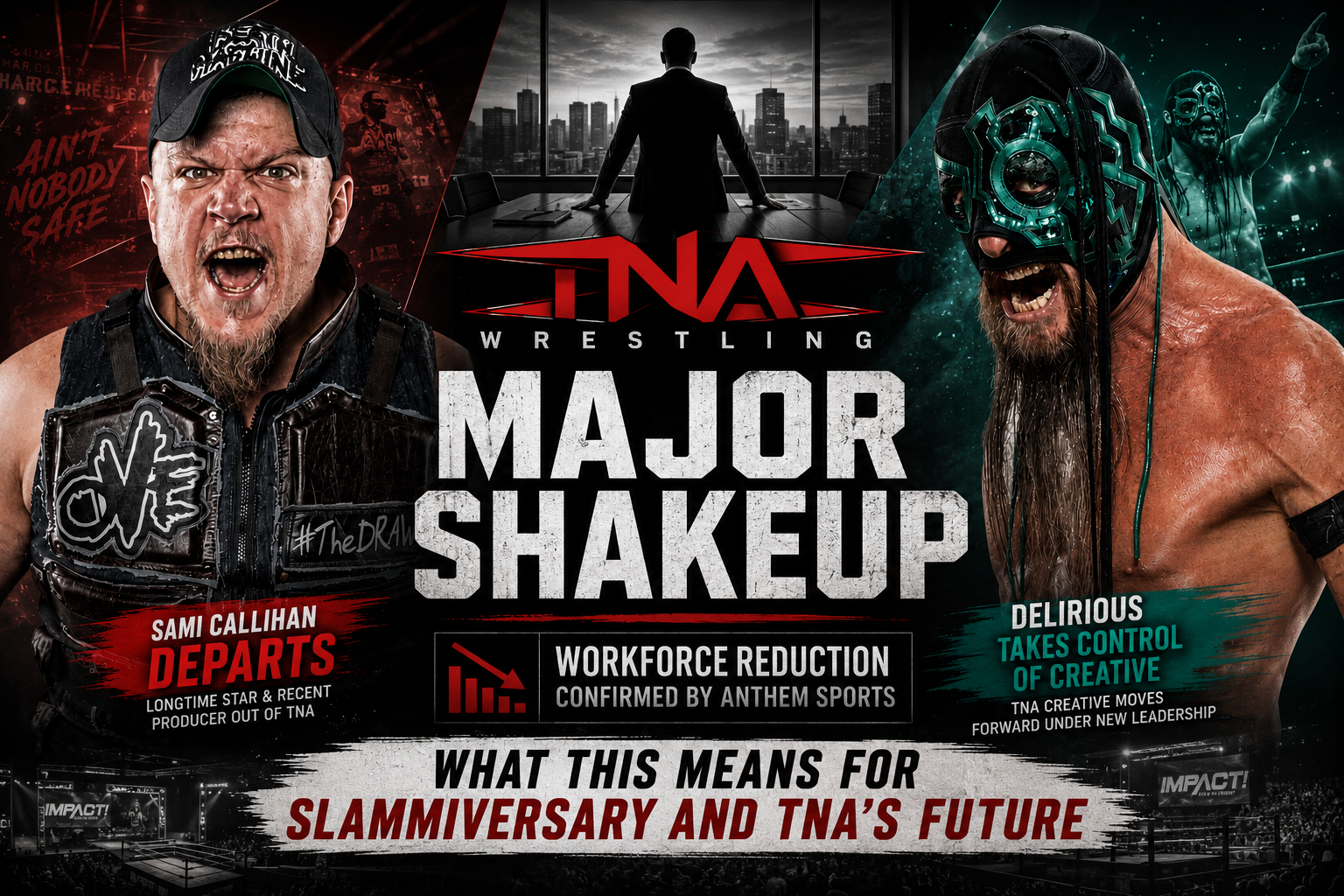
Anthem Sports & Entertainment confirmed Wednesday that TNA is undergoing a workforce reduction intended to streamline operations, sharpen the company’s strategic focus and improve profitability. The announcement formally confirmed Tommy Dreamer’s departure from his roles in creative and talent relations, as well as Tessa Blanchard’s release, while acknowledging that other unnamed employees are also leaving.
PWInsider subsequently reported that Sami Callihan has departed the company after recently transitioning into a backstage producer role. WrestlePurists also relayed PWInsider’s reporting that Hunter Johnston, better known to wrestling fans as Delirious, is expected to remain the central figure leading TNA creative moving forward.
Taken together, these are not isolated departures or routine roster adjustments. TNA is reducing expenses, consolidating authority and attempting to reshape its internal operation less than two weeks before Slammiversary—and only months into the company’s multi-year television agreement with AMC Networks.
Sami Callihan’s TNA Run Ends Behind the Curtain
Callihan’s departure closes the door on a relationship with TNA that began at Bound for Glory in November 2017, when he debuted as the leader of Ohio Versus Everything alongside Jake and Dave Crist.
His arrival helped define one of the strongest periods of the post-Spike TV era. Callihan was abrasive, unpredictable and completely different from the polished television wrestling archetype. His programs with Eddie Edwards, Pentagon Jr., Brian Cage and Tessa Blanchard gave TNA a genuinely dangerous antagonist capable of making feuds feel personal rather than manufactured.
Callihan reached the top of the company in October 2019 by defeating Cage inside a steel cage to win the Impact World Championship. His reign was ultimately designed to lead into Blanchard’s historic victory at Hard to Kill in January 2020, but that does not diminish his importance to the story. Callihan was the villain who gave the moment its emotional weight.
After leaving when his contract expired in 2023, he returned at Rebellion in April 2024. His second run never reached the creative heights of the first, but it eventually gave him a meaningful closing chapter. Callihan lost a career-threatening Baltimore Street Fight to Mike Santana at Emergence in August 2025 and left his boots in the ring, bringing his full-time in-ring career to an end.
He remained with TNA behind the scenes, working as a producer and contributing to the company’s live-event operation. That move was not ceremonial. Callihan already had valuable experience running Wrestling Revolver, organizing shows, developing talent and structuring the type of violent, emotionally driven matches that became his specialty.
His exit therefore removes more than another recognizable former champion. TNA is losing someone who understood the promotion as a performer, locker-room veteran, independent promoter and backstage producer.
Delirious Becomes TNA’s Undisputed Creative Point Person
The latest reporting does not mean Delirious is suddenly receiving TNA’s creative job for the first time.
Johnston joined the company as a writer and producer in 2023 after spending years as a wrestler, trainer, producer and influential creative figure in Ring of Honor. He was elevated to lead TNA creative in March 2025 following the departure of former executive producer Ariel Shnerer.
Dreamer remained an important part of the creative team while also working in talent relations. His departure now removes another experienced voice from the room and leaves Delirious as the clearest point person in the department, although additional creative personnel could eventually be added.
That gives TNA continuity at an unstable moment. Delirious already knows the roster, the current television direction and the plans heading into Slammiversary. The company is not handing control to an outsider who must learn everything during the final stages of building one of its biggest events.
However, continuity also eliminates excuses.
Delirious has already held substantial creative authority for more than a year. The current product—with its strengths, repeated matchups, uneven pacing and occasional lack of urgency—is not something he is merely inheriting. With Dreamer gone and his authority consolidated, the direction of TNA television will now be judged more directly as his vision.
A Workforce Reduction During TNA’s AMC Expansion
The most significant language in Anthem’s statement was not attached to any individual departure. It was the company’s open acknowledgment that the cuts are being made with profitability in mind.
TNA entered 2026 celebrating a multi-year agreement that moved Thursday Night iMPACT! to AMC and AMC+, giving the promotion its strongest American television platform in years. The move expanded TNA’s potential audience and was promoted as a major step forward after years of operating on AXS TV.
A larger television home, however, does not guarantee that the entire operation immediately becomes profitable.
Producing weekly programming for a more prominent network can increase production, staffing, travel, venue and talent expenses. The financial terms of TNA’s AMC agreement have not been publicly disclosed, making it impossible to determine how much guaranteed revenue Anthem receives or how the costs of producing the program are divided.
The workforce reduction does not prove that the AMC partnership is failing, nor is there any indication that TNA is losing its television home. It does show that the new deal has not removed the need for Anthem to control expenses and demand a more efficient operation.
That creates the central question surrounding these changes: Is TNA cutting genuine redundancy, or is it removing experienced people the product will eventually miss?
A leaner company can be healthier when responsibilities overlap and costs outgrow revenue. But professional wrestling depends heavily on relationships, communication and institutional knowledge. Creative and talent-relations responsibilities cannot always be absorbed as cleanly as ordinary corporate positions.
Slammiversary Must Reestablish the Conversation
The timing is difficult for TNA.
Slammiversary takes place June 28 at Boston’s Agganis Arena, with Mike Santana defending the TNA World Championship against Nic Nemeth in the main event. The card also includes a three-way ladder match for the TNA World Tag Team Championship and several major divisional programs.
Instead of entering the final promotional stretch with the conversation centered entirely on Santana, Nemeth, the championships and the teased return of Amazing Red, TNA is now answering questions about layoffs, backstage morale and the stability of its operation.
The creative plans are likely too advanced to be significantly rewritten, and Delirious was already leading the department before Dreamer’s exit. The immediate concern is not necessarily that Slammiversary’s card will collapse. It is whether the company can prevent uncertainty behind the scenes from bleeding into the final product.
Slammiversary now needs to feel decisive. Santana must emerge looking like a genuine franchise-level world champion. The tag-team ladder match must strengthen the division rather than exist solely as a spectacle. At least one younger performer must leave Boston feeling more important than they did entering it.
Most importantly, TNA must present a show that feels stable, ambitious and prepared. After publicly reducing its workforce, the company cannot afford for one of its signature events to appear cheaper, disorganized or creatively directionless.
What This Means for TNA Moving Forward
TNA has spent the last several years telling fans that it is growing: the company restored its historic name, expanded its relationship with WWE and NXT, increased its live-event ambitions and secured the AMC agreement.
Those developments are real, but growth is not measured only by announcements. It is measured by whether increased visibility creates sustainable business, stronger television and stars who become synonymous with the promotion.
TNA must now prove that “streamlining” means a more focused company rather than a smaller version of the same uneven product.
The AMC platform gives TNA a better opportunity to reach viewers, but the promotion still needs a distinctive identity once those viewers arrive. WWE crossover appearances can create interest, but TNA cannot become dependent on another company’s talent to make its own television feel important. Nostalgic returns can reward longtime supporters, but they cannot substitute for building the next generation.
For fans, skepticism is justified. The company is asking its audience to celebrate its strongest television platform in years while simultaneously acknowledging that improving profitability requires staff reductions. Both realities can exist at once, but TNA’s actions must eventually reconcile them.
Losing Dreamer removes an important connection between creative and talent relations. Losing Callihan removes a veteran who understood TNA’s identity both inside and outside the ring. Placing greater responsibility on Delirious creates clarity, but it also places the success or failure of the weekly product more directly on his shoulders.
This does not have to become the beginning of another TNA decline. Cost control could protect the company and its AMC future if Anthem has correctly identified what can be eliminated without damaging the product.
But cuts alone are not a strategy.
TNA must follow them with clearer storytelling, more disciplined roster construction, meaningful development of younger talent and a stronger reason for viewers to choose iMPACT! every Thursday. Otherwise, the company will have reduced its expenses without solving the creative and commercial problems that made those reductions necessary.
Slammiversary is now more than TNA’s annual anniversary celebration. It is the first major opportunity to show that this restructuring has not weakened the company at the exact moment it is supposed to be moving forward.
Make sure to subscribe to our Late Night Crew Wrestling YouTube Channel. Follow @yorkjavon, @kspowerwheels & @LateNightCrewYT on X.
I’m the quiet one until the bell rings then I’ve got takes. I live for WWE NXT and TNA, I want every promotion to succeed, and I will absolutely roast the bad decisions on sight (because someone has to). Anime taught me to respect long-term storytelling; wrestling taught me that sometimes the plan is “we panicked” and called it “unpredictable.” The Miz got me into all of this, so yeah I appreciate confidence, commitment, and the art of talking like you’re already the main event. Now I bring that same energy to the page as the main writer for Late Night Crew Wrestling because if you’re not here to be must-see and tell the truth, why are you here?!