
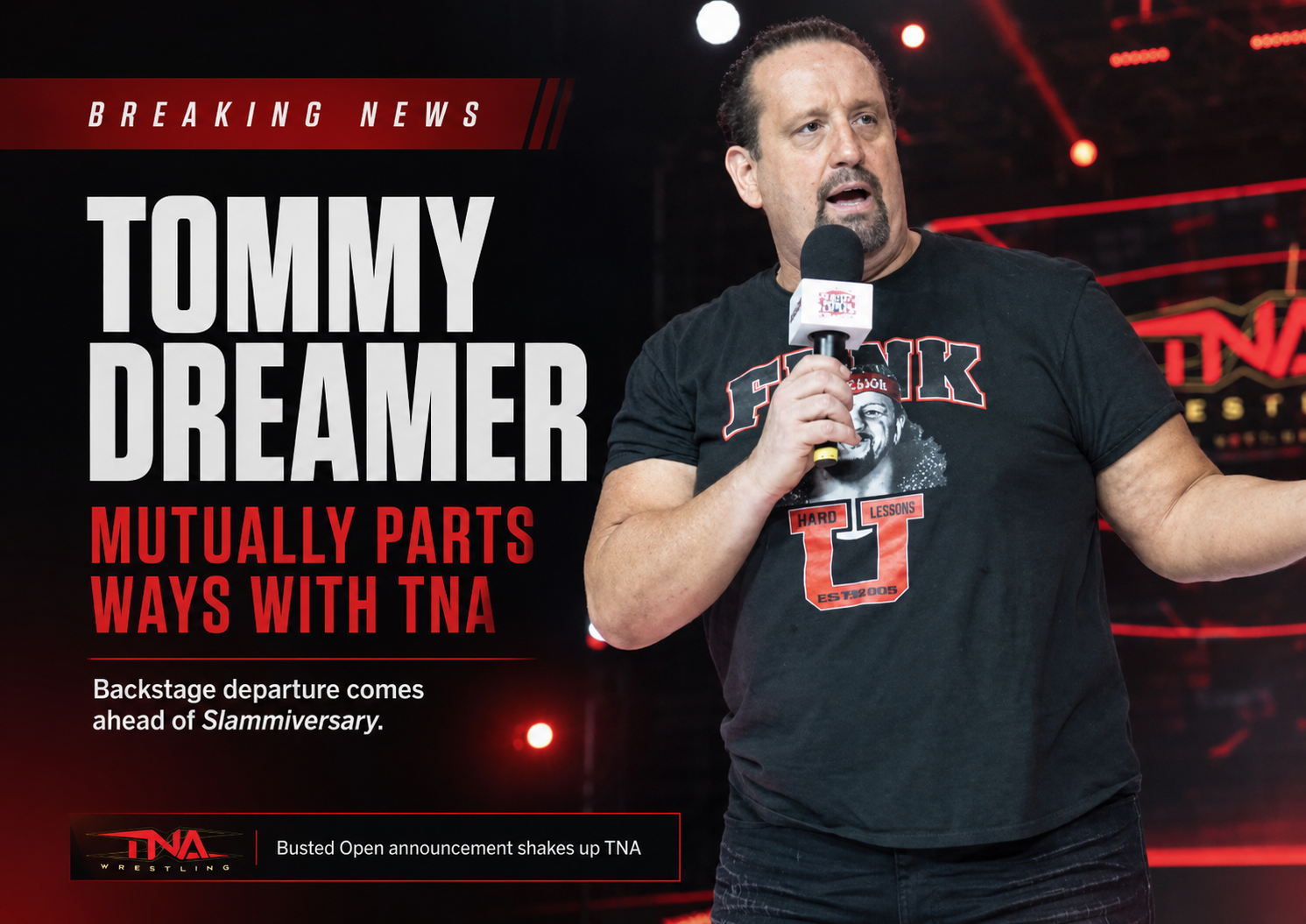
Tommy Dreamer has officially parted ways with TNA Wrestling, ending a run that made him one of the company’s most important backstage figures at the exact moment TNA can least afford more instability.
Dreamer announced the news Wednesday on Busted Open Radio, confirming that he and TNA had mutually agreed to separate. The announcement was emotional. Dreamer paused repeatedly, looked away from the camera and wiped his eyes while trying to explain that a relationship he had invested years into was over.
He did not attack TNA, blame company president Carlos Silva or expose the private conversations behind the decision. He remained respectful even while clearly struggling with the reality of leaving.
That professionalism should not be used to downplay what happened.
Dreamer was not simply an aging wrestler making occasional television appearances. He had become one of TNA’s most influential backstage figures, contributing to creative, working as a producer and agent, helping recruit talent and leading talent relations after the company’s major March 2025 restructuring.
When Gail Kim and several other longtime employees were removed, Delirious was placed in charge of creative while Dreamer took control of talent relations. Both reported directly to Silva.
Dreamer became one of the primary connections between management and the locker room. He was someone talent could approach about contracts, creative frustrations, television opportunities and their position within the company. He also played a meaningful role in recruiting wrestlers and selling them on the idea that TNA could provide something more personal and fulfilling than simply being another stop between larger promotions.
His departure therefore creates more than one hole.
TNA has lost a creative voice, a recruiter, a producer and one of the few people capable of delivering management’s decisions to wrestlers without sounding like a corporate spokesperson reading from a script.
Dreamer was not above criticism. TNA’s weekly creative direction has often been disorganized, repetitive and strangely passive. Promising stories have lost momentum. Wrestlers have disappeared from focus without explanation. Characters have gone weeks without meaningful development, and too many programs have felt like ideas introduced without a convincing plan for where they were supposed to go.
As one of the company’s leading backstage figures, Dreamer shared responsibility for that.
Being respected, hardworking and emotionally invested does not make someone immune from criticism. If TNA believed the creative and talent-relations structure was not producing the necessary results, then making a change was reasonable.
The problem is that Dreamer’s exit does not exist in isolation.
It comes during a stretch of departures that has made TNA look less like a company confidently entering a new era and more like one still trying to decide what that era is supposed to be.
On June 7, TNA announced the releases of former world champion Steve Maclin and Myla Grace. Both reportedly requested to leave. Maclin’s situation was especially damaging because he was still a credible upper-card performer and had reportedly grown frustrated with his creative direction.
That is not a minor detail.
When a former world champion who should still have value asks to leave because the company cannot provide him with satisfying direction, the issue is not simply one unhappy wrestler. It is evidence that the system responsible for keeping talent engaged was not working as well as TNA would like people to believe.
Nine days later, Tessa Blanchard requested and received her release while remaining connected to CMLL.
Blanchard’s return was always a gamble. TNA accepted the backlash, invested television time in rebuilding her character and positioned her as one of the most visible names in the Knockouts division. Allowing her to leave before that investment produced a major championship run or a meaningful conclusion makes the entire experiment look incomplete.
Dreamer is now gone immediately afterward.
Within less than two weeks, TNA has lost a former world champion, a developing women’s wrestler, one of the most recognizable performers in the Knockouts division and a central backstage leader.
Each departure may have a different explanation. Together, they create a pattern that cannot be dismissed with a series of polite statements about mutual decisions and requested releases.
TNA is losing people from several levels of the company at the same time.
That does not mean the promotion is collapsing. It does mean the company has a growing retention problem, a creative problem or both.
The timing makes the situation worse.
Slammiversary takes place Sunday, June 28, at Agganis Arena in Boston, with Mike Santana defending the TNA World Championship against Nic Nemeth in the main event. It is supposed to be one of the company’s biggest shows of the year and the event that establishes TNA’s direction for the second half of 2026.
Instead, the build is now competing with questions about who is leaving, who is unhappy and who is actually running the company.
Dreamer’s departure comes less than two weeks before the event. Current storylines, match finishes and post-Slammiversary plans may have been developed with his involvement. TNA now has to decide whether to continue using those ideas, quietly rewrite them or move immediately toward a new creative structure.
None of those options is ideal this close to a major event.
Keeping the existing plans may provide short-term stability, but it would mean continuing to execute a roadmap partly designed by someone who no longer works there.
Rewriting too much could result in rushed television, confused talent and finishes that exist only to clear the board for new leadership.
The safest route is to complete the major stories already in progress and begin the full transition after Slammiversary. But that only works if somebody is already prepared to take ownership of what comes next.
Slammiversary cannot merely be a good night of wrestling. TNA has had plenty of good matches. The company’s problem has rarely been a total lack of in-ring talent.
The show needs to feel like the beginning of something rather than another event that temporarily distracts from everything happening behind the scenes.
Mike Santana’s world-title reign needs definition. His program with Nic Nemeth cannot survive on mutual respect and championship ambition alone. Santana is supposed to represent TNA’s present, but the company has too often booked his reign as though holding the title is the story rather than giving him an actual story to carry.
The Knockouts division needs a clear plan after Blanchard’s departure and the earlier loss of Gail Kim’s backstage influence. The division cannot continue trading on its history while failing to establish a compelling modern identity.
The X Division must remain more than a collection of athletic matches with interchangeable challengers.
The tag-team division needs direction beyond nostalgia and established names.
TNA also has to prove that its own wrestlers remain the priority while continuing its relationship with WWE and NXT.
The WWE partnership has created valuable exposure, but it has also made TNA’s position increasingly complicated. When NXT wrestlers receive major opportunities inside TNA, the company must make sure its own contracted talent do not look like supporting characters on their own show.
TNA cannot build a sustainable identity by presenting itself as WWE’s friendly side project.
That relationship should strengthen TNA, not define it.
Dreamer’s departure removes one of the more recognizable wrestling voices inside that structure. Whatever flaws existed in his creative work, he understood the importance of TNA feeling like its own company.
The responsibility now falls even more heavily on Silva, Delirious and whoever inherits Dreamer’s duties.
The AMC television deal raises the stakes considerably.
TNA and AMC announced a multi-year agreement in December 2025, moving Thursday Night Impact to AMC and AMC+ beginning in January. It gave the company its strongest United States television platform in years and created a real opportunity to move beyond the low expectations that had followed TNA through years of survival.
But a larger television platform does not fix a promotion by itself.
AMC gives TNA access to more viewers. It does not create stronger stories, repair locker-room frustration, establish new stars or provide the company with a clear identity.
A bigger network simply puts the existing product in front of more people.
If the show is focused, consistent and emotionally engaging, AMC can help TNA grow.
If Impact remains uneven, directionless and dependent on former WWE names, nostalgia and outside partnerships, AMC will only make those weaknesses easier to see.
There is no credible evidence that the television deal is currently in danger or that AMC is unhappy with the company. Suggesting otherwise would be irresponsible.
However, TNA should not need a warning from AMC before understanding that repeated departures and backstage changes during the first year of a major television agreement are not a good look.
The company finally has a platform capable of helping it grow. It is now losing key people while still trying to establish what its television product is supposed to be.
Dreamer publicly celebrated the AMC agreement and spoke like someone preparing to help guide TNA through its next stage. Only months later, he is gone.
That contrast is difficult to ignore.
The larger issue is not simply whether Dreamer was right or wrong for the job. It is whether TNA has a stable enough internal structure to take advantage of the biggest opportunity it has received in years.
Scott D’Amore was removed in February 2024.
Gail Kim and other longtime backstage figures were removed in March 2025.
Dreamer was elevated during that restructuring and is now gone as well.
At some point, TNA’s leadership has to stop presenting every major change as an isolated decision and explain—through the quality of the product—what the actual plan is.
Carlos Silva now owns the result.
If Dreamer was no longer the right person to lead talent relations or contribute to creative, Silva must install someone better.
If Maclin left because he had lost confidence in his creative direction, Silva must make sure other valuable wrestlers do not reach the same conclusion.
If TNA invested in bringing Blanchard back only to let her leave before the story reached a meaningful payoff, the company must examine why the relationship failed.
Leadership cannot continually change the people beneath it while treating the people at the top as spectators.
TNA is not dying. It still has a valuable television agreement, recognizable wrestlers, promising younger talent, an active partnership with WWE and major events scheduled for the remainder of the year.
But survival is no longer the standard.
TNA has spent years asking to be taken seriously. AMC gave the company an opportunity to prove it deserves that respect.
Now the company has to act like it.
Dreamer’s departure does not destroy TNA, but it removes someone who helped connect management, creative, recruiting and the locker room.
Slammiversary will show whether TNA can steady itself in the short term.
The months that follow will show whether this was a necessary change made by leadership with a clear vision—or another backstage shake-up from a company that secured a bigger platform before fully figuring out what it wanted to become.
Make sure to subscribe to our Late Night Crew Wrestling YouTube Channel. Follow @yorkjavon, @kspowerwheels & @LateNightCrewYT on X.
I’m the quiet one until the bell rings then I’ve got takes. I live for WWE NXT and TNA, I want every promotion to succeed, and I will absolutely roast the bad decisions on sight (because someone has to). Anime taught me to respect long-term storytelling; wrestling taught me that sometimes the plan is “we panicked” and called it “unpredictable.” The Miz got me into all of this, so yeah I appreciate confidence, commitment, and the art of talking like you’re already the main event. Now I bring that same energy to the page as the main writer for Late Night Crew Wrestling because if you’re not here to be must-see and tell the truth, why are you here?!