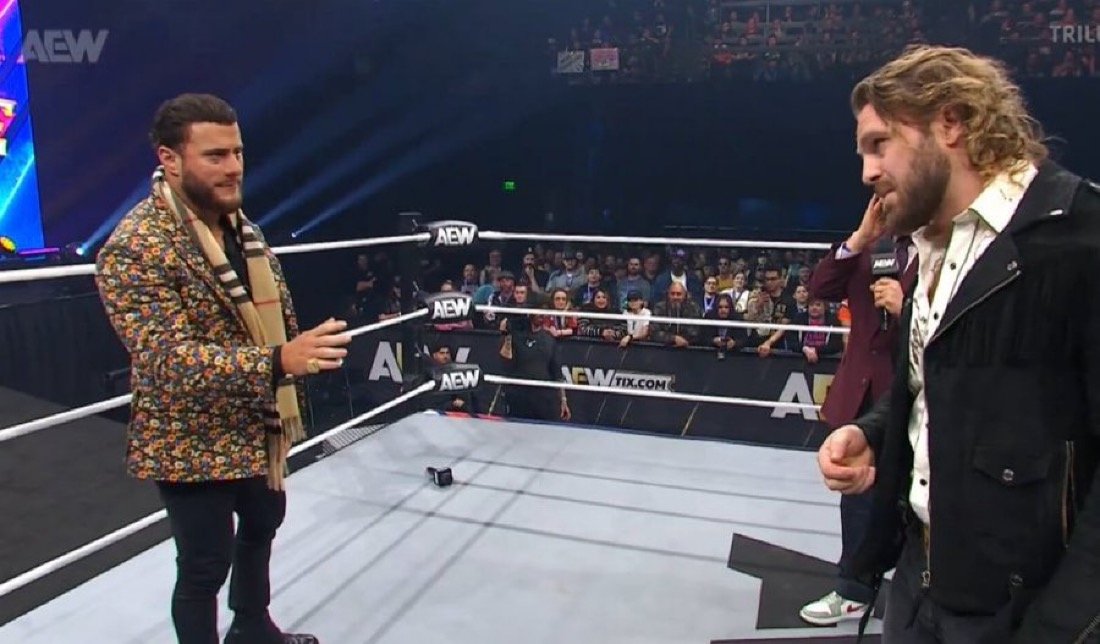
AEW rolled into Denver with a Revolution mandate: stop circling the pay-per-view and start locking it in. “Mile High Madness” wasn’t built like a placeholder episode; it was built like a fuse. Jon Moxley opened the night by reminding everyone why his brand of championship wrestling is so hard to derail, Gabe Kidd turned Orange Cassidy’s “I can outlast anything” philosophy into a cautionary tale, and Brody King reintroduced himself as a walking problem—then promptly aimed that problem at Swerve Strickland. But everything orbited the same gravity well: MJF vs. Hangman Page. In a segment that weaponized MJF’s greatest strength (manipulation) and his biggest blind spot (overconfidence), AEW didn’t just announce a stipulation—they cornered the champion into it. By the time the Anything Goes main event detonated, Dynamite felt less like weekly TV and more like AEW’s thesis statement heading into Revolution: this is what escalation looks like when consequences are real.
Here are the full results
- Jon Moxley def. El Clon (Continental Championship Eliminator)
- Gabe Kidd def. Orange Cassidy
- Kevin Knight def. Mansoor
- Babes of Wrath (c) def. MegaBad via DQ (AEW Women’s World Tag Team Championship)
- Brody King def. Mark Davis
- Jack Perry, The Young Bucks & The Rascalz def. Ricochet, Gates of Agony & FTR (Mile High Madness: Anything Goes)
The night in detail: recap, analysis, storyline history, and Revolution significance
Jon Moxley vs. El Clon: the champion doesn’t “survive”—he outlasts
Moxley’s best title matches don’t begin with wrestling; they begin with refusing to be moved. El Clon came in as the kind of challenger who can turn a champion’s power into air—speed, angles, and timing meant Mox couldn’t just bully his way through the opening minutes. That’s the entire point of an eliminator: not to convince you the champ is losing, but to show you how the champ wins when Plan A doesn’t work.
Moxley’s answer was the same answer it always is: drag the fight into deep water, make every exchange cost, and force his opponent to prove they can be brilliant and durable. El Clon flashed enough to feel like more than “a good hand,” but the closing stretch belonged to the champion—Moxley didn’t out-sprint him; he made him crash.
Revolution build: AEW’s message is clear: if you’re coming for Moxley’s title, you don’t just need a style advantage—you need a survival plan. That matters because Revolution season always tempts challengers into thinking they can “steal” a win from Moxley. Dynamite reminded everyone that stealing from Moxley usually ends with you leaving empty-handed and changed.
Gabe Kidd vs. Orange Cassidy: the moment the fun stops being protection
Orange Cassidy’s greatest strength is also his greatest trap: fans believe he can endure anything because he always looks like he doesn’t care… until he does. Gabe Kidd attacked that myth from the first contact. This wasn’t a “wrestle the match Cassidy wants” situation; it was Kidd forcing Cassidy to wrestle a match Cassidy hates—ugly, mean, and won in the margins.
The finish told the whole story. Kidd didn’t beat Cassidy by being better; he beat him by being worse—using chaos, positioning, and the referee as accidental cover before sliding into the kind of cheap damage Cassidy can’t joke away. It wasn’t just a tainted win; it was a statement: your resilience doesn’t matter if I’m willing to break rules you won’t even reach for.
Then came the post-match escalation—Darby Allin entering the orbit turns this from “Kidd wants to climb” into “Kidd wants to hurt someone in a way the audience remembers.” Darby doesn’t arrive for debates. Darby arrives when violence becomes a language.
Revolution build: Kidd needed a defining win that didn’t bury Cassidy. AEW found the cleanest version of that compromise: protect Cassidy’s ability while elevating Kidd’s danger. With Darby involved, the feud now has a clear PPV-ready shape—grudge logic, risk logic, and a “who can go further” question that AEW crowds buy instantly.
Kevin Knight vs. Mansoor: a sprint with a purpose—post-Revolution seeds
The match itself was a burst: Knight hits hard, moves faster than your eyes want to track, and finishes with highlight-reel certainty. But the real meat is what AEW is doing with Knight around the World title picture. This was less about Mansoor and more about Knight occupying a very specific role: the man already calling his shot for the day after Revolution.
When challengers start speaking like inevitability, AEW usually has a plan. Knight isn’t being positioned as “future star.” He’s being positioned as “next problem.” That is how you keep a championship scene from feeling like it resets after the PPV.
Revolution build: While MJF vs. Hangman is the headline, Dynamite quietly built the ecosystem underneath it. If Hangman wins, there are challengers ready. If MJF wins, there are fresh contenders circling anyway. Either way, the title feels like the center of a living roster—not a belt trapped in one feud.
MJF and Hangman Page: the rigged coin, the public humiliation, and the Texas Death trap
This was the most important segment on the show because it answered the one question that matters: why would MJF ever agree to a stipulation that removes his escape routes? He wouldn’t—so AEW didn’t ask him to. They baited him.
Hangman wanted Texas Death. MJF wanted control. So MJF offered a coin toss… except the coin was a con. It’s classic MJF—turn “sport” into “scam,” then smirk while everyone realizes too late they’re playing his game. The twist is that Hangman didn’t play dumb. He demanded to inspect the coin, and the moment the ruse cracked, the segment shifted from negotiation into punishment.
Tony Khan’s ruling (delivered via authority on-screen) didn’t feel like a random decree; it felt like consequences. MJF tried to cheat reality, got caught in public, and the stipulation became his cage: Texas Death at Revolution.
Now layer in Hangman’s prior pledge—if he loses, he won’t challenge for the World title again. That’s not a “match stipulation.” That’s a character sentence. It reframes every Hangman decision as desperation with pride on top.
Revolution build: This segment didn’t just set the match type. It set the tone. Texas Death implies physical ruin; Hangman’s pledge implies spiritual ruin. MJF is walking into a match where the man across from him has fewer options and therefore more willingness to burn the world down.
Women’s World Tag Team Championship: the audible finish and the fallout
Babes of Wrath vs. MegaBad had the structure of a heated rematch—champions controlling, challengers looking for one clean moment to flip momentum—until the finish arrived like a record scratch: disqualification via outside interference.
The reality underneath the TV finish matters here: reports indicated Penelope Ford suffered an injury during the match, and the DQ was an audible designed to protect everyone and get out safely. That context doesn’t magically make the finish satisfying—but it makes it understandable. In-ring, a DQ in a title match often reads as “we’re selling you the rematch.” In real-time, it may have been “we’re protecting a wrestler and salvaging the segment.”
Revolution build: If Ford’s status forces changes, AEW now has to decide what MegaBad’s direction becomes—whether Megan Bayne stays in the tag lane with a pivot, or whether AEW uses this to shift Bayne toward singles gold while the tag story recalibrates. The one thing AEW did accomplish: Lena Kross gained heat as the chaos lever, and the champions stayed protected.
Brody King vs. Mark Davis: hoss violence, then a direct line to Swerve
This was a physical match designed to feel like two men trying to out-slam a wall. Davis is strongest when he turns fights into collisions; King is strongest when he makes collisions feel pointless. King winning wasn’t the end—it was the opening.
Post-match, King immediately pointed at the next chapter: Swerve Strickland. This is where AEW’s character work gets sharp. Swerve’s recent posture has been about identity—being seen as the most dangerous, the most elite, the guy who decides what the future looks like. Brody’s challenge is a direct rebuttal: If you want that reputation, you earn it against me.
Revolution build: This is a perfect PPV pairing because it doesn’t need a complicated twist. It needs one sentence: “You say you’re dangerous—prove it.” The match sells itself as a credibility fight that can tilt Swerve’s entire heel presentation one way or the other.
Mile High Madness Anything Goes: AEW’s chaos as storyline currency
The main event was the show’s title in match form—an Anything Goes multi-team war built to be less about rules and more about relationships. FTR and the Young Bucks have a rivalry that doesn’t need explanation at this point—AEW has escalated it into family-level hatred. Ricochet’s presence adds championship adjacency and athletic spectacle, while The Rascalz and Gates of Agony make the match feel crowded in the best way: more bodies, more angles, more possible betrayals.
The key outcome: Jack Perry pinned Ricochet. In AEW logic, that’s not just a finish. That’s a receipt that turns into a title claim. Perry didn’t pin a random opponent; he pinned a champion-level centerpiece in the chaos.
Revolution build: AEW accomplished three things at once:
- Kept Bucks vs. FTR burning without blowing off the PPV payoff.
- Handed Perry a direct reason to demand more from Ricochet.
- Made the show feel “can’t-miss” in the exact way Revolution season should feel.
What’s getting praised
- The Hangman/MJF stipulation segment: widely viewed as smart, character-consistent storytelling—MJF’s cheating backfiring in public made the Texas Death stip feel earned rather than forced.
- The main event delivering PPV energy on free TV: most coverage agreed “Mile High Madness” felt like AEW leaning into its strongest identity—chaos with stakes.
- Brody King’s return direction: King calling out Swerve reads as clean, logical, and immediately PPV-ready without overcomplication.
What’s getting criticized (or at least questioned)
- The Women’s tag title DQ finish: even with injury context, a DQ title finish is always divisive, and it became the most common “thumbs down” talking point of the night.
- Swerve’s heel framing vs. audience response: some analysis suggested Swerve’s presentation is cool enough that AEW still needs one more decisive “you must boo him” beat for the turn to fully land.
- Hangman’s “never challenge again” pledge: it adds massive drama, but it also invites scrutiny—some viewers love the gravity, others feel it risks melodrama if AEW ever has to write around it later.
The big-picture Revolution temperature after this Dynamite
Across coverage, the consensus read is that AEW’s build is strongest when it leans into consequences and character traps (MJF/Hangman), and slightly shakier when real-world variables (injuries) force finishes that feel anti-climactic. But the momentum is real: AEW left Denver with clearer PPV paths and fewer “we’ll see next week” placeholders.
AEW Dynamite March 4th, 2026
- Thekla (c) vs. Thunder Rosa (AEW Women’s World Championship)
AEW Collision Feb. 28, 2026
- Kris Statlander & Thunder Rosa vs. Sisters of Sin
- Don Callis Family (Rocky Romero, Trent Beretta, Josh Alexander & Lance Archer) vs. Death Riders (PAC, Wheeler Yuta, Daniel Garcia & Claudio Castagnoli)
- Tomohiro Ishii vs. Andrade El Idolo
- Toni Storm vs. Zayda Steel
- Kyle Fletcher & Kazuchika Okada vs. Top Flight
- Brawling Birds in action
- We’ll hear from AEW World Champion MJF
- We’ll hear from AEW Women’s World Champion Thekla
Final Thoughts
“Mile High Madness” was Dynamite doing what AEW does best when the calendar turns toward a major PPV: raise the violence, sharpen the motivations, and make the next step feel unavoidable. The night’s most effective work wasn’t just match quality—it was how each major beat reinforced Revolution as the destination rather than an abstract idea.
The centerpiece was the MJF–Hangman stipulation segment, because it didn’t rely on authority figures yelling or forced drama. It relied on character truth. MJF tried to engineer an outcome with loopholes and leverage, and Hangman—too often portrayed as emotionally reactive—finally came across as the man who learned from every past heartbreak. That’s the kind of angle that doesn’t just “announce a stip,” it justifies the stip, and it reframes Revolution as a match where MJF’s usual toolkit might not matter.
In the ring, the show’s pacing was built around two pillars: credibility wins and controlled chaos. Moxley’s opener reinforced the idea that beating him requires something beyond athletic excellence—you have to survive his world. Gabe Kidd’s win over Orange Cassidy pushed Kidd forward without flattening Cassidy, then Darby’s involvement turned that rivalry from competitive to personal. Brody King’s victory and immediate callout of Swerve gave AEW a clean, logical PPV-level fight that’s rooted in identity and reputation, not random attacks.
The main event was exactly what it needed to be: a spectacle that advanced multiple stories at once, with the key takeaway being Jack Perry pinning Ricochet—an outcome that feels like a future title claim written in ink, not pencil. If AEW’s goal was to send fans into the weekend feeling like Revolution season is heating up in multiple lanes, the closer absolutely delivered.
The one major blemish—at least from a viewer satisfaction standpoint—was the women’s tag title DQ finish. Even if it was dictated by injury circumstances, that doesn’t change how it plays on television: DQ title endings often feel deflating, and the crowd reaction reflected that. AEW’s next move here matters, because the follow-up will determine whether that finish becomes a necessary pivot that protects momentum… or the start of a storyline stall.
Overall, this Dynamite felt like AEW tightening bolts: less “we’ll see,” more “here’s what it is.” If the next couple weeks maintain this balance—stipulations that make sense, contenders who feel credible, and chaos that produces clear consequences—Revolution is on track to feel like a culmination, not just another stop on the schedule.
Make sure to subscribe to our Late Night Crew Wrestling YouTube Channel. Follow @yorkjavon, @kspowerwheels & @LateNightCrewYT on X.
I’m the quiet one until the bell rings then I’ve got takes. I live for WWE NXT and TNA, I want every promotion to succeed, and I will absolutely roast the bad decisions on sight (because someone has to). Anime taught me to respect long-term storytelling; wrestling taught me that sometimes the plan is “we panicked” and called it “unpredictable.” The Miz got me into all of this, so yeah I appreciate confidence, commitment, and the art of talking like you’re already the main event. Now I bring that same energy to the page as the main writer for Late Night Crew Wrestling because if you’re not here to be must-see and tell the truth, why are you here?!