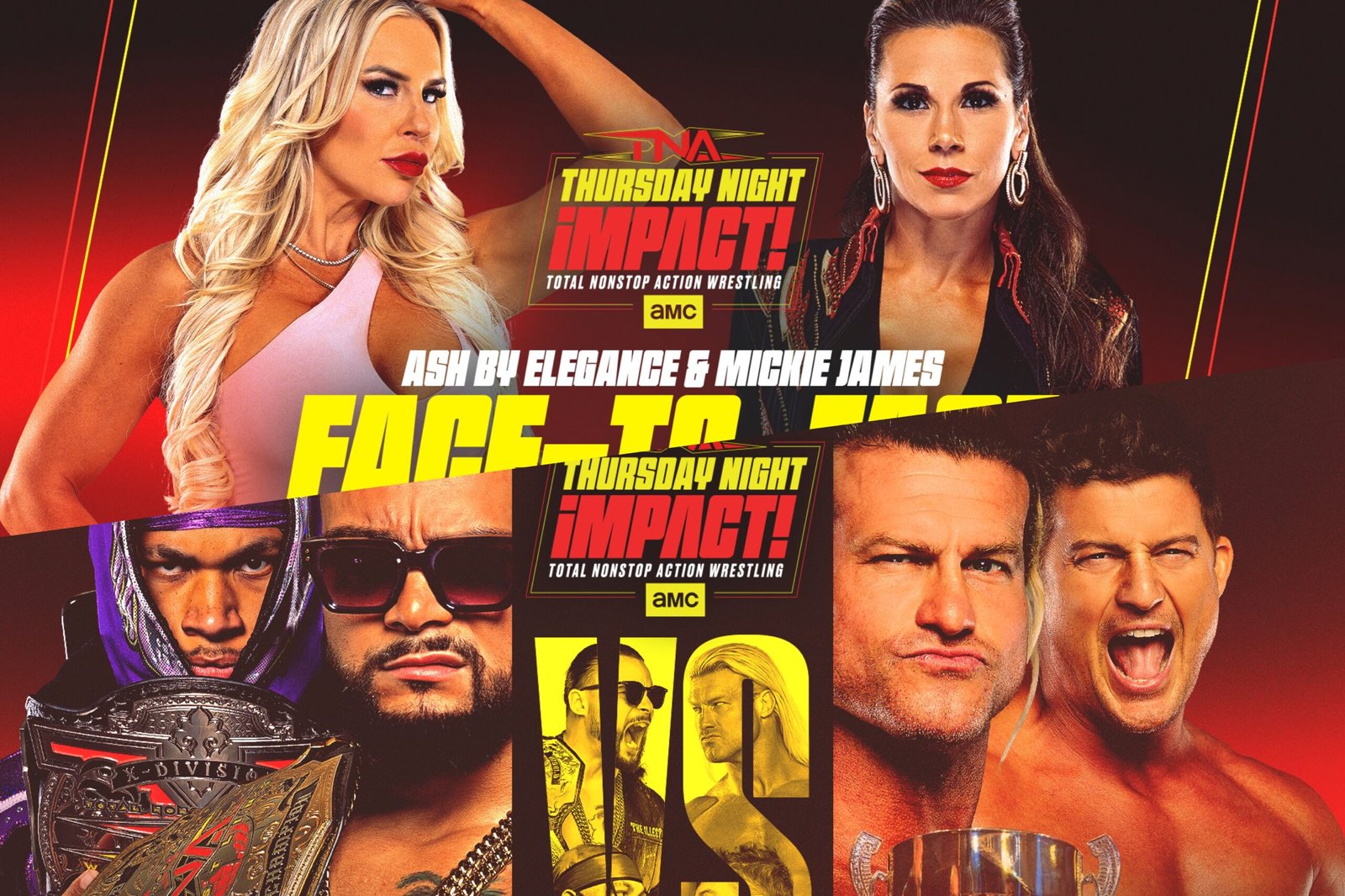
TNA’s AMC-era iMPACT has increasingly felt like a weekly checkpoint that actually matters, and tonight’s episode from Nashville is built like a crossroads: the company is juggling faction warfare, championship-adjacent positioning, and a Knockouts program that’s leaning hard into legacy as a weapon. The show’s spine is simple—prove your momentum is real on television, or get swallowed by the next month’s gravity toward Sacrifice on March 27 at the Alario Center (TNA+).
Here is everything advertised for tonight’s show
- The Hardys & The Righteous vs The System
- Mike Santana & Leon Slater vs Nic Nemeth & Ryan Nemeth
- AJ Francis vs Mance Warner
- Dani Luna vs Léi Yǐng Lee
- Jada Stone vs Tasha Steelz
- Ash By Elegance & Mickie James Face to Face
Breakdown, analysis, significance, storyline history, and the real praise/criticism
The Hardys & The Righteous vs The System: spectacle vs structure
This is the kind of match that tells you what TNA thinks its television identity is right now. The Hardys remain the most reliable “instant electricity” act on the roster—crowd response, greatest-hits pacing, and that feeling that anything can break open into chaos. The System, meanwhile, are presented as the promotion’s order-of-operations villains: more machine than individuals, a unit designed to win space, control tempo, and make everything feel like it requires permission. TNA’s own preview frames the night as rivalries igniting and alliances forming—this is that thesis in one match.
Why it matters for Sacrifice: Eight-man tags are often “safe storytelling,” but the finish will show intent. If the ending is decisive, it suggests TNA wants The System stabilized as a power center heading into March. If it’s messy—post-match, disputed pin, or the wrong man eating the fall—it screams Sacrifice blowoff.
What’s being praised: outlets covering the AMC run have repeatedly noted that TNA is doing the basics correctly—clear advertising, clear match hooks, and straightforward main-event framing. When the card is easy to understand, fans are more willing to invest in the weekly product.
What’s being criticized: the company’s reliance on chaotic finishes across multiple angles has become a pattern, and when everything ends in disorder, disorder stops feeling special. That’s the tightrope here: brawl energy is great, but “every story needs a run-in” can exhaust the audience.
Santana & Slater vs The Nemeths: champions fighting for credibility, challengers fighting for leverage
This is the quiet headline match, because it’s essentially a political argument in tag form. Santana and Slater carry championship aura into a non-title environment, which typically means the promotion is testing one of two things: can the champions absorb a protected loss to launch a title program, or can the challengers be elevated without taking the belts off the champs? ProWrestling.net highlighted the match as the key advertised attraction, and TNA’s own preview leans into the importance of the confrontation.
Storyline logic: The Nemeths don’t need belts to feel dangerous—they need proximity to belts. This is how TNA creates that proximity without announcing a title match too early.
Sacrifice forecast: If Nic or Ryan pins Santana or Slater, you’ve got instant justification for a Sacrifice title lane. If Santana/Slater win clean, then The Nemeths likely pivot to angle work—post-match heat, targeting a limb, or manufacturing controversy to keep their claim alive.
Praise vs critique from the wrestling press/fans: The praise is that this is a smart “television match that creates pay-per-view matches.” The critique, when it comes, tends to be about clarity—if the company wants Santana’s reign to feel definitive, it can’t constantly communicate “he’s a champion, but he’s always one segment away from chaos.”
Ash By Elegance and Mickie James: the Knockouts division turns “legacy” into a storyline weapon
Tonight’s face-to-face exists because the story has been carefully framed as more than a personal beef—it’s an argument about who gets to define the Knockouts history. TNA’s official preview positions Mickie’s AMC debut as direct fallout from the No Surrender attack, and broader coverage has emphasized how the Elegance Brand’s heat was engineered to make a legend’s return feel inevitable.
The deeper read: Ash’s character is built on curation—image, presentation, self-mythology. Mickie represents the opposite: credibility earned through wars, eras, and being there when the division’s reputation was built. That clash is why this program has “big match” gravity without needing a title attached.
Why it matters for Sacrifice: This is the kind of segment that either (1) locks in a marquee singles match for March, or (2) expands to a trios framework if TNA wants to keep the Elegance Brand’s tag identity central while still spotlighting Mickie. Either way, tonight is about establishing terms: does Ash control the narrative, or does Mickie force it into a fight?
What’s being praised: Mickie’s return has been treated as a meaningful injection of star power and historical weight—an angle that instantly makes the division feel bigger.
What’s being criticized: if the build leans too heavily on “social media heat” without translating it into decisive televised payoffs, audiences tend to label it as noise. The solution is simple: let the segment create a match with stakes, not just an exchange of lines.
Maclin with Hannifan: when TNA wants something to feel “serious,” it gives it a chair and a microphone
A sit-down interview is a tonal shift—it signals consequence. TNA’s preview explicitly says Maclin is breaking his silence, and that language usually means the next opponent or the next mission statement is about to be named.
Why it matters: Maclin functions as TNA’s credibility barometer. When his direction is clear, the upper-midcard feels organized. When it’s vague, the show can feel like a collection of angles rather than a progression toward Sacrifice.
AJ Francis vs Mance Warner: territory brawl as palette cleanser—and as a warning
This match is TNA leaning into the simplest professional wrestling promise: you embarrassed me, I’m going to hurt you. The official preview references the heated encounter that sparked the match, and it’s positioned as a collision that doesn’t require layers to work.
The upside: Warner is at his best when the match feels like a bar fight with rules. Francis is best when he can weaponize size, arrogance, and a sense of entitlement.
The risk: if the feud lives only in ambushes and “my room, your room” escalation without a definitive match outcome, fans will see it as spinning wheels. Tonight needs a finish that points somewhere—Sacrifice rematch, stipulation, or a pivot to a new target.
Dani Luna vs Léi Yǐng Lee and Jada Stone vs Tasha Steelz: undercard matches that can quietly define future contenders
TNA’s preview frames Luna/Lee as strength versus striking fury, and that’s a deliberate kind of language: it’s designed to make the match feel like a scouting report rather than a filler bout.
Jada vs Tasha, meanwhile, carries the “prove it without the noise” energy. When these matches hit, they become the kind of tape fans cite when arguing who deserves the next big spot.
Company-wide critique: where TNA is strong right now, and where it still trips itself
What TNA is doing well: This AMC stretch has been built with clearer advertising and tighter episodic themes than many past eras of iMPACT, and multiple top outlets echoed the focus on match-centric previews and direct hooks.
The recurring issue: too many stories across the company still default to the same vocabulary—interference, influence, run-ins, and “controversial” outcomes. That can protect talent, but it can also make victories feel interchangeable. Sacrifice season is where that has to tighten: payoffs need to be clean enough that fans believe the journey mattered.
Make sure to subscribe to our Late Night Crew Wrestling YouTube Channel. Follow @yorkjavon, @kspowerwheels & @LateNightCrewYT on X.
I’m the quiet one until the bell rings then I’ve got takes. I live for WWE NXT and TNA, I want every promotion to succeed, and I will absolutely roast the bad decisions on sight (because someone has to). Anime taught me to respect long-term storytelling; wrestling taught me that sometimes the plan is “we panicked” and called it “unpredictable.” The Miz got me into all of this, so yeah I appreciate confidence, commitment, and the art of talking like you’re already the main event. Now I bring that same energy to the page as the main writer for Late Night Crew Wrestling because if you’re not here to be must-see and tell the truth, why are you here?!