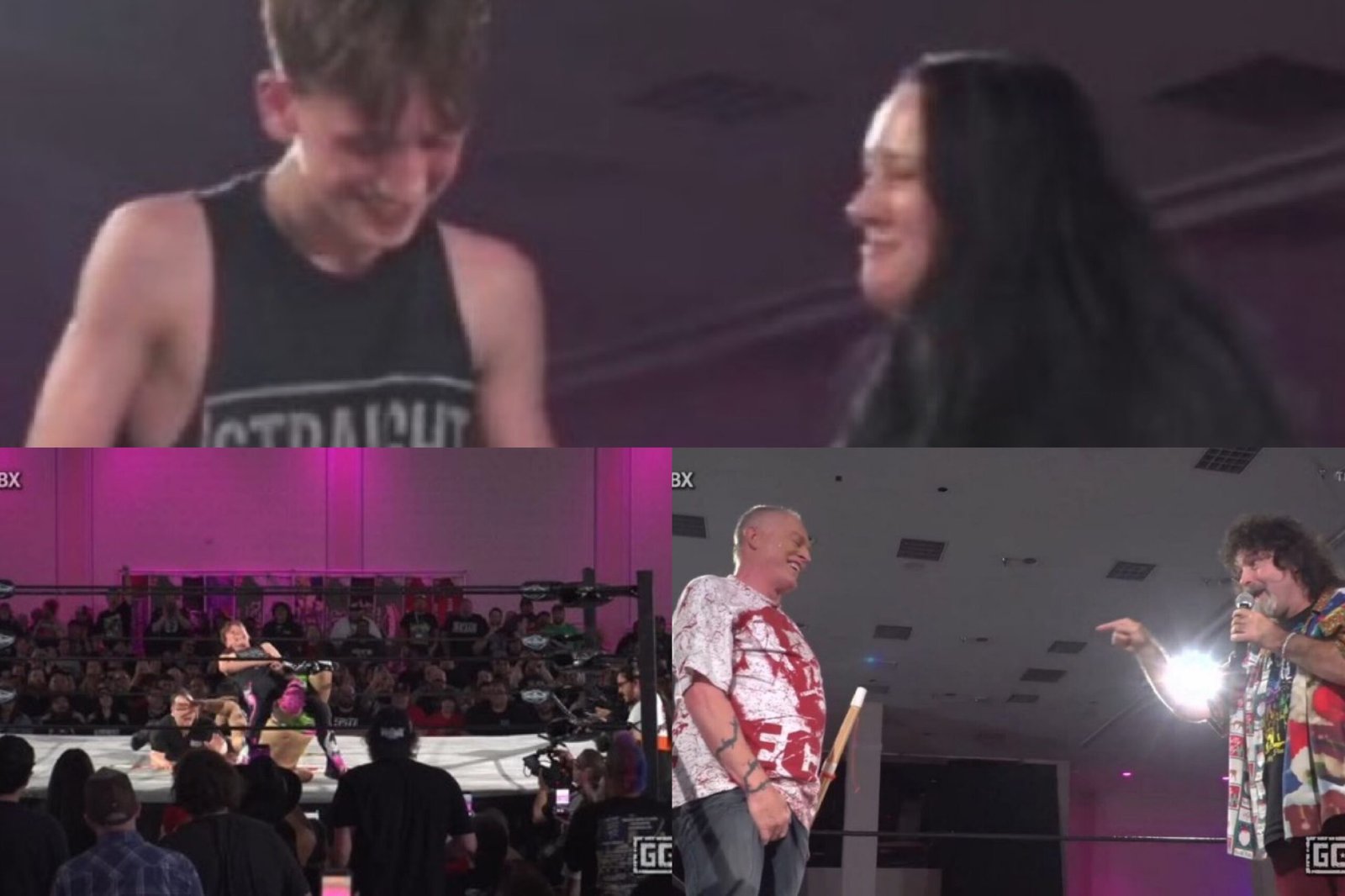
Joey Janela’s Spring Break X was never going to be a normal wrestling show, and it would have been a problem if it tried to be. The tenth Spring Break came to Las Vegas during The Collective with the same anything-can-happen identity that turned this event into one of WrestleMania week’s true institutions, but this year’s card also carried a little more pressure because anniversaries invite comparison. By the end of the night, Spring Break X delivered exactly the kind of card this brand is supposed to deliver: a mix of stunt-show insanity, hardcore violence, emotional fallout, ECW nostalgia, indie spectacle, and one genuinely memorable closing story that gave the whole night a stronger center than some past editions have had. The biggest headline was Brodie Lee Jr. beating Joey Janela in his first official singles match, but that was only part of the story. Sandman’s farewell leaned all the way into absurd chaos, Effy and Allie Katch gave the card its ugliest and most emotionally loaded fight, and the rest of the show kept swinging between spectacle and self-destruction in a way only Spring Break really can.
Here are the full results:
- 1 Called Manders def. Vipress, Bear Bronson, Terry Yaki, Shotzi Blackheart, Vengador, Sidney Akeem, Gringo Loco, Charles Mason, Man Like DeReiss, and Masato Tanaka
- The Rascalz def. Alec Price, Jordan Oliver, and Marcus Mathers
- Atticus Cogar (c) def. Hayabusa (GCW World Championship)
- Marko Stunt and Jack Perry def. Sam Stackhouse and KJ Orso
- The Invisible Man def. The Sandman
- Effy def. Allie Katch
- Nick Gage and Megan Bayne def. Steph De Lander and Mance Warner
- Brodie Lee Jr. def. Joey Janela
The main event was the match everybody was watching with the most curiosity, and it ended up being the strongest argument for why Spring Break still matters. The Brodie Lee Jr. story had been building for weeks after the angle where he pushed Janela too far, Janela responded violently, and the match stopped feeling like a novelty announcement and started feeling like an actual grudge match. That mattered, because this only works if the audience buys into the emotion first. Janela played his role exactly right as the smug bully who thought this would eventually become a lesson, while Brodie was presented as the kid fighting from underneath rather than some unbelievable prodigy already pretending to be a finished wrestler. The crowd had a clear emotional investment in seeing him survive, and the match smartly leaned into that instead of trying to force something beyond what it needed to be.
What made the finish hit was that it did not come off like charity. Brodie survived the piledriver, fired back with the Cross Rhodes and the discus lariat, then forced Janela to tap out with the sharpshooter. That was a huge call, and it was the right one. A flash pin would have protected Janela and still sent the fans home happy, but a submission win gave the result more weight and made the whole thing feel like a real breakthrough moment instead of a sentimental cameo ending. That is why so much of the reaction coming out of the show centered less on the controversy of the match existing and more on the fact that Brodie actually delivered in the spot. For a card built on chaos, that main event had surprising discipline.
That also says a lot about where Spring Break is at as a brand. The event built its reputation on outrageous matchmaking, late-night mania-week energy, and the idea that literally anything might happen, but the better editions usually have one or two segments that give the madness a real emotional anchor. This year, Brodie Lee Jr. vs. Joey Janela was that anchor. The show still had all the nonsense and excess people expect, but the main event gave it a story people will actually remember rather than just a collection of clips and cameos. That is a big reason this edition felt more complete than some Spring Break cards that were fun in the moment but harder to talk about the next day beyond the shock value.
Sandman’s final match was the total opposite kind of success. There was nothing disciplined about it, and that was the point. Sandman losing his final match to The Invisible Man is the kind of sentence that either perfectly explains Joey Janela’s Spring Break to you or makes you immediately hate it. The actual match went even further into that insanity, with Bill Alfonso involved, Invisible Stan showing up, a parade of run-ins and cameos, and the whole thing turning into an exaggerated wrestling fever dream before The Invisible Man stole the win. On one hand, it was ridiculous, overbooked, and impossible to defend as serious wrestling. On the other hand, it was exactly the kind of deranged farewell this brand was always going to give Sandman.
That segment is where the Spring Break praise and criticism meet in the middle. Fans who love this event love it because no other WrestleMania week show is this comfortable being openly stupid, deeply nostalgic, and completely committed to the bit. Fans who hate this event point to matches like this and say it is all self-indulgence with no guardrails. Both arguments were on display here. The Sandman farewell was not meant to be clean, emotional in a conventional sense, or even especially coherent. It was meant to be a Spring Break version of a goodbye, and that means smoke, beer, nonsense, and a crowd reacting to the vibe more than the mechanics. As a straight match, it was a mess. As a final Spring Break-style Sandman memory, it did what it was supposed to do.
The shadow hanging over that match, though, is the larger conversation Spring Break keeps inviting with these ECW-flavored retirement attractions. Last year it was Sabu. This year it was Sandman. That gives the event a certain grimy, dangerous aura that absolutely fits its identity, but it also keeps raising fair questions about how far nostalgia should be pushed and whether Janela’s brand sometimes leans too hard on the audience’s affection for broken-down legends. That tension is part of the Spring Break formula now. It helps the event stand out, but it also guarantees backlash every time one of these farewell matches gets announced.
Effy vs. Allie Katch ended up being the emotional low point of the night in the best and worst way. It was violent, ugly, and built around the kind of relationship damage that gives deathmatch wrestling something heavier to work with than just weapons and blood. The Loser Leaves GCW stipulation gave it obvious stakes, but the bigger story was the collapse underneath it. Effy came into the match spiraling, angry, and willing to do anything. Allie came in with the sense that she still understood who he used to be even if he did not anymore. The match played right into that dynamic, which is why it felt nastier than a regular plunder fight. This was not just violence for a pop. It was violence tied to a friendship breaking apart in public.
Effy winning and forcing Allie out of GCW gave the show one of its few results with immediate long-term fallout beyond WrestleMania week. That is important, because Collective shows can sometimes feel detached from the regular rhythm of a promotion. This did not. Allie leaving gives GCW a real story to deal with after the weekend, and it makes Effy’s current trajectory feel even darker. The post-match reaction around Allie made it clear the stipulation landed the way it needed to. There was emotion there, not just shock. That gave Spring Break X another piece of real narrative substance on a card that could have very easily drifted too far into spectacle-only territory.
The opener, Grab The Brass Ring, was pure Spring Break card-setting chaos. It packed in bodies, surprises, dives, and gimmick energy right away, with Masato Tanaka’s inclusion giving the match some extra historical flavor and Manders getting the win to leave with a tangible future prize. As an opener, it worked because it immediately reminded the crowd that Spring Break is not interested in easing into anything. The downside is the same downside these matches always have: when there are that many moving parts, several people are reduced to moments instead of stories. Still, as a tone-setter for this specific show, it absolutely did its job.
The Rascalz beating Alec Price, Jordan Oliver, and Marcus Mathers gave the card one of its cleaner in-ring showcases and helped break up the heavier gimmick material with something closer to straight-up athletic chaos. It was also a reminder of what makes The Collective work when it is functioning well. These cards are strongest when they balance nostalgia and spectacle with current indie names who make the week feel alive rather than purely retro. The Rascalz, Price, Oliver, and Mathers all fit that role, and the match helped the show avoid becoming too one-note.
Atticus Cogar retaining the GCW World Championship over Hayabusa was one of the more interesting results on paper and one of the least talked-about by the end of the night, which honestly says a lot about the kind of event this was. A world title match involving a character as central to GCW’s current identity as Cogar should normally be one of the lead stories. Here, it felt like part of the card rather than the card’s engine. That is not necessarily a knock on the match itself so much as it is a reminder that Spring Break is still built more around attractions, personalities, and moments than around championship hierarchy. The title was on the show, but it was not the show’s center of gravity.
Marko Stunt and Jack Perry beating Sam Stackhouse and KJ Orso added another nostalgia-heavy thread to the night, especially with Marko declaring he was back afterward. That was very much in line with the whole card’s philosophy. Spring Break X constantly rewarded fans who know wrestling’s overlapping history and who enjoy seeing old relationships, old names, and old vibes collide with the present in weird combinations. That approach can be messy, but it is also part of why these shows feel like events instead of just match lists.
Nick Gage and Megan Bayne beating Steph De Lander and Mance Warner gave the late portion of the card the ugly, weapon-filled escalation it needed before the main event. The surprise of Gage as Bayne’s partner instantly changed the energy in the room, and the match delivered exactly what that lineup promised: violence, plunder, chaos, and the kind of atmosphere that makes Spring Break feel dangerous even when the whole show is winking at you. The only real criticism there is fatigue. On a long show with multiple forms of chaos already happening, another hardcore spectacle can blur in with the rest unless there is a strong enough hook. Gage’s reveal was that hook.
The bigger picture is that Spring Break X did what this event needed to do in its tenth edition. It reminded people why this show is still one of the most talked-about non-WWE attractions of WrestleMania week. The attendance momentum heading into the event already showed that interest was still strong, and the card itself backed that up by giving fans multiple different kinds of talking points instead of just one. Brodie Lee Jr. gave the show its biggest emotional and headline-grabbing win. Sandman gave it its most ridiculous farewell. Effy and Allie gave it its most painful fallout. That is a pretty complete night by Spring Break standards.
Final thoughts
Joey Janela’s Spring Break X was messy, overstuffed, indulgent, sentimental, violent, and at times completely ridiculous. It was also one of the clearest examples of why this event still has real value during WrestleMania week. It does not feel like a polished supercard trying to compete with WWE on WWE’s terms. It feels like its own world, and that is exactly why people keep showing up for it. The show’s best decision was giving the night a real ending people could invest in with Brodie Lee Jr. beating Joey Janela. The smartest thing the rest of the card did was stay true to the unhinged Spring Break identity without losing that emotional center. Not every part of the show worked equally well, and some of the usual criticism about overbooking, nostalgia dependence, and chaos for chaos’ sake still applies. But when Spring Break is working, it feels like wrestling’s weirdest parts still have a place on the biggest weekend of the year. Spring Break X felt like that.
Make sure to subscribe to our Late Night Crew Wrestling YouTube Channel. Follow @yorkjavon, @kspowerwheels & @LateNightCrewYT on X.
I’m the quiet one until the bell rings then I’ve got takes. I live for WWE NXT and TNA, I want every promotion to succeed, and I will absolutely roast the bad decisions on sight (because someone has to). Anime taught me to respect long-term storytelling; wrestling taught me that sometimes the plan is “we panicked” and called it “unpredictable.” The Miz got me into all of this, so yeah I appreciate confidence, commitment, and the art of talking like you’re already the main event. Now I bring that same energy to the page as the main writer for Late Night Crew Wrestling because if you’re not here to be must-see and tell the truth, why are you here?!