Let me start by clarifying something: I don’t have a problem with all wrestling podcasts. I don’t even have a problem with all wrestling podcasts hosted by wrestlers or other people in the business. I’m a fan of Stevie Richards, Maven Huffman, Dutch Mantel, and, of course, Jim Cornette. If they want to tell old road stories or give their opinion on modern wrestling, I have no problem with that, and there’s a decent chance I’ll be listening.
I’m not even terribly concerned with wrestlers “exposing the business.” The business was fully exposed in 1934 by Jack Pfeffer, and I plan to eventually write a series of articles on the destruction of Kayfabe. I know shoot interviews have existed since at least Bruiser Brody’s August 1987 interview on a local West Virginia news station. Again, exposing the business isn’t new.
What I do have a problem with is wrestlers exposing themselves—and I don’t mean like Sable’s handprint bikini or The Kat celebrating at Armageddon 1999.
…God, I miss the ’90s.
Sorry, where was I? Right, wrestling podcasts.
Here is what’s new: Active WWE talent appearing on—or in the most extreme cases, hosting—WWE-produced podcasts. Whether it’s on What Do You Wanna Talk About? with Cody Rhodes, What’s Your Story? with Stephanie McMahon, or Six Feet Under with Michelle McCool and her husband, Mark, active talent are discussing not only the business but themselves for anyone to hear, for free.
The Mick Foley Standard
I’ve been using the following example with the LNC Wrestling guys over the last few days as we discussed this issue.
Professional wrestling, to me, should primarily function as a live stage play in the arena and as episodic television at home. Central to both of those are storytelling and characters. (I will get into the modern lack of storytelling in another post; it’s too big a topic and not relevant here).
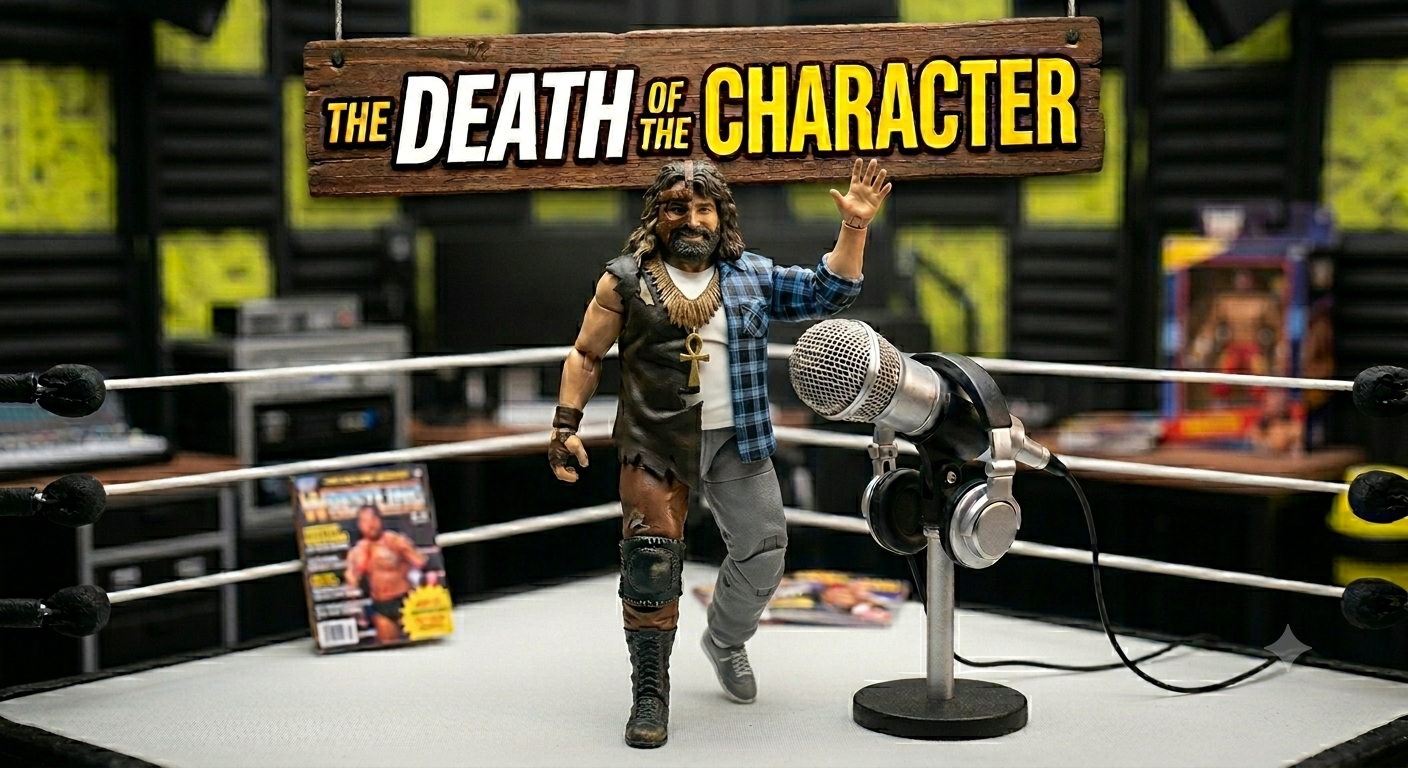
Mick Foley is, overall, probably my favorite performer in wrestling history. It’s just a bonus that he perfectly makes my point here: Mankind was not a father of two with a Santa fetish. That was Mick Foley. Despite sharing the same body, Mick Foley and Mankind were entirely different entities. They were kept largely separate, even when Jim Ross regularly made references on television to “Mrs. Foley’s baby boy,” or when WWE frequently used Mick Foley’s home videos portraying the Dude Love prototype and diving off a shed.
- Mankind.
- Dude Love.
- Cactus Jack.
The Three Faces of Foley were three distinct characters. All separate from the man who played them.
The Modern Crisis of Character
Look at today’s television product. The characters on the WWE main roster are either ill-defined or entirely indistinguishable from the athletes who perform the roles.
- Rhea Ripley: What is her character? What’s her backstory? Why does she wear the gear and makeup she wears? Is she in a romantic relationship with Iyo Sky, or are they just fucking? You know what? Nevermind.
- Seth Rollins: What is he? A “Visionary”? Of what? A “Revolutionary”? What did he revolutionize? “The Architect”? Of what? The Shield? How did that turn out? Why does he wear his wife’s clothes? You know what? Nevermind.
I could do this for the vast majority of the roster.
The Fix: A Return to Depth
This blurring of the lines becomes a real problem for me when the earliest introduction I got to Royce Keys sounded like a therapy session with Stephanie McMahon. Or when you have Rhea Ripley recently discussing her real-life mental health struggles on the same podcast.
I mean absolutely no disrespect to either of them, but as a viewer, I don’t need to know these things. I want superstars. I want comic book heroes and soap opera storylines.
WWE and the wrestling industry as a whole need to turn their performers into characters again. I’m not asking for a locker room full of undead morticians or evil clowns. Not everyone needs to be The Undertaker or Doink the Clown. What I am asking for is depth.
The characters we see on screen today desperately need defined backstories. We need clear motivations that go beyond “I want to win a championship” or “I’m a really good athlete.” Without that foundational lore, there is absolutely no depth to the modern roster. They are just athletes in branded merchandise, playing themselves with the volume turned up.
If professional wrestling wants to thrive as compelling episodic television, it needs to remember how to build a universe. And crucially, the performers need to step back, protect the mystique, and let the character be their fan-facing presentation.
Make sure to subscribe to our Late Night Crew Wrestling YouTube Channel. Follow @yorkjavon, @kspowerwheels & @LateNightCrewYT on X.
