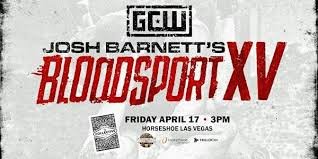
Josh Barnett’s Bloodsport is one of the few WrestleMania week shows that does not need a lot of extra selling. By now, the format tells the story for it. No ropes, knockouts and submissions, a stripped-down fight presentation, and a card usually built around wrestlers and fighters who actually fit the concept instead of just being dropped into it for novelty. That is why Bloodsport has become one of the strongest identities under GCW’s Collective banner. It is not trying to outdo the rest of the weekend with chaos or nostalgia. It stands out by being more disciplined, more violent, and more believable than almost anything else on the schedule. As part of this year’s Collective in Las Vegas, Bloodsport again looks like one of the day’s most serious cards, and that matters in a week where so many shows are built around excess.
Here is everything advertised for today’s show
- Josh Barnett vs. Yuji Nagata
- Nattie Neidhart vs. Shayna Baszler
- Timothy Thatcher vs. Charlie Dempsey
- Masashi Takeda vs. Pete Dunne
- Zack Sabre Jr. vs. Ray Jaz
- Shane Mercer vs. Royce Isaacs
- Miyu Yamashita vs. Janai Kai
- Erick Stevens vs. Fuminori Abe
- Ulka Sasaki vs. Joe Dashou
- Matt Mako vs. Angel Verduzco
The main event is exactly the kind of match Bloodsport should be built around. Josh Barnett vs. Yuji Nagata has credibility, toughness, and enough stylistic history behind it that it feels bigger than just another name-vs.-name booking. Barnett has spent years making Bloodsport an extension of his own fight-driven vision, while Nagata brings a level of legitimacy and veteran gravitas that immediately gives the card more weight. This is not a match that needs artificial hype. It works because both men make sense here, and that has always been one of Bloodsport’s biggest strengths when it is firing on all cylinders.
Beyond the main event, this lineup is strong because it feels curated instead of random. Timothy Thatcher vs. Charlie Dempsey is one of the cleanest Bloodsport matches on paper because both men naturally fit the style. Pete Dunne vs. Masashi Takeda brings a rougher edge and the possibility of something nastier than the standard technical grind. Zack Sabre Jr. vs. Ray Jaz gives the card one of its purest stylistic attractions, while Nattie Neidhart vs. Shayna Baszler has the kind of crossover appeal and built-in intrigue that should get immediate attention. Miyu Yamashita vs. Janai Kai also feels important because Bloodsport has done a good job making its women’s fights feel essential to the brand rather than secondary to it.
That is really what separates Bloodsport from a lot of the other WrestleMania week cards. This show does not just have a concept. It protects that concept. The card is usually strongest when the matches look like they belong under this ruleset, and this year’s lineup mostly does exactly that. Even the lower-profile bouts fit the environment. Ulka Sasaki, Joe Dashou, Matt Mako, Angel Verduzco, Erick Stevens, and Fuminori Abe may not all come in with the same headline pull as Barnett, Nagata, Baszler, or ZSJ, but they still make sense within the larger shape of the event. That gives the whole show more cohesion than a lot of indie supershows usually have.
As part of this year’s Collective, Bloodsport also serves a bigger purpose. Every major Collective show has its own lane, and Bloodsport’s lane is probably the clearest of all of them. It is the fight card. It is the show for fans who want structure, grit, and a more stripped-down presentation in the middle of a week full of stunt matches, nostalgia pops, and spectacle-heavy lineups. That role matters because it keeps The Collective from becoming one-note. Bloodsport gives the weekend balance, and its consistency over the years is a big reason it has become one of the most anticipated recurring attractions on the schedule.
The praise around Bloodsport is usually pretty straightforward. Fans who love it tend to love the clarity of the format, the seriousness of the presentation, and the fact that it feels different from standard indie wrestling without feeling forced. Wrestling media and journalists usually respond well to that too, especially when the card is built with obvious intent and not just recognizable names. The criticism is familiar as well. Some viewers think the format can make too many matches blend together, and if the crowd is not fully locked in, the show can feel flatter than a more traditional card. That has always been the tradeoff with Bloodsport. It asks the audience to buy into a very specific rhythm. When the audience does, the show feels unlike anything else all weekend.
There is also real significance in how established Bloodsport now feels during WrestleMania week. What started as a niche attraction has grown into one of the most dependable specialty shows of the weekend. That says a lot about the concept, but it also says a lot about the discipline behind it. Bloodsport has not lasted because it is different. It has lasted because it knows exactly what kind of different it wants to be. In a week where a lot of shows can feel like they are trying to do everything at once, Bloodsport still works by doing less and doing it with purpose.
Final thoughts
Josh Barnett’s Bloodsport XV looks like one of the strongest and most focused cards of the day. Barnett vs. Nagata gives it a real main event, Thatcher vs. Dempsey and Baszler vs. Nattie add major intrigue, and the rest of the lineup looks built for the format instead of just borrowing it. That is the difference. Bloodsport is not for everyone, and it has never tried to be. But when the card is this well-shaped and the concept is this protected, it usually does not need to be for everyone. It just needs to be Bloodsport, and tonight’s show looks fully capable of doing that.
Make sure to subscribe to our Late Night Crew Wrestling YouTube Channel. Follow @yorkjavon, @kspowerwheels & @LateNightCrewYT on X.
I’m the quiet one until the bell rings then I’ve got takes. I live for WWE NXT and TNA, I want every promotion to succeed, and I will absolutely roast the bad decisions on sight (because someone has to). Anime taught me to respect long-term storytelling; wrestling taught me that sometimes the plan is “we panicked” and called it “unpredictable.” The Miz got me into all of this, so yeah I appreciate confidence, commitment, and the art of talking like you’re already the main event. Now I bring that same energy to the page as the main writer for Late Night Crew Wrestling because if you’re not here to be must-see and tell the truth, why are you here?!