
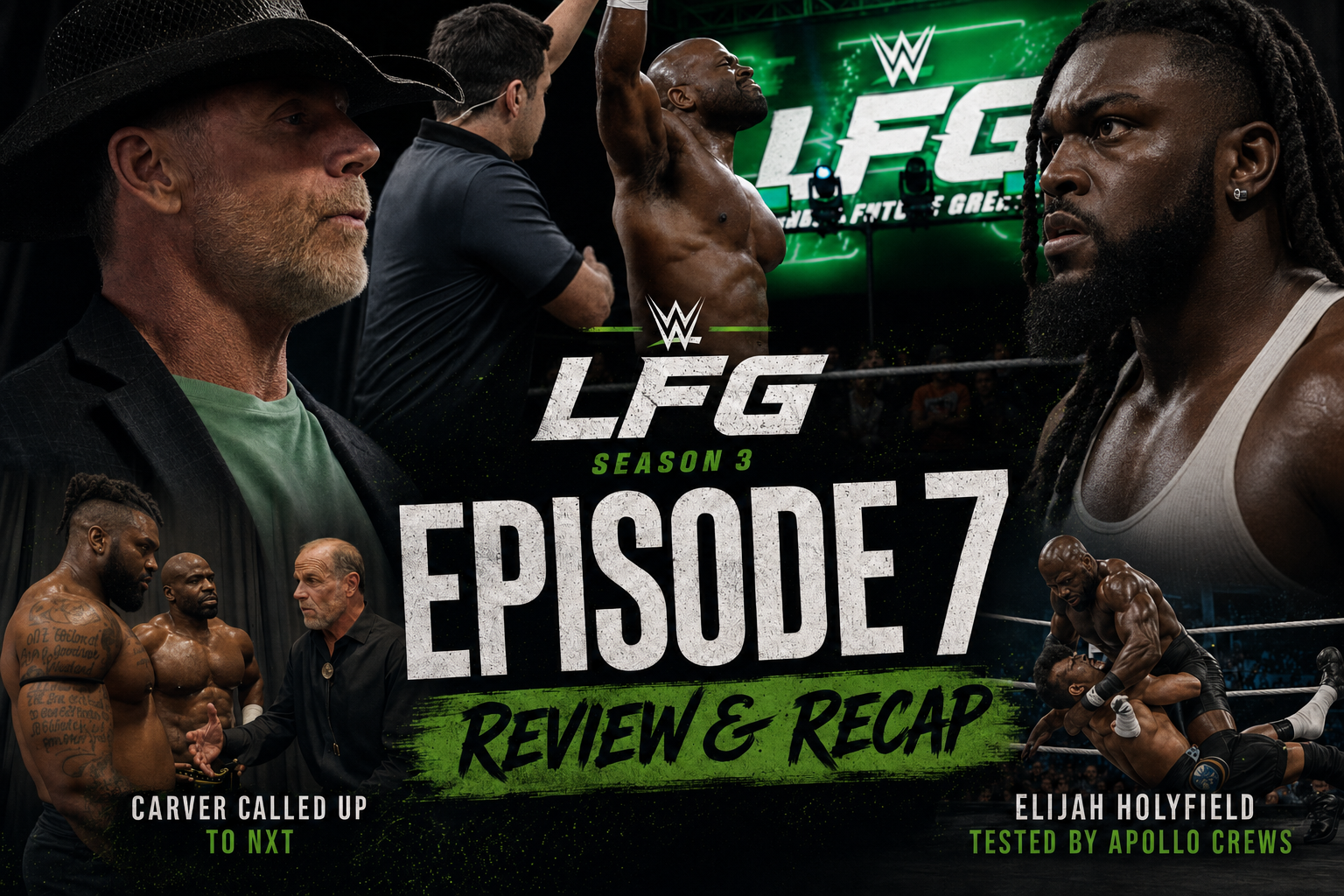
WWE LFG has improved significantly in its third season because it finally stopped trying to force a reality-show competition into a developmental process that was always more interesting on its own. The team format, point totals and artificial weekly stakes have been removed. That has allowed the series to focus on the part that actually matters: watching young wrestlers receive direct feedback, struggle with their weaknesses and attempt to prove they belong on a larger stage.
Episode 7, titled “Crews Control,” was not one of the strongest episodes of the season from an in-ring standpoint. None of the matches reached the level of Elio LeFleur and Mike Derudder’s standout main event from last week. The middle portion of the show also dragged at times because several of the wrestlers remain far from television-ready. However, the episode still served a purpose. It gave Elijah Holyfield the most important test of his run on the show, moved Keanu Carver into WWE NXT and continued presenting development as an ongoing process rather than a manufactured competition.
The episode opened with Shawn Michaels approaching Carver inside the Performance Center and offering him an opportunity to move up to NXT. Carver has the size, presence and natural edge WWE cannot teach, but he has also spent much of the season showing why his promotion comes with legitimate questions. His attitude has created friction with the coaches, particularly Booker T, and his refusal to take simple instructions without resistance has made him look unnecessarily difficult to work with. NXT is not a reward for becoming a finished product. It is the next test for someone WWE clearly believes is too physically imposing to leave in place.
The main event told a similar story with Holyfield. After two seasons of promise, an injury setback and a gradual return to the ring, he faced Apollo Crews in a match designed to determine whether his physical tools could hold up against an experienced opponent. Holyfield did not deliver a flawless performance, but he looked like someone worth continuing to invest in.
Here are the full results
- Harlem Lewis defeated Tate Wilder with the Boomslang.
- Masyn Holiday defeated PJ Vasa with a small package.
- Apollo Crews defeated Elijah Holyfield with a roll-up.
Breakdowns & Reactions
Keanu Carver Receives His NXT Opportunity
Keanu Carver entered the episode with the same blunt confidence that has defined him throughout the season. He believes he works harder than everyone around him. He wants to become a champion in NXT. He does not seem especially concerned with whether the coaches enjoy dealing with him along the way.
That mentality can be useful in professional wrestling, but there is a difference between confidence and stubbornness. Earlier in the season, Booker T asked Carver to follow a simple instruction during training. Carver pushed back instead of listening. Booker was not trying to undermine him. He was testing whether Carver could accept coaching without turning every conversation into a confrontation.
Carver has enough physical presence to command attention before the bell rings. That is why WWE is moving him forward. However, his NXT opportunity should not be framed as proof that every concern has been resolved. His presentation remains raw. His matches still need more structure. His attitude could become part of his appeal, but only if he learns when to channel it and when to stop making the process harder than it needs to be.
Shawn Michaels acknowledged that Carver had not exactly made himself popular before offering him the opportunity. Carver accepted without hesitation and made it clear that he considered his LFG chapter finished.
It was an effective opening segment because it reinforced the strongest part of Season 3. Wrestlers no longer need to wait for a finale or win a contrived competition before receiving an opportunity. When WWE believes someone has earned a bigger platform, the move can happen immediately.
Grade: A-
Harlem Lewis vs. Tate Wilder
Johnny Gargano joined Booker T and Kevin Owens as the special guest coach for the episode and brought a perspective that fit the show well. Gargano understands developmental wrestling better than most. He was never the obvious future star built around size or athletic credentials. He had to become undeniable through consistency, emotional connection and the ability to make matches matter beyond the moves.
That lesson was especially relevant for Harlem Lewis and Tate Wilder. Both wrestlers have tools, but neither has developed a complete identity. Gargano encouraged them to stop thinking exclusively about movement and focus more heavily on emotion. That distinction sounds simple, but it remains one of the biggest issues throughout LFG. Several wrestlers can perform athletic sequences. Far fewer know how to make the audience care about what those sequences mean.
Lewis and Wilder began with a steady exchange of holds before the pace increased. Wilder used his athleticism to create momentum, including a moonsault to the floor, but the match changed after he suffered an eye issue and continued despite being unable to see properly.
Wilder deserves credit for finishing the match under difficult circumstances. However, the injury also prevented the match from settling into any real rhythm. The action became uneven and never fully recovered. Lewis eventually caught Wilder and finished him with the Boomslang.
Lewis remains frustrating because his potential is obvious, but his presentation still feels forced. He is a large, physically imposing wrestler who should not need to work so hard to convince the audience that he is intimidating. When he tries to perform intensity instead of naturally projecting it, the act becomes less believable. He needs to simplify his approach and stop overthinking something his size already communicates for him.
Grade: C+
Masyn Holiday vs. PJ Vasa
Masyn Holiday entered the episode as the clear underdog against PJ Vasa, one of the most physically imposing women in the developmental system. Vasa controlled the early stages with splashes, backbreakers, a sidewalk slam and a Black Hole Slam that looked capable of ending the match.
The structure was basic but effective. Holiday spent most of the match surviving rather than threatening Vasa with any sustained offense. That made her small-package victory believable as an upset, but it also highlighted the limitations of both wrestlers.
Vasa looks the part and has enough power to build a convincing style around. However, her pacing remains inconsistent, and she does not always react strongly enough when control begins slipping away from her. A dominant wrestler needs to make every shift in momentum feel significant. Vasa occasionally moves from one sequence to the next without giving the audience enough time to process the story.
Holiday showed resilience, but her strikes still lack the force needed to create the illusion that she can meaningfully threaten someone with Vasa’s size advantage. The finish protected Vasa while giving Holiday a win, but neither wrestler left the match looking ready for a major television role.
This was useful developmental work. It was not a memorable match.
Grade: C+
Apollo Crews vs. Elijah Holyfield
The main event carried the most weight because Elijah Holyfield has spent the last few weeks building toward it.
Holyfield returned in Episode 5 after a lengthy injury layoff and defeated Nathan Cranton with the uppercut. In Episode 6, he overwhelmed Malik Blade in a short showcase while Apollo Crews watched from the background. Crews saw enough to request the opportunity to work with him directly.
That immediately gave the main event more purpose than the first two matches. This was not another prospect-versus-prospect evaluation. Crews could expose weaknesses, control the pace and force Holyfield to respond when raw power was no longer enough.
Holyfield looked comfortable early. He matched Crews physically, sent him to the floor with a shoulder tackle and earned chants from the crowd. Crews then targeted Holyfield’s arm after Holyfield collided with the ring post, forcing him to sell damage and work through a more layered match than the short showcases that preceded it.
Holyfield still has work to do. His transitions are not always smooth. Some of his movements can look deliberate rather than instinctive. His offense carries more impact than finesse, and he remains several steps away from being ready for a sustained television role. However, the physical presence is legitimate. The crowd responds to him. Most importantly, he did not look out of place sharing the ring with someone as experienced as Crews.
The finish was smart. Holyfield missed a punch and struck the post, allowing Crews to catch him with a roll-up. Crews won without making Holyfield look weak. Holyfield lost because he made a mistake against a veteran who knew how to capitalize immediately.
The match was not a breakout performance, but it was a productive one. Holyfield proved he could handle a longer, more structured assignment without being exposed. That is meaningful progress, even if the show should resist rushing him into a position he is not ready to carry.
Grade: B
The Story Of WWE LFG Season 3 So Far
Season 3 began by establishing a better format. There are no teams, no point totals and no need to wait until the finale before someone receives an opportunity. Wrestlers are being evaluated in real time, which makes the show feel more closely connected to WWE’s developmental system and less like a competition built around artificial television stakes.
Episode 1 introduced that change immediately. Kali Armstrong defeated Nikkita Lyons in a physical opener. Drake Morreaux defeated Keanu Carver, although both men were criticized for failing to make their offense match their size. Kendal Grey then defeated PJ Vasa in the main event and received the first NXT call-up of the season. Grey was already operating at a higher level than most of the roster. The match merely confirmed it.
Episode 2 placed Morreaux under pressure after several seasons of LFG appearances. He defeated Nathan Cranton, but Shawn Michaels informed him that his next opportunity would not be in NXT. Morreaux was instead sent to AAA, giving him a different path rather than allowing him to remain stuck in the same developmental cycle. Carlee Bright defeated Layla Diggs, while Harley Riggins and Jax Presley defeated Harlem Lewis and Mike Derudder in tag-team action.
Episode 3 continued emphasizing honest evaluation. Trill London defeated Braxton Cole but struggled to establish an identity separate from the high-flying influences surrounding his work. Layla Diggs and Masyn Holiday defeated PJ Vasa and Sirena Linton. Tate Wilder then lost to Kam Hendrix in a match that showed Hendrix needed to regain control of his confidence and presentation. After another shaky performance, Hendrix was temporarily pulled from the show and told to reset.
Episode 4 featured Terry Taylor as a guest coach and placed a stronger emphasis on emotional connection. Bayley Humphrey defeated Nikkita Lyons. Tate Wilder defeated Chris Island after Island pushed his attempt at intensity too far and crossed into exaggerated screaming. Chantel Monroe defeated Zena Sterling in the main event, but the larger story was Sterling’s frustration over her inability to consistently reach the next level.
Episode 5 marked Holyfield’s return. Braxton Cole defeated Andre Chase by leaning into his intellectual heel persona and using a book as part of the finish. Kali Armstrong defeated Sirena Linton in a showcase of her natural edge as a heel. Holyfield then defeated Nathan Cranton and reminded the audience why WWE has continued investing time in him despite the injury setback.
Episode 6 delivered the strongest match of the season so far. Bayley Humphrey defeated Carlee Bright and continued establishing herself as a believable powerhouse. Holyfield defeated Malik Blade in a short but effective showcase. Elio LeFleur and Mike Derudder then tore through their main event with a pace and level of athleticism that felt completely different from the usual LFG match. LeFleur won and was immediately called up to NXT by Shawn Michaels.
That brings the televised NXT call-up list through Episode 7 to three names:
- Kendal Grey
- Elio LeFleur
- Keanu Carver
Drake Morreaux also received a meaningful opportunity, but his next destination was AAA rather than NXT.
Final Thoughts
Episode 7 was solid, but it was not a standout installment. The first two matches exposed how far several wrestlers still have to go. Harlem Lewis continues to fight against his own presentation instead of allowing his natural size to do the work. Tate Wilder’s eye issue hurt the flow of the opener. Masyn Holiday and PJ Vasa told a clear story, but neither performance felt close to television-ready.
The episode worked because the larger stories mattered more than the match quality. Keanu Carver’s NXT opportunity created a meaningful opening development. Elijah Holyfield’s main event against Apollo Crews gave the show a clear destination and allowed Holyfield to prove he could survive a more demanding assignment.
Holyfield did not win, and he did not need to. The value of the match came from watching him work through adversity against a veteran who could expose his weaknesses without embarrassing him. Holyfield remains raw, but the upside is obvious.
Season 3 continues to be the strongest version of WWE LFG because it has stopped pretending every prospect is equally close to being ready. Some wrestlers are advancing. Some are being redirected. Others are being exposed by the process. That honesty is what makes the show worth watching.
Overall Episode Grade: B-
Make sure to subscribe to our Late Night Crew Wrestling YouTube Channel. Follow @yorkjavon, @kspowerwheels & @LateNightCrewYT on X.
I’m the quiet one until the bell rings then I’ve got takes. I live for WWE NXT and TNA, I want every promotion to succeed, and I will absolutely roast the bad decisions on sight (because someone has to). Anime taught me to respect long-term storytelling; wrestling taught me that sometimes the plan is “we panicked” and called it “unpredictable.” The Miz got me into all of this, so yeah I appreciate confidence, commitment, and the art of talking like you’re already the main event. Now I bring that same energy to the page as the main writer for Late Night Crew Wrestling because if you’re not here to be must-see and tell the truth, why are you here?!
1 thought on “WWE LFG Season 3 Episode 7 Review & Recap: Elijah Holyfield Steps Into The Ring With Apollo Crews As Keanu Carver Receives His NXT Opportunity”