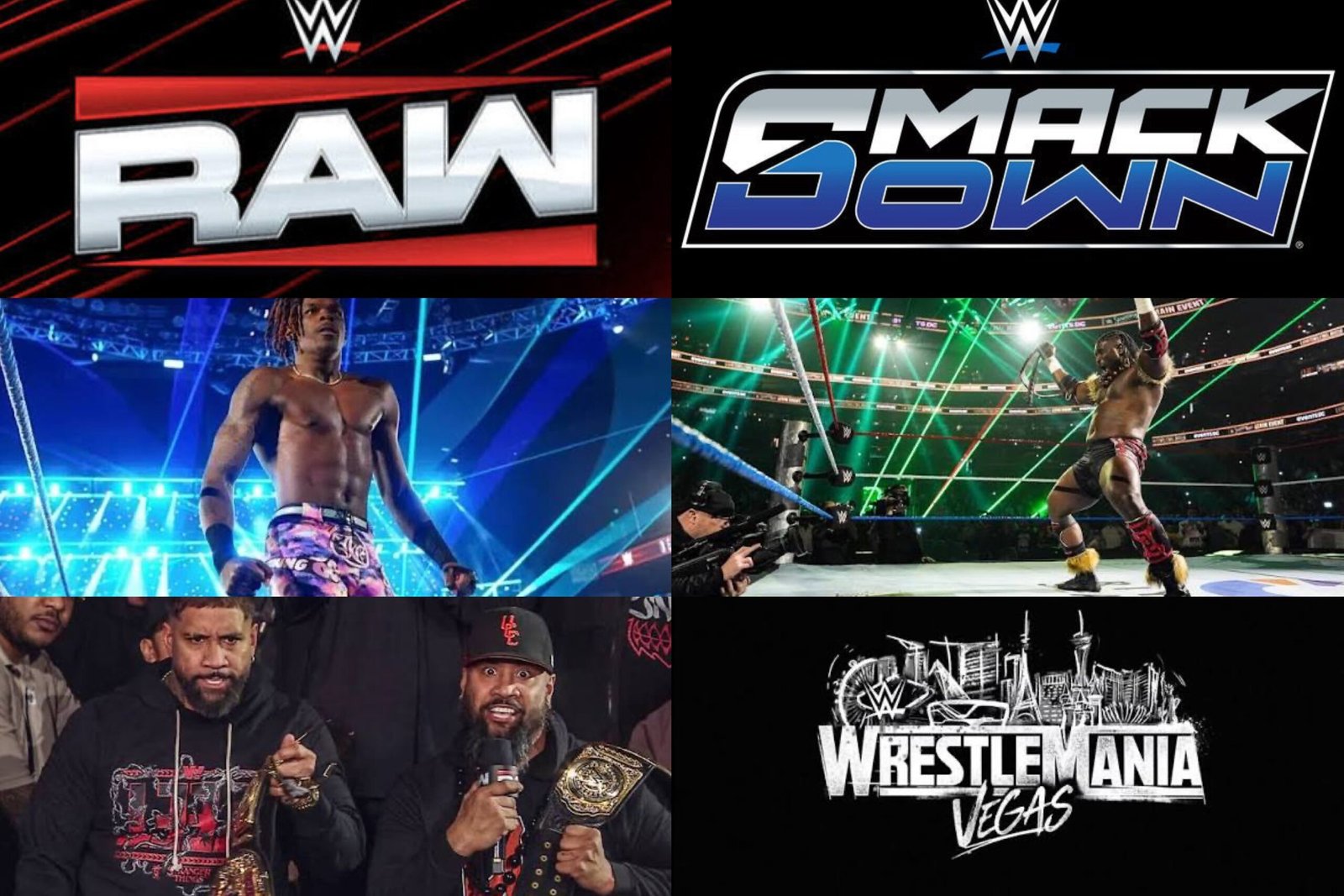
WWE does not enter 2026 lacking momentum. It enters the year lacking commitment to cohesion.
The difference matters.
Across RAW and SmackDown, WWE television is presenting compelling moments — returns, title changes, confrontations, emotional escalations — but moments alone do not make a great creative year. Direction does. Identity does. Continuity does. The challenge for WWE is not generating excitement; it is organizing that excitement into a long-term vision that rewards audience investment.
The good news is this: WWE is already telling us what that vision could be. The pieces are visible on weekly television. What follows is not reinvention, but alignment — a creative blueprint rooted entirely in what is already unfolding on screen.
RAW’s Identity Crisis — and Why Tag Team Wrestling Is the Answer
RAW has spent much of the last year feeling like a show that hosts stars rather than defines itself. That subtle distinction is critical. RAW needs more than big names; it needs a philosophical anchor.
Tag team wrestling provides that anchor.
With The Usos once again positioned at the top of the division, WWE has the rare opportunity to rebuild RAW around something it has historically excelled at but gradually abandoned: tag team wrestling treated as main-event worthy storytelling. The Usos are not simply champions or contenders — they are standard bearers. Their presence instantly communicates importance, history, and credibility.
Making tag team wrestling a central focus on RAW would do more than elevate one division. It would:
- Create multiple parallel storylines that feel interconnected
- Allow underutilized talent to gain weekly television relevance
- Provide RAW with a distinct identity separate from SmackDown
In WWE’s strongest eras, tag team wrestling was not filler — it was infrastructure. RAW in 2026 should treat it the same way.
World Titles as Narrative Engines, Not Shortcuts
Roman Reigns and the World Heavyweight Championship Equation
Roman Reigns’ aura has survived precisely because WWE has resisted overexposure. Television has positioned him not as a constant presence, but as a looming inevitability — and that matters.
A long-term pursuit of the World Heavyweight Championship fits the current creative tone far better than an immediate coronation. Roman chasing the “big gold” is not about validation; it’s about control. It reframes the title as something conquered through inevitability rather than handed down through entitlement.
A Roman-led World Heavyweight Championship reign would:
- Instantly elevate the title’s prestige
- Create a gravitational pull around RAW’s main event scene
- Force challengers to define themselves against dominance, not novelty
This is legacy storytelling done with patience — and WWE television has already laid the groundwork.
Drew McIntyre vs Cody Rhodes: A Study in Obsession and Identity
What WWE has done particularly well with Drew McIntyre and Cody Rhodes is strip the conflict of abstraction. This is no longer about rankings, contracts, or opportunity. It is about worldview.
Drew is presented as a man who believes righteousness comes through suffering and force. Cody is portrayed as a champion whose strength is emotional transparency and belief in legacy. Their on-screen escalation reflects that clash — one cold and calculating, the other deeply personal.
If WWE chooses to place the championship on Drew, it should not feel like a twist. It should feel like consequence.
A Drew McIntyre reign heading into WrestleMania season creates:
- A colder, more confrontational main event environment
- Natural friction with both veterans and emerging stars
- A champion whose presence reshapes the tone of RAW
This is the kind of title change that clarifies direction rather than disrupts it.
Why Cody Rhodes vs Randy Orton Works Best Without a Championship
Randy Orton’s return was not framed as desperation. It was framed as inevitability.
That distinction is important, because it gives WWE creative freedom. A Cody Rhodes vs Randy Orton feud does not need a championship to justify its existence. Their shared Legacy history carries enough emotional gravity to stand on its own — and arguably works better without gold involved.
Removing the title from the equation allows WWE to explore:
- Mentor versus successor dynamics
- Philosophical differences in leadership and ambition
- The emotional weight of outgrowing your past
By keeping this feud non-title, WWE elevates the story itself — and preserves the championship for moments that truly require it.
RAW’s Youth Movement: Integration Over Protection
Je’Von Evans’ presence on RAW is a quiet but significant creative signal. WWE is no longer content with sheltering young talent until they are “perfect.” Instead, the approach appears to be integration through experience.
Evans fits RAW’s athletic tempo and represents a broader shift: younger performers being trusted with meaningful screen time rather than token appearances.
That philosophy must extend to Oba Femi.
Oba does not present as a long-term project. Television has framed him as a disruptive force — dominant, composed, and physically overwhelming. When he enters the RAW ecosystem fully, WWE must resist the instinct to dilute his impact through overcautious pacing.
Oba’s rise should feel sudden, uncomfortable, and undeniable — because that is how real power shifts occur.
SmackDown’s United States Championship Model Should Be the Standard
The United States Championship has become one of WWE’s most effective storytelling tools precisely because it is being treated as a proving ground rather than a placeholder.
Since the reintroduction of open challenges under Sami Zayn, the title has functioned as a weekly stress test. Champions are required to perform. Styles are exposed. Weakness is punished. Growth is visible.
This is how WWE should identify future main-eventers:
- Who thrives under weekly pressure
- Who adapts to unfamiliar opponents
- Who can carry both match quality and narrative weight
If WWE wants to know who is ready for the world title conversation, it should look no further than who survives the United States Championship ecosystem.
Women’s Divisions: Stability on RAW, Urgency on SmackDown
The women’s tag team title change on RAW was not just a result — it was a recalibration. Placing the championships on established stars outside the singles title picture gives the division immediate legitimacy and space to grow.
A strong women’s tag division requires:
- Consistent challengers
- Storylines that matter week to week
- Champions treated as anchors, not placeholders
Meanwhile, SmackDown’s women’s division faces a different challenge: depth. Injuries and a limited challenger pool have exposed the need for reinforcements. Potential call-ups and confirmed arrivals are not optional; they are essential to sustaining three hours of weekly television without creative stagnation.
Fresh faces are not about novelty — they are about oxygen.
Gunther: The Unanswered Question
Gunther remains WWE’s most difficult creative problem — not because he lacks credibility, but because he has too much of it.
After dismantling legends and surviving high-profile programs, the question is no longer whether Gunther belongs in the world title picture. It is where his presence creates the most impact.
A move to SmackDown would not diminish him. It would refocus him. The blue brand’s main event scene could benefit from a champion — or challenger — who does not negotiate his dominance.
Gunther does not chase relevance. He enforces it.
Conclusion: 2026 Is a Year That Demands Commitment
WWE does not need sweeping reinvention in 2026. It needs discipline.
The television product is already telling coherent stories. The challenge now is committing to them long enough for them to matter. Tag team wrestling as a pillar. Championships as narrative engines. New talent integrated without fear. Legacy treated with respect rather than reliance.
If WWE commits to what it is already doing well — and aligns its creative decisions with the logic unfolding on screen — the Road to WrestleMania 42 does not just become a destination.
It becomes a culmination.
Make sure to subscribe to our Late Night Crew Wrestling YouTube Channel. Follow @yorkjavon, @kspowerwheels & @LateNightCrewYT on X.
I’m the quiet one until the bell rings then I’ve got takes. I live for WWE NXT and TNA, I want every promotion to succeed, and I will absolutely roast the bad decisions on sight (because someone has to). Anime taught me to respect long-term storytelling; wrestling taught me that sometimes the plan is “we panicked” and called it “unpredictable.” The Miz got me into all of this, so yeah I appreciate confidence, commitment, and the art of talking like you’re already the main event. Now I bring that same energy to the page as the main writer for Late Night Crew Wrestling because if you’re not here to be must-see and tell the truth, why are you here?!