Last night’s WWE NXT wasn’t just “the first show after a title change.” It was a mission statement about what this rebuilding-era brand wants to be on the road to Stand & Deliver: a place where new champions don’t get coronations — they get stress tests. Joe Hendry’s reign began the only way a modern NXT reign can begin if the company wants it to feel real: with a hostile locker room, a coordinated ambush, and a title defense designed to force him to prove that last week’s ladder-match miracle wasn’t a one-night story.
And in the main event, NXT pulled off the exact kind of layered angle that makes a division feel alive: a tag match with a poison-pill stipulation where teamwork is a liability, ego is the weapon, and the prize is a championship opportunity. Sol Ruca walked out with the No. 1 contender spot to Jacy Jayne’s NXT Women’s Title — but the real fallout is what that win did to ZaRuca, because NXT is quietly telling you that the road to Stand & Deliver is going to be paved with broken partnerships, not just wins and losses.
Here Are The Full Results
- Blake Monroe vs. Jaida Parker ended in Double Count-Out
- Eli Knight def. Josh Briggs (WWE Men’s Speed Title No. 1 Contender Tournament Match)
- The Vanity Project (Brad Baylor & Ricky Smokes) def. Hank & Tank
- Joe Hendry (c) def. Jackson Drake (NXT Championship)
- ZaRuca (Sol Ruca & Zaria) def. WrenQCC (Wren Sinclair & Kendal Grey) (NXT Women’s Championship No. 1 Contender “pinfall/submission earns the shot” Tag Match)
Vanity Project attack Hendry, and NXT chooses “pressure” over celebration
Joe Hendry kicked off the show as the newly crowned NXT Champion and immediately framed his reign as a brand-lifting mission — the kind of babyface champ promo that usually signals stability. NXT refused to let it breathe. Vanity Project hit him early and hit him hard, turning Hendry’s “new era” moment into an instant crisis. Fightful’s live coverage notes the key structural choice: the attack wasn’t just heat, it was the mechanism for setting up Hendry vs. Jackson Drake later that night.
This is how you build a champion fast in a rebuilding period: you don’t tell the audience he’s the guy — you show the audience the locker room is trying to tear him down, and he’s still standing. WWE’s own framing of the night underscores that intent, presenting the Hendry era as beginning with immediate conflict and an immediate defense.
Stand & Deliver implication: Hendry’s early reign is being positioned as a survival story. The belt is the prize, but legitimacy is the real fight — and that’s the exact tone you want if you’re building to a major spring showdown.
Blake Monroe vs. Jaida Parker: the double count-out wasn’t a finish — it was a declaration
Their match sprinted into chaos and never really came back. WWE’s recap emphasizes that neither woman answered the referee’s count, and the fight continued into a brawl that even produced incidental contact with an official on the outside — the kind of detail NXT includes when it wants to underline that the violence is spilling beyond “normal match boundaries.”
A double count-out is often treated like a TV shortcut. Here, it read as something more intentional: NXT is protecting both women while signaling that this isn’t resolved in a way a clean pin can settle.
Stand & Deliver implication: This is the kind of unresolved heat that often escalates into a stipulation match, or becomes the feeder feud that produces a breakout performance when the card expands closer to the PLE stretch.
The Speed Tournament: Eli Knight advances — then Jasper Troy reasserts control through violence
Eli Knight beating Josh Briggs matters on paper because it moves the No. 1 contender tournament forward. What matters in the bigger story is what happened after: Elio LeFleur showed sportsmanship, and then Speed Champion Jasper Troy arrived and flattened both of them. WWE’s write-up treats this as Troy injecting himself as the gravitational center of the entire lane — not just waiting for a challenger, but manufacturing fear around the tournament itself.
Stand & Deliver implication: You can see the outline of the eventual title program: the tournament produces a worthy contender, and Troy makes sure the contender feels like they’re walking into a champion who’s not just defending a belt, but defending a hierarchy.
Tony D’Angelo and the tag-division traffic jam: NXT keeps stacking bodies to justify a multi-team collision
NXT stitched together several tag and faction threads into one mess of interruptions and violence. Fightful’s report is especially clear about the sequence: DarkState tried to claim space, The Culling interrupted, then OTM and Hank & Tank got involved, and the segment detonated into a brawl that Tony D’Angelo used to lay people out and stand tall.
This isn’t random chaos. It’s roster management through storytelling: the division is crowded, so NXT is making the crowd feel the crowding. That’s why the show later includes Robert Stone announcing a four-way tag direction — because the television has already justified why “one team vs. one team” isn’t enough to contain the situation.
Stand & Deliver implication: Multi-team structures are coming, and NXT is giving itself the runway to make them feel earned rather than convenient.
Vanity Project vs. Hank & Tank: a “tag win” that also feeds the NXT Title story
Vanity Project beating Hank & Tank wasn’t presented as a simple upset; WWE’s recap explicitly notes the ringside chaos and even ties Jackson Drake into the moment as a cheap-shot factor that helped Vanity Project steal the win.
That matters because it turns Vanity Project into a show-wide parasite: they’re not only undermining the new champion in the top story, they’re also building their own credibility in the tag scene. That’s efficient booking — one act, multiple problems created.
Stand & Deliver implication: If Hendry is the “new era” centerpiece, Vanity Project are being shaped as the antagonists who keep that era unstable across the card.
NXT Championship: Joe Hendry (c) vs. Jackson Drake — the defense was the proof, the post-match was the warning
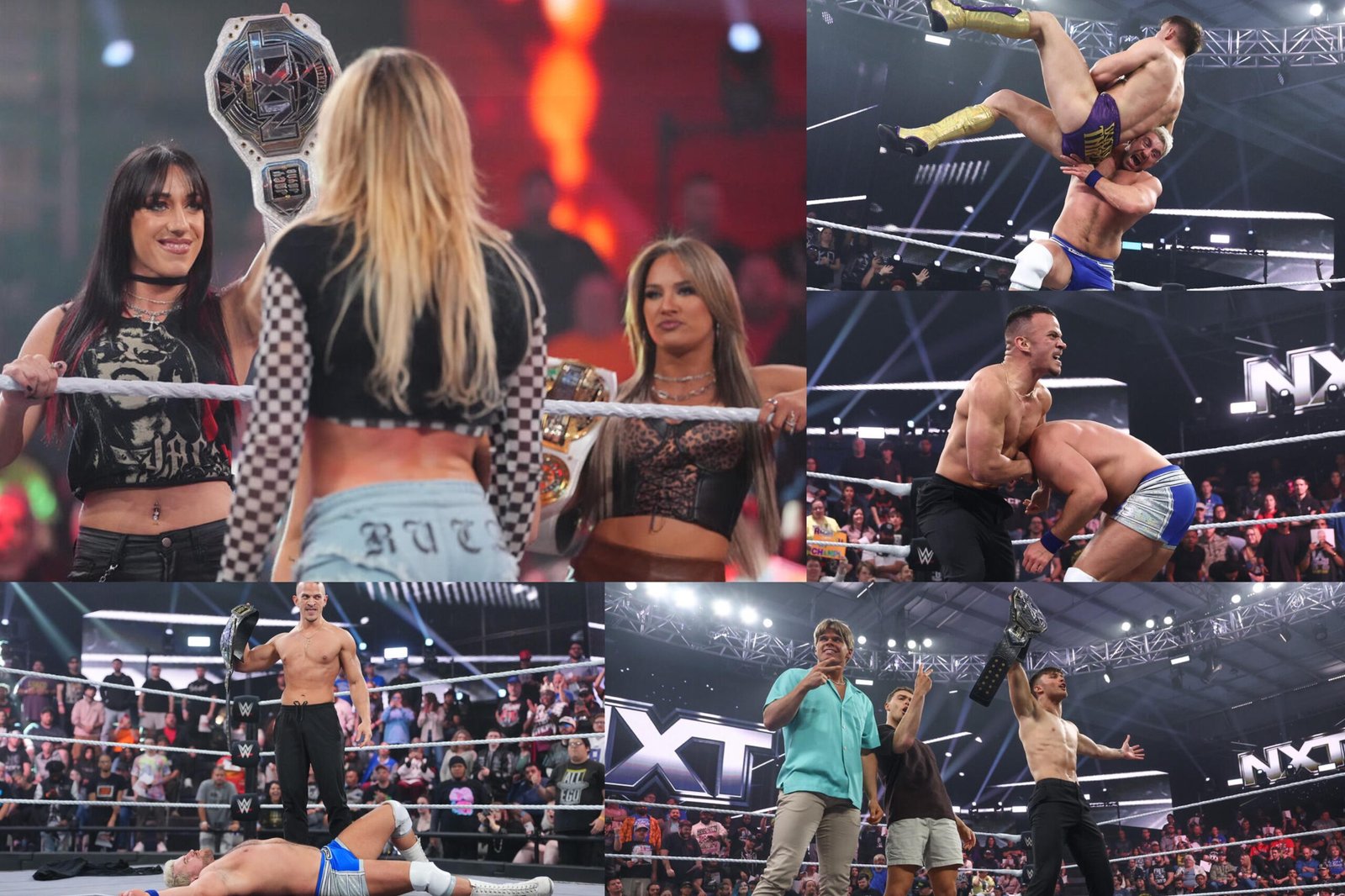
The match itself was constructed as an “odds shift” story. WWE’s recap calls out the attempted involvement from Baylor and Smokes, their ejection, and Hendry weathering Drake’s storm before winning with Standing Ovation. In other words: Hendry didn’t just win — he won after the match tried to become the kind of interference circus that invalidates new champions.
And then the real chapter began: Ricky Saints attacked Hendry after the bell. WWE spotlights that beat, and Fightful confirms it as the defining punctuation on Hendry’s first night as champion.
This is the most important storytelling detail of Hendry’s early reign: Vanity Project are the loud problem, but Saints is being positioned as the serious one — the threat who doesn’t need a posse to make the champion feel vulnerable.
Stand & Deliver implication: The show basically mapped Hendry’s immediate roadmap: fend off the faction warfare, but prepare for the lone shark that’s circling specifically for the title.
Main event: ZaRuca vs. WrenQCC — Sol Ruca becomes No. 1 contender, and ZaRuca’s fracture becomes the real engine
This match was the episode’s best piece of narrative architecture because the stipulation is inherently corrosive: the team can win, but only one partner truly benefits. WWE’s own recap emphasizes the misalignment between Sol and Zaria, the chaos that followed, and the decisive moment — Zaria inadvertently tagging Sol in before Sol hit Sol Snatcher and secured the pin to become No. 1 contender.
Cageside Seats’ coverage leans into what that means emotionally: Sol’s “solo act” moment is the triumph, but Zaria’s frustration is the hook, because this isn’t just a title chase — it’s a partnership being slowly disassembled on live TV.
Then came the visual that matters most on the road to Stand & Deliver: Jacy Jayne and Fatal Influence confronting Sol. WWE frames it as a staredown, and that’s exactly what it should be — the champion, the new contender, and the sense that the contender’s biggest obstacle might not even be the champion… it might be the teammate standing beside her with resentment in her eyes.
Stand & Deliver implication: NXT just created two lanes at once:
- Jacy Jayne vs. Sol Ruca as the clean title direction, and
- Sol Ruca vs. Zaria as the emotional landmine that can explode at any point (before the title match, during it, or after it).
That’s how you make a division feel layered instead of linear.
Make sure to subscribe to our Late Night Crew Wrestling YouTube Channel. Follow @yorkjavon, @kspowerwheels & @LateNightCrewYT on X.
I’m the quiet one until the bell rings then I’ve got takes. I live for WWE NXT and TNA, I want every promotion to succeed, and I will absolutely roast the bad decisions on sight (because someone has to). Anime taught me to respect long-term storytelling; wrestling taught me that sometimes the plan is “we panicked” and called it “unpredictable.” The Miz got me into all of this, so yeah I appreciate confidence, commitment, and the art of talking like you’re already the main event. Now I bring that same energy to the page as the main writer for Late Night Crew Wrestling because if you’re not here to be must-see and tell the truth, why are you here?!