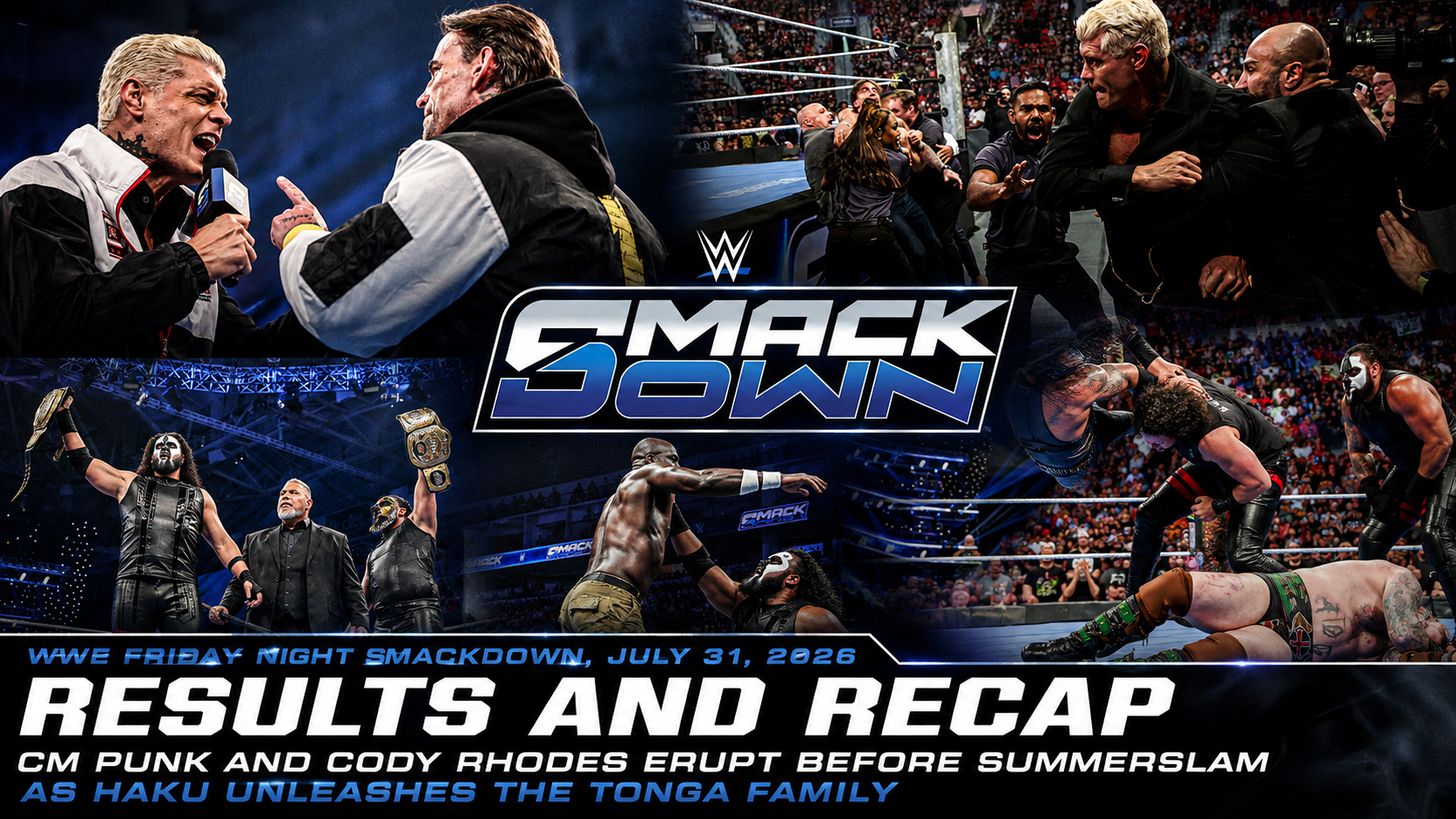
WWE Friday Night SmackDown delivered its final stop on the road to SummerSlam last night from the Resch Center in Green Bay, Wisconsin, with CM Punk and Cody Rhodes finally abandoning the uneasy respect that had defined their Undisputed WWE Championship rivalry. The two SummerSlam opponents closed the show by fighting around ringside as referees and officials desperately attempted to separate them, giving WWE the heated final image that its biggest blue-brand match had been missing. Finn Bálor and Sami Zayn added genuine emotion to their No. 1 Contender’s Match, Gunther and Nick Aldis continued transforming an initially strange pairing into a believable fight, and Haku’s surprise appearance immediately gave Tama Tonga, Tonga Loa and Talla Tonga a stronger identity. However, the actual wrestling remained an afterthought. Last night featured only four matches, the advertised Title-for-Title Match ended without a winner, Giulia was defeated in barely more than two minutes, and even the best match was cut short by interference and comedy. SmackDown found enough late momentum to improve SummerSlam’s strongest stories, but it also exposed how many programs reached the finish line through hurried television rather than a consistently compelling build.
Here Are the Full Results
- Michin and B-Fab defeated WWE Women’s United States Champion Tiffany Stratton and Chelsea Green.
- WWE Tag Team Champions Damian Priest and R-Truth versus AAA Tag Team Champions The War Raiders ended in a no-contest.
- Rey Fenix (c) defeated JD McDonagh (AAA Cruiserweight Championship)
- Lash Legend defeated Giulia to qualify for the Interim WWE Women’s Championship Ladder Match at SummerSlam.
Breakdown & Reactions
Finn Bálor and Sami Zayn Put Their Unfinished Championship Stories on the Line
Finn Bálor opened last night’s SmackDown by returning to the defining contradiction of his WWE career.
SummerSlam 2016 gave Bálor the greatest accomplishment and cruelest disappointment of his career on the same night. He defeated Seth Rollins to become the inaugural Universal Champion, suffered a severe shoulder injury during the match and was forced to relinquish the championship the following evening.
Ten years later, Bálor is still trying to reach that level again.
The significance of his SummerSlam match against Sami Zayn is not simply that the winner receives an Undisputed WWE Championship opportunity. For Bálor, the match represents another chance to reclaim the place WWE once appeared ready to build around him before injury changed everything.
Zayn interrupted with an equally legitimate grievance.
He argued that the No. 1 Contender’s Match should not exist because he should already be involved in the SummerSlam championship match between CM Punk and Cody Rhodes. Zayn defeated Cody to become champion, only to lose the title when Punk replaced an injured Rhodes and received an opportunity that was never originally intended for him.
Zayn said he wanted Cody to regain the championship because he had already defeated him and believed he could do it again. His resentment toward Punk was considerably sharper. Zayn viewed Punk as a hypocrite who once complained about corporate favoritism before becoming the latest man to benefit from it.
Bálor challenged Zayn to enter the ring and say everything to his face.
The conversation then became more personal.
Zayn acknowledged that Bálor should have been a world champion several times by now, but argued that this was his moment. Bálor responded by questioning where justice had been for him during the previous decade. Zayn answered with the harshest line of the exchange, suggesting that if Bálor had spent ten years trying to return to the top without getting close, perhaps it was never meant to happen.
That line gave their match the edge it needed.
Both men are respected veterans who have watched WWE repeatedly build around other stars. Both have experienced painfully short world-title reigns. Both believe SummerSlam could be their final realistic route back into the championship picture.
Gunther interrupted before the confrontation could become physical and attacked both men.
Nick Aldis then arrived and fought his SummerSlam opponent, eventually trapping Gunther in the Texas Cloverleaf before officials intervened.
The segment successfully connected two different SummerSlam matches through one coherent theme: overlooked men attempting to reclaim their identities.
Bálor and Zayn are fighting for another chance at the top. Aldis is stepping out from behind the general manager’s desk to remind Gunther and the audience that he was a world champion long before arriving in WWE.
Gunther remains the clear favorite against Aldis, as he should. However, Aldis applying the Cloverleaf showed that he possesses at least one believable route to creating danger.
The segment was one of last night’s strongest pieces of television because everyone involved had a clear motivation, and no one needed to behave irrationally to advance the story.
Grade: A-
What Worked
- Bálor’s SummerSlam 2016 history gave the No. 1 Contender’s Match emotional weight.
- Zayn had a credible reason to remain bitter about losing the championship to Punk.
- The verbal exchange became personal without feeling manufactured.
- Gunther immediately changed the atmosphere through physicality.
- Aldis looked capable without making Gunther appear weak.
- Two SummerSlam matches advanced through one connected segment.
What Didn’t Work
- WWE waited until the final SmackDown before SummerSlam to give Bálor and Zayn this level of meaningful interaction.
- Gunther’s interruption prevented Bálor and Zayn from fully escalating their own confrontation.
- Aldis applying the Cloverleaf created expectations that the SummerSlam match must now justify.
Michin and B-Fab vs. Tiffany Stratton and Chelsea Green
Michin and B-Fab entered alongside Jade Cargill to face Tiffany Stratton and Chelsea Green in last night’s opening match.
Jade repeatedly involved herself behind the referee’s back and attacked Tiffany, leaving Chelsea increasingly isolated against both opponents.
Michin and B-Fab capitalized by hitting Chelsea with the BTA to earn the victory.
The match lasted just over four minutes and primarily existed to place several women from SmackDown’s championship picture in the same segment before SummerSlam.
Charlotte Flair appeared after the bell and immediately targeted Jade. Tiffany and Chelsea recovered and joined Charlotte in overwhelming Jade, Michin and B-Fab.
The result gave Michin and B-Fab a useful televised victory, but the winners quickly became secondary to the post-match confrontation.
That has been a recurring problem throughout the Interim WWE Women’s Championship build.
Charlotte and Jade have been treated as the central rivalry, while Tiffany and Chelsea have operated around them. Lash Legend later completed the Ladder Match as its most physically imposing competitor, but the presentation still strongly suggests that everyone else is navigating a story built primarily around Charlotte and Jade.
That approach could create an effective SummerSlam finish. Charlotte and Jade may become so consumed with destroying one another that Tiffany, Chelsea or Lash steals the championship.
However, WWE has not done enough to make all five women feel equally important.
Tiffany is a former champion with the athleticism to thrive in a Ladder Match. Chelsea is an opportunist whose entire character is suited to escaping with a championship while everyone else is distracted. Lash possesses a significant physical advantage.
The field has several believable winners. The television has not consistently presented it that way.
Last night’s match was functional rather than memorable. It moved the story forward, gave Michin and B-Fab a win and created another physical encounter between Charlotte and Jade. It never became important enough to feel like a major part of the final SummerSlam build.
Grade: C
What Worked
- Michin and B-Fab received a clean televised victory.
- Jade’s involvement created a logical disadvantage for Tiffany and Chelsea.
- Charlotte and Jade’s hostility remained central without another lengthy promo.
- The post-match chaos previewed the disorder expected in the Ladder Match.
- Chelsea remained positioned as the competitor most likely to exploit everyone else’s conflict.
What Didn’t Work
- The match received only four minutes.
- Michin and B-Fab became irrelevant almost immediately after winning.
- Charlotte and Jade continued overshadowing the rest of the Ladder Match field.
- The segment did little to improve Tiffany’s momentum before SummerSlam.
- WWE used the match more as an angle than a meaningful athletic contest.
Haku Reminds His Sons Who They Are
Last night featured a backstage vignette with Tama Tonga and Tonga Loa reflecting on how far they had drifted from their family identity.
Haku then appeared and delivered the message the group needed.
He reminded them that they were his sons and told them to make people fear the family again.
The segment was brief, but its authenticity made it more effective than weeks of overproduced explanations would have been.
Haku carries a reputation that WWE does not need to manufacture. His presence immediately communicates toughness, danger and family pride. He did not need to wrestle, threaten anyone directly or explain the entire history of the Tonga family.
He simply reminded his sons of the standard attached to their name.
Tama Tonga has spent much of his WWE run surrounded by different versions of The Bloodline and often positioned beneath a more prominent leader. Tonga Loa has struggled even more to establish an individual identity.
Haku gives the family a reason to exist beyond becoming another Bloodline variation.
The vignette also received a physical payoff later in the show when Tama and Talla Tonga attacked both sets of tag-team champions.
That separation is important. Tonga Loa appeared with Tama during the vignette, while Talla joined Tama during the attack. Haku’s influence connected both scenes and suggested that the entire family had become dangerous again.
Online reaction during last night’s show was overwhelmingly positive toward Haku’s appearance. The excitement was not based on nostalgia alone. Viewers immediately understood that his involvement made Tama and Talla feel more legitimate than another generic post-match ambush would have.
The challenge now falls on WWE.
One memorable appearance does not create a successful faction. The company must follow this with a meaningful championship direction rather than several weeks of short victories and repeated attacks.
Grade: A
What Worked
- Haku brought immediate credibility without requiring a long explanation.
- The segment gave the Tonga family a clearer identity.
- Tama and Tonga Loa’s recent struggles were acknowledged instead of ignored.
- The message directly connected to the later tag-team attack.
- The presentation felt authentic rather than excessively theatrical.
- Fan reaction showed immediate interest in Haku’s potential ongoing involvement.
What Didn’t Work
- The segment risks becoming a one-night novelty unless Haku remains involved.
- Tonga Loa appeared in the vignette but not the later attack, which may confuse viewers unless WWE clarifies the group’s structure.
- The family still needs a defined goal beyond attacking champions.
Damian Priest and R-Truth vs. The War Raiders Ends Without a Winner
WWE Tag Team Champions Damian Priest and R-Truth faced AAA Tag Team Champions Erik and Ivar in a Title-for-Title Match.
On paper, this should have been one of last night’s most important matches.
Two championship teams were fighting with both sets of titles at stake on the final television show before SummerSlam. The match had enough consequence to produce a significant result for both WWE and AAA.
Instead, it lasted just over two minutes before ending in a no-contest.
Priest and The War Raiders traded heavy offense while Truth increased the pace. The fight eventually broke down as all four men became involved and repeatedly shoved referee Charles Robinson.
Robinson called for the bell when the competitors refused to regain control.
The official no-contest was a deeply unsatisfying conclusion to an advertised Title-for-Title Match.
WWE promoted the possibility of one team leaving with both championships, then avoided making a decision. The company could have booked a standard non-title match if the only goal was to set up a post-match attack.
The brawl continued through the arena before Tama Tonga and Talla Tonga arrived.
Talla caught Truth during a dive and drove him into the ring post. Tama attacked Erik, while Talla planted Priest. Haku then entered the ring as his sons held both sets of tag-team championships above their heads.
The visual was excellent.
Tama and Talla did not select one champion to target. They attacked everyone and presented themselves as a threat to both WWE and AAA’s tag-team divisions.
Haku standing behind them gave the angle an authority and authenticity it would not have possessed otherwise.
The problem is that the destination did not justify the route.
WWE could have allowed Priest and Truth or The War Raiders to win before the attack. The Tonga family still would have looked dominant. Instead, the company sacrificed a championship match because it wanted the image without accepting the consequences of a real finish.
Online reaction reflected that split. Haku and his sons received praise, while the no-contest drew criticism for making the Title-for-Title stipulation feel like promotional bait.
The angle created an exciting new direction. The match itself was barely a match.
Grade: C-
What Worked
- The four wrestlers immediately established a physical tone.
- Priest’s athleticism remained impressive against larger opponents.
- Tama and Talla Tonga looked dominant during the attack.
- Haku standing behind his sons created one of last night’s strongest visuals.
- The angle connected WWE and AAA’s tag-team title pictures.
- The Tonga family emerged as an immediate championship threat.
What Didn’t Work
- The advertised Title-for-Title Match ended without a winner.
- The match lasted only slightly more than two minutes.
- Both championship teams became props for the post-match angle.
- WWE could have reached the same destination after a decisive finish.
- The no-contest made the championship stipulation feel meaningless.
- The finish reinforced the feeling that wrestling was secondary throughout last night’s show.
CM Punk and Trick Williams Tease a Future Championship Collision
CM Punk was interviewed backstage after footage aired of his previous confrontation with Cody Rhodes.
Punk acknowledged that he and Cody did not need to remain friends once the bell rang. He framed his responsibility as champion around accepting every challenger and leaving SummerSlam with the Undisputed WWE Championship.
Trick Williams interrupted and confidently told Punk that he intended to pursue the championship eventually.
Punk did not dismiss him.
Instead, Punk said he was disappointed Trick had failed to earn a championship opportunity because he wanted new challengers. He then warned Trick that reaching WWE’s highest level would result in Punk defeating him.
The exchange was short, direct and effective.
Trick did not behave like a fan receiving a moment with an established main-event star. He approached Punk as a fellow champion who believed the Undisputed WWE Championship was eventually within his reach.
Punk acknowledged Trick’s potential while refusing to treat him as an equal.
That distinction created tension without manufacturing an unnecessary fight.
The segment planted a possible future match and subtly raised the stakes of Trick’s United States Championship defense against Baron Corbin. Trick cannot convincingly look beyond Corbin toward Punk if he fails to retain his current championship.
It also gave Punk a useful moment away from Cody.
Punk’s line about wanting new contenders reinforced his belief that he is prepared to lead SmackDown as champion. It also allowed him to dismiss Cody’s claim without pretending the match did not matter.
A future Punk-Trick rivalry would depend heavily on Trick’s continued development, but last night proved that he can share a segment with one of WWE’s biggest stars without looking intimidated.
Grade: B+
What Worked
- Trick approached Punk with confidence rather than admiration.
- Punk acknowledged Trick without treating him as an established equal.
- The exchange planted a future championship match naturally.
- Punk reinforced his identity as a champion willing to face new challengers.
- The segment increased the pressure on Trick before facing Corbin.
What Didn’t Work
- The interaction was too brief to become a major moment.
- Trick discussing Punk risked distracting from his immediate SummerSlam challenger.
- WWE must avoid teasing the match too early if there is no near-term plan to deliver it.
Nick Aldis Explains Why Gunther Pushed Him Back Into the Ring
Last night aired a video package examining Nick Aldis’ career before his SummerSlam match against Gunther.
Aldis discussed the unexpected turns that eventually brought him to WWE after years as a world champion elsewhere. He explained that he had not originally imagined himself becoming a general manager, but committed to becoming the best authority figure he could be once WWE placed him in the role.
That changed when Gunther pushed him too far.
The video package was necessary because a portion of WWE’s audience only knows Aldis as SmackDown’s general manager.
His career before WWE matters to the credibility of this match. Aldis is not an executive suddenly deciding to wrestle one of the most dangerous men in the company. He is an experienced former world champion who stepped away from active competition and now believes Gunther has forced him to reconnect with that identity.
The package also acknowledged the obvious concern.
Aldis has not competed regularly in years, while Gunther has spent that time wrestling at WWE’s highest level. Gunther should be faster, sharper and better conditioned.
That imbalance makes the match interesting.
Aldis does not need to dominate Gunther or suddenly become the better wrestler. He needs to survive long enough to prove that Gunther underestimated him.
The road to SummerSlam has succeeded by treating Aldis seriously without pretending the time away does not matter. His Texas Cloverleaf gives him a believable weapon, while Gunther’s violence gives the match an unavoidable sense of danger.
The program began as one of SummerSlam’s strangest announcements. It has become one of the blue brand’s better-developed fights.
Grade: B+
What Worked
- The package explained Aldis’ history to viewers unfamiliar with his wrestling career.
- WWE acknowledged his time away from competition.
- Aldis’ motivation felt personal and credible.
- The segment reinforced that Gunther pushed Aldis beyond his role as general manager.
- The match now feels like a serious fight rather than a novelty attraction.
What Didn’t Work
- WWE should have established more of Aldis’ wrestling history earlier in the rivalry.
- A video package cannot completely replace meaningful weekly physical development.
- The match still carries a major risk if Aldis shows significant ring rust.
Trick Williams Calls Out Baron Corbin
United States Champion Trick Williams entered the ring and called out Baron Corbin.
Trick mocked Corbin’s appearance, compared him to a giant Tommy Pickles and demanded that he come to the ring for an immediate fight.
Corbin appeared but refused to give the champion what he wanted.
He argued that Trick had been handed everything and lacked patience. Corbin promised that their SummerSlam match would feel like quicksand before he cut off Trick’s oxygen and took the United States Championship.
Trick challenged him to provide a preview in Green Bay.
Corbin teased the possibility before refusing, telling Trick and the audience that he did not care what either wanted.
That refusal was the strongest part of the segment.
WWE used multiple brawls throughout last night’s show. Corbin walking away created variety and presented him as the veteran attempting to control the timing and pace of the rivalry.
That mirrors the likely structure of their match.
Trick is younger, faster, louder and more explosive. Corbin believes he can slow him down, frustrate him and expose the difference between presentation and experience.
The central idea is solid. The road to the match has been rushed.
Corbin returned, attacked Trick and received a championship opportunity. Their verbal exchanges have been entertaining, but WWE has not developed enough history to make the rivalry feel deeply personal.
Trick’s charisma carried last night’s exchange. Corbin supplied the threat and structure.
The SummerSlam match now has a clear responsibility: prove that Trick’s rapid rise is supported by his performance when matched against a veteran capable of controlling him.
Grade: B
What Worked
- Trick’s personality kept the crowd engaged.
- Corbin refusing to fight created a different type of tension.
- Their veteran-versus-rising-star dynamic was clearly established.
- Corbin’s strategy for the match sounded specific and threatening.
- The crowd’s reaction reinforced Trick’s connection with the audience.
What Didn’t Work
- The rivalry still feels rushed.
- Several of Trick’s insults were more comedic than cutting.
- Corbin received a major championship match without a sufficiently developed path.
- The segment did not make the match feel as important as SmackDown’s stronger SummerSlam programs.
Rey Fenix vs. JD McDonagh — AAA Cruiserweight Championship
Rey Fenix accepted JD McDonagh’s challenge after an earlier backstage confrontation involving Fraxiom and Dominik Mysterio.
The match immediately delivered the fastest wrestling of last night’s show.
Fenix and McDonagh exchanged counters, athletic offense and rapid near-falls. Fenix used his balance and creativity to keep McDonagh unsettled, while McDonagh repeatedly attempted to slow the champion and capitalize on Dominik’s interference.
Fenix connected with a springboard cutter before McDonagh responded with a running Spanish Fly.
Dominik attacked Fenix while the referee was distracted, but his continued interference eventually became too obvious. The official caught him attempting to help again and ejected him from ringside.
Danhausen then appeared on the stage.
Dominik blocked the curse and briefly celebrated before the Minihausens attacked him from behind. Danhausen and the Minihausens chased Dominik backstage while McDonagh became distracted.
Fenix capitalized with the Mexican Muscle Buster to retain the championship.
This was easily last night’s best match, although that distinction came with limited competition.
Fenix and McDonagh looked capable of producing something significantly better than the three minutes they received. Their offense was smooth, their pacing was urgent and McDonagh felt credible enough to create brief doubt about the result.
The interference connected the match to Dominik’s Human Monies on a Pole Match against Danhausen, but it also prevented the championship bout from becoming anything more substantial.
The crowd responded to Danhausen and the Minihausens, and the comedy achieved its intended reaction. That does not mean the interference improved the wrestling.
A Cruiserweight Championship match between Fenix and McDonagh did not need four outside characters. It needed time.
Fenix retained, Dominik’s SummerSlam story advanced and McDonagh lost because his ally became distracted by his own problems.
Everything was logically connected. The match was still denied the space it deserved.
Grade: B-
What Worked
- Fenix and McDonagh displayed immediate chemistry.
- The action was the fastest and most athletic of last night’s episode.
- McDonagh looked credible during the limited time he received.
- Fenix retained the championship with a decisive finishing move.
- Dominik’s interference connected directly to his SummerSlam story.
- The audience responded positively to Danhausen and the Minihausens.
What Didn’t Work
- The match lasted only three minutes.
- Outside interference overwhelmed the championship contest.
- McDonagh’s distraction made the finish predictable.
- Fenix and McDonagh were capable of delivering considerably more.
- The AAA Cruiserweight Championship became secondary to a comedy rivalry.
Lash Legend vs. Giulia — Interim WWE Women’s Championship Qualifier
Lash Legend faced Giulia for the final position in SummerSlam’s Interim WWE Women’s Championship Ladder Match.
Giulia immediately attempted to attack through technique and speed, applying an Octopus Hold before connecting with the Arrivederci knee.
Lash survived the early offense, powered Giulia into position and hit the Lash Extension for the victory.
The match lasted two minutes and 26 seconds.
Lash looked dominant, which was clearly WWE’s intention.
She enters SummerSlam as the largest and most physically imposing woman in the Ladder Match. Charlotte Flair, Jade Cargill, Tiffany Stratton and Chelsea Green must now account for someone capable of controlling the ladder through raw power.
Adding Lash also gives the field a different type of threat.
Establishing her as dangerous was the correct decision. Treating Giulia as disposable was not.
Giulia is too accomplished and too talented to be reduced to a brief obstacle in another wrestler’s qualification story. WWE could have presented Lash as dominant after a competitive six-minute match. A decisive win would have meant more if Giulia had been allowed to look credible first.
Instead, Giulia applied one submission, landed one major strike and lost almost immediately.
That does not significantly elevate Lash. It primarily lowers Giulia.
The online reaction during last night’s show reflected that frustration. Many viewers understood why Lash qualified but questioned why WWE needed to make Giulia look so insignificant to accomplish it.
WWE introduced Giulia with the aura of a major international star. Repeatedly treating her as secondary gradually strips away that aura.
The correct woman may have won for the structure of the Ladder Match. The execution was unnecessarily damaging.
Grade: D+
What Worked
- Lash looked powerful and decisive.
- The final Ladder Match position was filled before SummerSlam.
- Lash adds a different physical dynamic to the match.
- Giulia’s early offense briefly showed that she understood the danger.
- The Lash Extension was presented as an immediate match-ending weapon.
What Didn’t Work
- The match lasted less than two and a half minutes.
- Giulia was treated like an enhancement wrestler.
- Lash’s victory would have meant more after a competitive match.
- WWE damaged Giulia’s credibility to solve a short-term booking need.
- The qualifier never felt important enough for the final SmackDown before SummerSlam.
The Road to SummerSlam Is Condensed Into Two Video Packages
Last night also featured video packages for Oba Femi versus Brock Lesnar inside Hell in a Cell and Roman Reigns versus Seth Rollins for the World Heavyweight Championship.
Both packages were polished and effective reminders of SummerSlam’s largest Raw-brand stories.
The Lesnar-Oba package emphasized violence, physical dominance and the possibility that Hell in a Cell could represent the final stage of their rivalry. Oba enters the match trying to prove that his rapid rise has prepared him for WWE’s most dangerous attraction, while Lesnar enters as the established destroyer attempting to remind everyone that size and confidence are not substitutes for experience.
Roman and Seth’s package leaned on their extensive shared history.
Their rivalry does not require explanation to longtime viewers. Their time in The Shield, repeated betrayals, championship history and inability to permanently move beyond one another have created years of material.
The packages were useful, but they also highlighted the uneven nature of WWE’s SummerSlam promotion.
The company has a card filled with major names and potentially strong matches, yet much of the final week relied on videos and extended talking segments rather than meaningful in-ring action.
Last night’s SmackDown was effective as a collection of advertisements. It was less successful as a wrestling show.
Grade: B
What Worked
- Both packages clearly established the stakes of their respective matches.
- Lesnar and Oba were presented as a genuine collision of monsters.
- Roman and Seth’s history gave their package natural emotional weight.
- The videos helped connect SmackDown viewers to Raw’s SummerSlam matches.
- WWE’s production remained excellent.
What Didn’t Work
- The packages occupied time that could have gone to longer matches.
- Much of SummerSlam’s final promotion depended on prerecorded material.
- The polished videos could not completely hide the uneven weekly builds.
- SmackDown increasingly felt like an extended commercial for the weekend.
CM Punk and Cody Rhodes Finally Stop Pretending the Championship Has Not Divided Them
Cody Rhodes entered for the final segment of last night’s SmackDown, but CM Punk interrupted him before Cody could complete his entrance.
That decision immediately established the tone.
Punk was no longer interested in ceremony, mutual respect or allowing Cody to control the conversation.
The two men argued on their way to the ring before Punk said it was time to stop discussing friendship and focus on the Undisputed WWE Championship.
Punk wanted to determine who was the better wrestler for business purposes.
Cody immediately rejected that explanation as typical Punk double talk.
To Cody, the match was never simply business.
The championship represents the top position in WWE. The person holding it becomes the face of the company, controls the direction and receives the right to call himself the best in the world.
Cody also understands exactly how Punk became champion.
Cody earned another opportunity after losing the title without being pinned. Gunther then attacked him and removed him from the scheduled match. Punk stepped into that opening, defeated Sami Zayn and walked away with the championship Cody believed he was next in line to reclaim.
Punk did nothing illegal. He accepted an opportunity and won.
Cody still has every reason to resent him.
Punk acknowledged that he did not return to WWE to lose friends, but made it clear that he would sacrifice a friendship before surrendering the championship.
Cody became fixated on Punk repeatedly discussing what would happen tomorrow and challenged him to do something about their tension last night.
Punk removed his jacket.
The fight began immediately.
Cody and Punk exchanged punches inside the ring before the brawl spilled to ringside. Cody drove Punk into the announce desk and cleared it, but Punk recovered and threw Cody over it.
Officials and referees repeatedly separated them, only for both men to escape and continue fighting. Punk climbed onto the announce desk, Cody joined him and the two resumed exchanging punches before being pulled apart again.
Last night’s closing segment was exactly what the rivalry needed.
For weeks, WWE spent too much time asking whether Punk and Cody could remain friends. That was never the most interesting question.
The real issue was whether Cody could accept Punk benefiting from his misfortune and whether Punk could prove his championship reign was more than a perfectly timed opportunity.
Neither man needs to become a conventional villain.
Punk legitimately won the title. Cody legitimately earned the right to challenge for it. Both believe the championship validates their place at the top of WWE.
That moral tension is stronger than a forced betrayal.
The criticism is obvious: WWE waited until the final minutes of the final show before SummerSlam to let the rivalry become this intense.
The match always looked important on paper because of the names involved. The weekly television rarely matched that importance.
Last night’s brawl finally did.
WWE’s social clips centered heavily on the fight, and the online response was largely positive because the segment delivered physical conflict instead of another carefully worded conversation about friendship.
Now SummerSlam needs a decisive result.
Another disputed finish may extend the rivalry, but it would undermine the promise that Punk and Cody are finally going to determine who is better.
Grade: A
What Worked
- Punk interrupting Cody’s entrance immediately created tension.
- Both men had credible and understandable motivations.
- Cody directly addressed why the championship was personal.
- Punk refused to apologize for legitimately taking an available opportunity.
- The brawl provided the strongest final image possible before SummerSlam.
- Officials were unable to contain either man, making the fight feel heated.
- WWE avoided forcing either wrestler into a simplistic hero-or-villain role.
- Online reaction showed that viewers wanted physicality from the rivalry.
What Didn’t Work
- WWE waited until the final segment of the final show to reach this intensity.
- Weeks of friendship discussion delayed the rivalry’s strongest material.
- The story still risks becoming overcomplicated through an indecisive SummerSlam finish.
- Punk and Cody’s star power carried a build that was not consistently worthy of them.
Best Match and Segment of the Night
Best Match: Rey Fenix vs. JD McDonagh
Rey Fenix and JD McDonagh delivered last night’s best wrestling despite receiving only three minutes.
Their counters were smooth, the pace was urgent and McDonagh looked credible enough to briefly create uncertainty about the result. Fenix’s springboard offense brought the crowd to life, while McDonagh’s Spanish Fly provided the match’s strongest near-fall.
The heavy interference prevented the match from becoming anything special.
Dominik Mysterio, Danhausen and the Minihausens ultimately received as much attention as the championship. Fenix and McDonagh were capable of producing a significantly better match without the surrounding comedy.
Calling it the best match of last night is accurate. It is not a major compliment considering the other three matches lasted approximately four, two and two-and-a-half minutes.
Best Segment: CM Punk and Cody Rhodes’ Closing Brawl
CM Punk and Cody Rhodes finally stopped discussing friendship and behaved like two men willing to damage one another for WWE’s most important championship.
The verbal exchange clearly established their competing perspectives. Punk sees himself as a legitimate champion who accepted an opportunity and won. Cody sees Punk as the man occupying the position he was prevented from reclaiming.
Their fight around ringside created the urgency the rivalry had lacked.
It was not revolutionary storytelling. It was simply WWE finally using the strongest elements that had been available from the beginning.
The brawl left SummerSlam with the correct final image: Punk and Cody separated by officials, still trying to reach one another, with neither man willing to surrender physical or psychological ground.
WWE SummerSlam 2026 Night One Match Card
- CM Punk (c) vs. Cody Rhodes (Undisputed WWE Championship)
- Oba Femi vs. Brock Lesnar (Hell in a Cell Match)
- Liv Morgan (c) vs. Iyo Sky (Women’s World Championship)
- Gunther vs. Nick Aldis
- The Usos and Jacob Fatu vs. LA Knight, Solo Sikoa and Royce Keys
- Fatal Influence vs. The Bella Twins and Paige
WWE SummerSlam 2026 Night Two Match Card
- Roman Reigns (c) vs. Seth Rollins (World Heavyweight Championship)
- Charlotte Flair vs. Jade Cargill vs. WWE Women’s United States Champion Tiffany Stratton vs. Chelsea Green vs. Lash Legend (Interim WWE Women’s Championship Ladder Match)
- Finn Bálor vs. Sami Zayn (No. 1 Contender’s Match for the Undisputed WWE Championship)
- Trick Williams (c) vs. Baron Corbin (United States Championship)
- Penta (c) vs. Chad Gable (Intercontinental Championship)
- Dominik Mysterio vs. Danhausen (Human Monies on a Pole Match)
Final Thoughts
Last night’s WWE Friday Night SmackDown was a stronger SummerSlam advertisement than it was a complete wrestling show.
CM Punk and Cody Rhodes finally gave the Undisputed WWE Championship match the hostility it needed. Finn Bálor and Sami Zayn turned their No. 1 Contender’s Match into a fight between two overlooked veterans carrying a decade of frustration. Gunther and Nick Aldis continued exceeding expectations, while Haku’s appearance immediately made the Tonga family feel more dangerous and important.
Those developments mattered.
The wrestling barely did.
Four matches occupied less than 12 combined minutes. The advertised Title-for-Title Match ended without a winner after just over two minutes. Giulia was treated like an enhancement wrestler. Rey Fenix and JD McDonagh were capable of delivering the match of the night but were given only enough time to provide a glimpse of it.
WWE leaned heavily on promos, video packages, interference and post-match angles because the company needed to finish several SummerSlam stories at the last possible moment.
The strongest programs survived that approach because the performers involved are exceptional.
Punk and Cody possess enough history, charisma and credibility to make their match feel enormous regardless of the uneven build. Bálor and Zayn needed one serious conversation to make their motivations clear. Haku needed less than a minute to give his sons more credibility than weeks of generic attacks could have created.
Other stories remain less convincing.
Trick Williams versus Baron Corbin still feels closer to a weekly television title defense than a major SummerSlam attraction. The Interim WWE Women’s Championship immediately places an asterisk beside its eventual winner. Dominik Mysterio versus Danhausen may entertain the crowd, but the Human Monies on a Pole stipulation remains comedy stretched onto WWE’s second-biggest event.
SummerSlam has enough talent to deliver two strong nights of wrestling.
Last night’s SmackDown did not prove the road was consistently worthwhile. It proved the wrestlers are talented enough to make people care when WWE finally gives them material with urgency.
The closing brawl created the necessary final image.
Now the matches must accomplish what much of the build could not.
Overall Grade: B-
Make sure to subscribe to our Late Night Crew Wrestling YouTube Channel. Follow @yorkjavon, @kspowerwheels & @LateNightCrewYT on X.
I’m the quiet one until the bell rings then I’ve got takes. I live for WWE NXT and TNA, I want every promotion to succeed, and I will absolutely roast the bad decisions on sight (because someone has to). Anime taught me to respect long-term storytelling; wrestling taught me that sometimes the plan is “we panicked” and called it “unpredictable.” The Miz got me into all of this, so yeah I appreciate confidence, commitment, and the art of talking like you’re already the main event. Now I bring that same energy to the page as the main writer for Late Night Crew Wrestling because if you’re not here to be must-see and tell the truth, why are you here?!