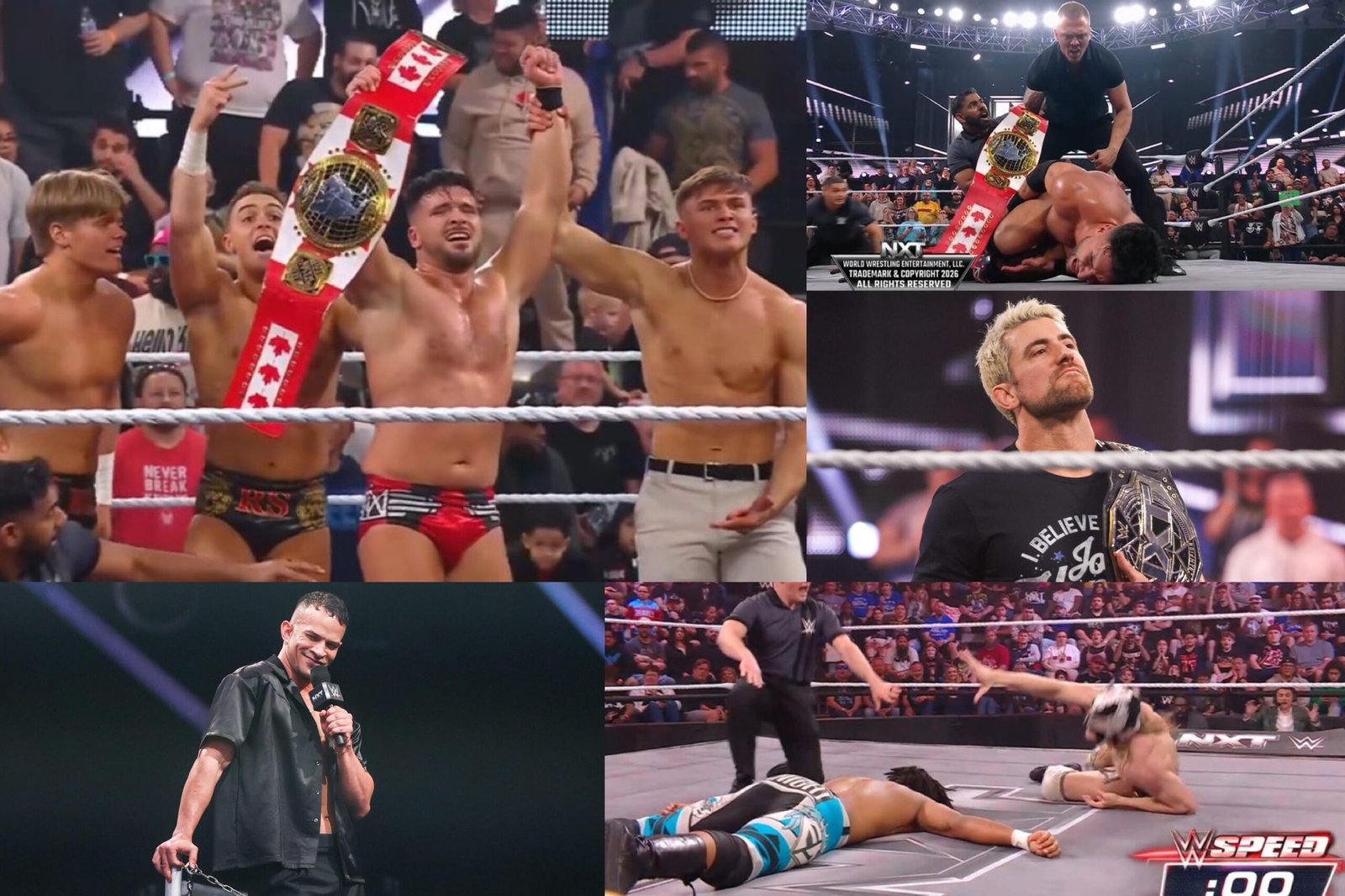
There are “road” episodes, and then there are episodes that pave the road. WWE NXT on February 17 didn’t just advance stories — it sharpened them into weapons. A champion with allies he doesn’t fully control. A top title feud that finally stopped smirking and started swinging. A tag division that erupted into one of those glorious, messy NXT traffic jams where opportunity goes to the team ruthless enough to snatch it. And a Speed title scene that literally hit the wall of the clock… and forced the brand to rewrite its own rules in real time.
By the time the show closed, the message was clear: Vengeance Day isn’t coming together politely. It’s being dragged into existence — one ambush, one injury angle, and one deadline panic at a time.
Here Are The Full Results
- Kelani Jordan def. Lola Vice
- Tony D’Angelo def. Cutler James
- The Vanity Project def. Hank & Tank vs. OTM vs. The Culling (Fatal 4-Way Tag Team No. 1 Contender’s Match)
- Eli Knight vs. Elio LeFleur ended in Time-Limit Draw (Men’s Speed No. 1 Contender Tournament Final)
- Ethan Page (c) def. Shiloh Hill (NXT North American Championship)
Kelani Jordan vs. Lola Vice — a win that felt like a warning
Kelani didn’t treat this like a match; she treated it like a consequence. The entire fight orbited one theme: control. Kelani attacked with urgency, punished openings without hesitation, and took a rivalry that had been loud and personal… and made it clinical. Lola tried to rally on adrenaline, but Kelani’s finish wasn’t about “surviving” — it was about ending the argument with a tap-out.
Story ripple: Kelani’s edge is sharpening. Lola’s path forward now has a built-in hook — either she adapts, or she stays trapped in the same cycle where emotion gets weaponized against her.
The NXT Title picture ignites: Joe Hendry vs. Ricky Saints becomes official for Vengeance Day
This was the kind of segment that doesn’t need fancy staging — because the hostility is the set. Hendry and Saints finally dragged their tension into the light and locked the stakes in place: the NXT Championship at Vengeance Day on March 7. Saints framed Hendry as hype; Hendry answered like a champion who’s tired of being treated like a novelty.
Story ripple: This feud’s power is contrast. Saints isn’t chasing a belt; he’s chasing validation. Hendry isn’t defending a belt; he’s defending legitimacy.
Tony D’Angelo vs. Cutler James — the Don returns, and the tone turns violent
Dion Lennox and the orbit of DarkState have made life miserable for Tony. Tony responded by treating his comeback like a demolition job: dominance, spinebuster, win.
Then came the real headline: Tony’s post-match attack on Lennox with the steel steps — the kind of escalation that tells you this isn’t a “get my win back” story. It’s a “take everything from you” story.
Story ripple: Tony’s not just back. He’s angrier, more direct, and willing to cross lines to drag DarkState into a fight they can’t hide from.
Fatal 4-Way Tag No. 1 Contender’s Match — opportunists win the chaos
When you book four hungry teams with one prize, the match isn’t supposed to be neat — it’s supposed to be a stampede. Hank & Tank, OTM, The Culling and The Vanity Project crashed into each other until the finish rewarded the one skill that matters most in multi-team wars: timing.
The Vanity Project stole the closing seconds and became the next challengers — not because they were the strongest, but because they were the smartest in the moment.
Story ripple: This instantly writes the next tag-title promo for the champs: “You didn’t beat us — you survived the pile and landed on top.”
The women’s scene combusts: Jacy Jayne, Sol Ruca, Zaria and a rescue with strings attached
NXT loves a relationship story that feels unstable, and this one is built on emotional explosives. Jacy’s presence screamed championship entitlement — but her words carried something sharper: resentment that Sol’s shine is louder than Jacy’s résumé.
When things turned physical, Fallon Henley and Lainey Reid helped stack the deck… until Zaria ran in and flipped the script, saving Sol and detonating the segment into a new alignment.
Story ripple: The hug is the hook. Is Zaria protecting Sol — or positioning herself to claim the spotlight the second Sol reaches it?
Speed Tournament Final hits the wall — and Robert Stone changes the rules of the road
Eli Knight vs. Elio LeFleur didn’t end with a winner. It ended with a clock. And that’s exactly what Speed is supposed to feel like: panic, urgency, a finish line that doesn’t care about your momentum.
Stone’s call was the pivot: both men advance to face Jasper Troy for the men’s Speed title — as a triple threat — and the time limit gets bumped to seven minutes for this first-time stipulation.
Story ripple: NXT just turned Speed into a weekly “anything can happen” attraction — because now the brand has publicly established it can bend the format when the story demands it.
NXT North American Championship: Ethan Page vs. Shiloh Hill — a champion, his shield, and a challenger who refused to stay down
Jackson Drake and The Vanity Project hovering around Ethan Page isn’t subtle. It’s the point. Page fought like a champion who knows exactly how good he is — and like a champion who still wants a safety net.
Shiloh Hill pushed him into uncomfortable territory, forcing Page to lean into interference, opportunism, and cruel precision to keep the championship. WWE’s framing underlined the historical layer: Page’s win set a record for most North American title defenses.
Then Myles Borne arrived and turned the entire ending into a threat: not a polite challenge, but a violent demand. Page agreed to a title match — and immediately paid for underestimating the level of madness Borne was willing to bring.
Story ripple: Page’s reign is no longer just “great defenses.” It’s “great defenses while enemies multiply… and allies make you look guilty by association.”
Breakdown, Analysis, Narrative, Significance
The Vengeance Day spine is now clear — and it’s built on legitimacy
Hendry vs. Saints is the cleanest kind of main-event story: one man claims the throne, the other claims the crown is fake. Vengeance Day on March 7 is confirmed; the location remains unannounced publicly in the most credible reporting as of the post-show cycle. That uncertainty actually helps the narrative — because this feud is already framed as “prove it,” and now the event itself has an air of “wait and see.”
Ethan Page’s reign just shifted from “historic” to “endangered”
Page’s defense count is being positioned as a legacy marker. But the show’s final minutes reframed the entire reign: Page isn’t just fighting challengers — he’s fighting the consequences of his own strategy. The more he hides behind bodies, the more challengers like Borne feel justified in going to extremes.
The tag division rewarded the most NXT trait of all: opportunism
The Vanity Project didn’t need a clean showcase win; they needed a claim. Now the champs have the moral high ground (“you stole it”), and the challengers have the one thing that matters most in wrestling: the match contract. That’s a ready-made feud engine.
The women’s title picture is running on emotional truth
Jacy’s resentment of Sol is not cartoon jealousy — it’s the kind of insecurity that real champions have when the crowd loves someone else louder. Add Zaria’s complicated connection to Sol, and NXT has a triangle of motivations that can pivot at any moment.
Speed is evolving into a “format as storyline” feature
Speed’s identity is built on urgency, with standard matches operating under a short limit and title matches historically operating under a longer one. Now, NXT has established a new precedent: format exceptions can be earned via circumstance (a draw) and stipulation (triple threat), without abandoning the whole brand concept.
WWE Speed Rules and History
- Core concept: Speed was introduced as a short-form match format built around a strict clock — designed to force sprint-style pacing and decisive risk-taking.
- Time limits: Standard Speed matches have been presented under a shorter limit, while championship bouts have commonly operated under longer time limits (frequently five minutes).
- Why the triple threat is seven minutes: NXT explicitly adjusted the usual Speed title structure for the first-ever triple threat men’s title defense — announced on-air after the tournament final went to a draw.
- Practical difference in triple threats: A third competitor changes finish access (more bodies to block pinfalls, more scramble resets), so a longer limit preserves the “clock pressure” while giving the match room to logically resolve.
Looking Ahead: Quick Rundown for Feb. 24, 2026
NXT isn’t easing up next week — it’s doubling down with a title-heavy card and the fallout from every major Feb. 17 angle.
Here is everything advertised for Feb. 24th:
- Jacy Jayne (c) vs. Sol Ruca (NXT Women’s Championship)
- Ethan Page (c) vs. Myles Borne (NXT North American Championship)
- Jasper Troy (c) vs. Eli Knight vs. Elio LeFleur (Men’s Speed Championship — Triple Threat, 7-minute limit)
- Osiris Griffin & Saquon Shugars (c) vs. The Vanity Project (NXT Tag Team Championship)
- Blake Monroe vs. Thea Hail (Women’s Speed Tournament)
- Kale Dixon vs. Uriah Connors
- Keanu Carver vs. Sean Legacy
The key question heading into Feb. 24: does this become the night where Page’s “historic” reign finally collapses under the weight of the enemies he created — and the allies he chose?
I’m the quiet one until the bell rings then I’ve got takes. I live for WWE NXT and TNA, I want every promotion to succeed, and I will absolutely roast the bad decisions on sight (because someone has to). Anime taught me to respect long-term storytelling; wrestling taught me that sometimes the plan is “we panicked” and called it “unpredictable.” The Miz got me into all of this, so yeah I appreciate confidence, commitment, and the art of talking like you’re already the main event. Now I bring that same energy to the page as the main writer for Late Night Crew Wrestling because if you’re not here to be must-see and tell the truth, why are you here?!