
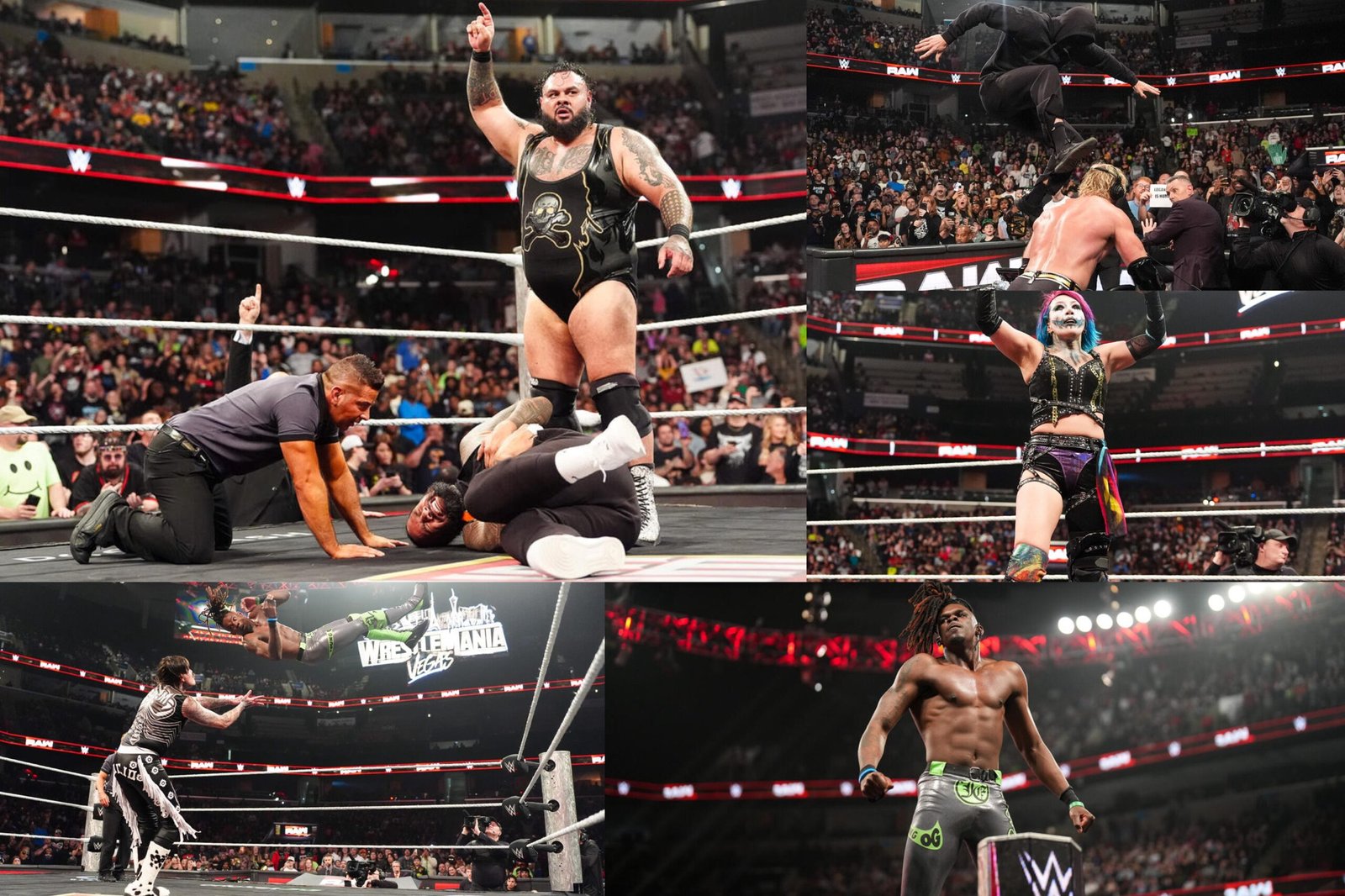
Last night’s RAW in Memphis tried to do what this stretch of the calendar demands: make Elimination Chamber feel urgent instead of routine. WWE leaned hard into qualifiers again, but the show’s real engines weren’t just the matches—they were the power struggle around The Vision’s “we run RAW” rhetoric, the psychological tone-setting for the top programs, and the mystery crate angle designed to force curiosity all the way to Chicago.
The catch is the same one fans keep circling: qualifiers can generate stakes, but when they dominate the structure, the build risks feeling like a conveyor belt. WWE partially solved that problem last night by delivering a genuine “shift-the-board” moment in the main event and giving multiple stories a clearer direction—while still leaving The Vision’s credibility issue hanging in the air.
Full Results
- The Vision def. LA Knight & The Usos
- Asuka def. Bayley vs Nattie (Elimination Chamber Qualifier)
- Penta def. El Grande Americano (No. 1 Contender Match for the Intercontinental Championship)
- Je’Von Evans def. Dominik Mysterio vs GUNTHER (Elimination Chamber Qualifier)
Full Recap and Analysis
The opening tone: Champions show up, “management” interrupts, and RAW’s identity problem resurfaces
Last night opened with The Usos arriving like champions should—hot entrance, crowd energy, a sense of “this is our show.” The Vision immediately tried to overwrite that with the classic corporate heel posture: stop the music, stop the fun, start the lecture about control.
This is where the fan complaint you raised becomes impossible to ignore. The Vision’s mission statement says the roster should be afraid and RAW should feel governed by their will. But what WWE actually books is closer to “they’re constantly negotiating for authority” rather than exercising it. That’s not automatically bad—heels often posture before they dominate—but it creates a credibility gap if the posture doesn’t evolve into consequences.
Narrative purpose: set The Vision up as the villains of RAW’s power structure while framing Adam Pearce as the last barrier between order and takeover.
LA Knight and Jey as uneasy allies: WWE acknowledges the friction, then bets on star power
Knight stepping into the chaos gave RAW a practical babyface solution: if The Vision wants to jump the line, fight them right now. The more interesting layer is the one you called out—last year’s continuity about Knight and Jey not liking each other and colliding in the World Title lane.
Last night’s show didn’t pretend that history didn’t exist. It treated the alliance like a tactical ceasefire. That’s a defensible story choice, but WWE still left money on the table by not reminding viewers why the friction existed. “We don’t like each other, but we hate them more” works best when the audience can instantly recall the receipts.
Significance: WWE positioned Knight as the type of babyface who will take the fight anywhere, and positioned Jey as the champion who can’t avoid the Chamber gravitational pull.
Six-man tag: The Vision wins the match, but the angle still makes them feel exposed
The match did what it needed to do in-ring: it made Bronson Reed feel like the closer, it let the babyfaces build momentum in bursts, and it gave The Vision a win they had to get. On paper, this is the kind of result that should strengthen a faction’s presence going into a major event.
But the post-match undercut is the reason fans are still complaining.
The masked attacker striking Logan Paul immediately after The Vision’s biggest statement win reinforces the idea that they don’t control the environment. It gets a pop, it keeps the mystery hot, and it fuels the weekly hook—but it also continues to frame The Vision as a faction that gets “violated” on their own turf.
If the goal is to make the roster scared of The Vision, the show has to eventually show The Vision making someone pay in a way that changes behavior. Last night gave them a win, not a consequence.
What this did for Chamber: it moved The Vision’s story forward, but it didn’t resolve the core credibility critique. If anything, it amplified it: a group that “runs RAW” shouldn’t be getting embarrassed seconds after winning.
The mystery crate: WWE adds a simple, effective “you must watch the PLE” device
Backstage, Pearce found the crate with the warning not to open it until the Elimination Chamber date. Then WWE made an important choice: the crate wasn’t just RAW’s problem—it was shipped to Nick Aldis on SmackDown.
That detail matters. WWE is signaling this isn’t a throwaway RAW prop. It’s a company-wide mystery that will live across shows until the event. That’s how you sell the idea that Elimination Chamber isn’t just another Saturday night—it’s the place where the lid finally comes off.
Significance: this is WWE trying to manufacture “appointment viewing” in one clean stroke. Even fans tired of qualifiers will want the payoff.
Women’s Chamber qualifier: Asuka qualifies, but the division quietly pivots into personal grudges
Asuka winning the triple threat was predictable in the best way: credible performer, credible result, credible threat added to the Chamber picture. The more telling part came after, when Maxxine Dupri attacked Natalya.
That wasn’t just an extra beat—it was a small but valuable attempt to give RAW a women’s story that isn’t “qualifiers and contender math.” It’s conflict with a clear personal direction.
What this did for Chamber: it strengthened the women’s field while simultaneously building a secondary program that can live outside the Chamber treadmill.
Oba Femi’s contract tease: RAW plants the next monster problem
Pearce offering Oba Femi a contract and Oba wanting time reads like WWE staking out future terrain. The Rusev stare-down was simple and effective: power recognizes power, and RAW can create a new collision whenever it wants.
Significance: not directly “Chamber build,” but strong WrestleMania-season infrastructure. WWE needs the post-Chamber runway to feel real, and this is how you start paving it.
Liv Morgan’s sit-down becomes a pressure test: champions and factions circling the decision
Liv trying to slow-walk her WrestleMania choice is WWE telling you she’s not just fighting opponents—she’s fighting the politics of being the person everyone needs something from. Stephanie Vaquer confronting her, with Dominik inserting himself as translator/agent-of-control, sharpened the idea that Liv’s “choice” is becoming a cage of its own.
Significance: this segment advanced the story without a match, which is exactly what RAW needs more of when fans are burned out on qualifier structure.
CM Punk vs Judgment Day: the best “identity war” segment on the show
Punk’s approach last night was strategic: he didn’t just hype the match—he attacked Balor’s self-image. He framed Balor as a great wrestler who became dependent on the group, then let Judgment Day’s dynamics support that claim.
That’s effective build because it gives the Chamber title match a theme: is Balor still the man who wins alone, or is he the product of interference and numbers?
Significance for Chamber: this made the title match feel like a psychological fight, not simply a booking obligation.
Penta earns the Intercontinental lane: comedy chaos with real stakes
Penta beating “El Grande Americano II” (the Kaiser version) is WWE combining two tones: the Americano absurdity and legitimate mid-card title direction. It worked because the match had an actual prize and Penta is credible enough to stabilize the story around him.
Significance: a clean path into an Intercontinental Championship program, plus a continued hook for the Americano angle without forcing it into the world-title lane.
AJ Lee and Becky Lynch: tension built on control, not brawling
This was one of the most effective promo segments last night because it refused the easy crutch. AJ wanted the first strike, wanted chaos, wanted the visual of Becky being rattled. Becky refused to give her that satisfaction and framed Chicago like it would become AJ’s humiliation.
That’s real story math: AJ needs to prove she still belongs at the top; Becky needs to prove she’s the gatekeeper AJ can’t bypass with nostalgia.
Significance for Chamber: this made their match feel like pride vs legitimacy, not just “big name returns.”
Main event qualifier: Je’Von Evans changes the Chamber’s energy in one finish
Je’Von Evans qualifying over Dominik and GUNTHER is the kind of result that immediately re-frames the Chamber match. WWE used outside chaos to remove GUNTHER from the finish, then let Evans get the decisive win.
This did three things at once: it injected unpredictability into the men’s Chamber field, it created a ready-made “you didn’t beat me straight up” grievance for the person who lost, and it instantly elevated Evans from “prospect” to “variable.”
Significance: this was the show’s strongest counterpunch to qualifier fatigue. One surprise result can justify weeks of qualifiers if the payoff feels like it matters.
Did RAW actually build Elimination Chamber in a way that sells tickets and viewership?
What worked as a sales pitch
- The crate is a clean “must-see reveal” tied directly to the event date.
- Punk vs Balor felt sharper and more personal.
- AJ vs Becky felt like a true status fight.
- Evans qualifying made the Chamber feel less predetermined.
What still drags the momentum
- Qualifier volume remains high enough that the weekly formula is easy to predict.
- The Vision’s credibility gap remains the loudest structural weakness: they can win matches, but they don’t yet feel like they control RAW.
If WWE wants the audience to believe The Vision should “run RAW,” the next step can’t just be another qualifier. It has to be a show-altering act: a forced stipulation, a hostage situation around Pearce’s authority, a targeted destruction of a top star, or finally catching the masked attacker and turning him into an example.
What are people predicting is in the crate?
Last night’s speculation fell into three main buckets:
- A major debut/return (the “wrestling box reveal” trope for a big moment).
- A reveal tied to the masked attacker (two mysteries converging into one payoff).
- A Chamber-specific twist (something that changes match structure, entrants, or stakes rather than introducing a new person).
The SmackDown handoff suggests WWE wants this to feel bigger than one brand, which makes a multi-show payoff at the PLE more likely than a small-angle reveal.
Final Verdict
Last night’s RAW advanced Elimination Chamber with the right tools—stakes, mystery, and star-driven promos—but still suffers from the same shape: too many qualifiers and an over-reliance on weekly cliffhangers that undercut The Vision’s aura.
The show’s biggest win was the main event. If WWE can pair that kind of unpredictability with real consequences in the Vision storyline, the Chamber build can feel urgent instead of mechanical.
Make sure to subscribe to our Late Night Crew Wrestling YouTube Channel. Follow @yorkjavon, @kspowerwheels & @LateNightCrewYT on X.

I’m the quiet one until the bell rings then I’ve got takes. I live for WWE NXT and TNA, I want every promotion to succeed, and I will absolutely roast the bad decisions on sight (because someone has to). Anime taught me to respect long-term storytelling; wrestling taught me that sometimes the plan is “we panicked” and called it “unpredictable.” The Miz got me into all of this, so yeah I appreciate confidence, commitment, and the art of talking like you’re already the main event. Now I bring that same energy to the page as the main writer for Late Night Crew Wrestling because if you’re not here to be must-see and tell the truth, why are you here?!